


Tagged: kilesha Toggle Comment Threads | Keyboard Shortcuts
-
hardie karges
-
hardie karges
Buddhism In an Imperfect World. The world outside…

The world outside may be cruel and cold, but the world inside can be perfect. This is implicit in the Buddhist teachings, Theravada especially, before the Mahayana emphasis on the Bohisattva’s sacrifice of enlightenment until all sentient beings can join in the awakening. And, if that seems selfish of the Theravadins, then it’s not, not really. It’s simply a recognition that the challenges are many and the awakenings are few, in an imperfect world, with few Bodhisattvas available, so maybe being a satisfied arhat might be better.
Because, even if the world were infinite, with no need for competition, there would still be the challenges of hate, anger and greed. Those are the kileshas that haunt all of us, rich or poor, no matter our status or our position in life. And competition is a function of greed, no matter that there might be an infinite abundance, somehow somewhere. No alpha male is worried about getting his share of the offerings. He wants them all, or at least a controlling interest, no matter that there is plenty to go around.
That is the difference between us and the animal kingdom, the ability to reason and ration any scarcity of resources fairly amongst all interested parties. That is why the alpha male is an anachronism in the world of humans, strutting his stuff as if he were king of the jungle. For the human race to advance, we must leave the jungle behind, and any notion of a warrior ethos that defines us. It doesn’t. It only divides us.
-
hardie karges
Buddhism 102: Cooling the fires of Kilesha…

When everything is burning, cool the fires inside with the water of empathy and the chemistry of compassion. There are always at least two different ways to kill a wildfire, of course, as every firefighter knows. You can kill it with water, or you can kill it with fire itself. But which method causes more damage? That’s why water is always preferable, when possible. Because to kill a fire with a rival fire is to destroy everything in the path, ‘scorched earth’, so to speak. It ain’t pretty.
But drenched earth can be quite pretty, especially after a nasty fire. And if those fires are inside, such as with hatred, greed, and anger, then the improved results are notable. Two foes can fight to the death, of course, but neither one could truly be considered a winner in that case. So, peaceful solutions are always preferable. Both parties will live to play another day, and with all faculties intact, both might even succeed.
But that is the hardest thing to accomplish, of course, what with alpha males hogging the harem and acting like DNA whose only goal is to climb the ladder of succession to another day and another successful matchup in the breeding room and the board room, where the winner takes all and the losers take nothing. That’s the world of Nature, sometimes cruel and forbidding. But we can do better than that. Because we have the world of consciousness and mind, hopefully even some measure of mindfulness. Be kind.
-
hardie karges
Buddhism: Dealing with Dukkha, Suffering…

Depression and sadness are not the same thing. Still Buddhism can help with both. Dukkha, suffering, is a very broad concept, as all the modern reinterpretations prove. Still, it all comes down to unhappiness, as the modern Sanskrit (and Hindi and Nepali) words confirm: दुःखी, dukhi, nothing about stress, dissatisfaction, or my favorite word ‘bummer’: haha. Thank you, Google Translate. But if you think you’re clinically, i.e. chemically, depressed, always sad, you might want to get a clinical diagnosis, and solution, in addition to anything that Buddhism might be able to do for you.
Because what Buddhism can do best for you is to make you feel better about your current condition, seeing it as impermanent, as it certainly is, and even unreal, as it also arguably is. More importantly, it can help you realize that many of these conditions are the result of your own kileshas, errors, defilements, or shortcomings (not sins), in particular the defilement of avarice, or craving, or attachment to the passing show of superficial satisfactions of consumption, lust, and hatred.
These are problems with solutions, though, specifically training your mind to find its satisfactions elsewhere. Once you’ve found satisfaction in kindness and compassion, after all, why would you want to return to the crude contrivances of drunkenness, braggadocio, and one-upmanship? If you’re like me, then you probably wouldn’t. Subtle satisfactions that ease the sufferings of others can also have the added benefit of easing your own suffering, later if not sooner. We’re all in this together.
-
jmoran66
Another great post. I read it several times in succession, then went back to it again later.
-
hardie karges
Thank you…
-
-
-
hardie karges
Buddhism 101: Anger is a Warning Sign of Impending Danger…


Anger is like a lying dog, that, when provoked, rises up in consciousness, and strikes the nearest hand that most recently fed it. Because it’s blind, and usually vicious, hatefulness optional, and it infects everything it touches, anger does. But it’s not always so easy to recognize, because it comes in many forms, most often in concert with hatred, true, but equally conversant with deception and denigration and the other delusions of sense perception, always a prime source of suffering, no matter the particular place and time in question…
And then there is the other ‘poison’ of Buddhism, besides hatred and delusion, which is greed, or sensual desire, with which anger is also often associated. But sometimes the symptom is worse than the disease, and this could often be one of those cases, in which the anger is worse than the moha, raga, or dvesha itself. These are also variously known as the Three Unwholesome Roots and the Three Kileshas, which are also available in a convenient Five-Pack for serious abusers, but who’s counting?
Still, it all counts as demerit in a lifestyle that prides itself on making merit, and doing good, and so worth making a sea change in order to avoid the choppy waves, right? But that gets into issues of global warming and rising sea levels, when simply wearing a life jacket and learning how to swim might accomplish much the same thing in a much shorter amount of time. Why get a brain operation if a pill can cure the headache? That’s what I want to know.
Hatred, delusion, and greedy attachments can take a lifetime to cease, overcome, or even diminish, much less cure, though, so in the meantime please do us all a favor and control your anger, okay? It becomes you. And there are many American Buddhist ‘teachers’ who might disagree with that, but they may not be so smart, after all, since they often look to Freud and Jung, rather than Buddha, for inspiration, as if the notion of superego were somehow scientific and Freud’s ego were what the Buddha was really talking about in denouncing the Brahmanistic cosmic atta/atman. It wasn’t. So, let go of all anger, the sooner the better. It sucks.
-
hardie karges
Buddhism and the True Meaning of Love

‘Falling in Love’ is all about attachment. True love is all about non-attachment. True love looks for soft spots to protect. Aggression looks for soft spots to attack, and attachment isn’t much better, by weakening that spot, even if not physically attacking. By ‘true love,’ of course, I’m talking about Buddhist metta, typically translated as ‘lovingkindness,’ if you’re Jewish or Christian, but that still preserves some passion, and suffering, so maybe better translated more like the Buddha himself probably intended, so something like ‘brotherly love’ or ‘sisterly love,’ as the case may be. To be clear, I think that being in a relationship is fine, sometimes wonderful, but it shouldn’t necessarily be based on the hysterical (no pun) madness of being ‘in love.’
Score one for arranged marriages? I wouldn’t go that far. Exercising one’s innate free will, to whatever extent it exists, and despite all the limitations placed upon it, is all about what it is to be human. ‘Give me liberty or give me death’? Haha, once again, I probably wouldn’t go that far. Because true freedom is freedom FROM, not freedom TO, freedom from any and all the defilements that plague us, but not freedom to do anything we want, regardless of whom it hurts. And this is an important distinction. Kileshas are the Buddhist name for those defilements that destroy our humanity and reduce us once again to the animal world from which we’ve evolved.
It’s funny, though, because often these defilements themselves come paired just like the pair-bonding couples that cause many of the problems in their quest for reproduction rights, in addition to other attachments and liens on property. Because jealousy and revenge are twin kileshas, just like hate and anger, one feeding off the other like two heads of a serpent striking, and best avoided. The great Buddhist dilemma, or tetralemma, is how to deal with aggression. Do you turn the other cheek? But no Christian really did that, did they? To live from sensation to sensation is to live like an animal. To follow dharma is to live like a human.
-
hardie karges
Buddhism, Mental Formations, and Defilements of the Heart and Logic…
Who says you can’t go home again? Home is a warm place in your heart, and mind. And if that’s a ‘mental formation’ as is often said in Buddhism, then that’s not such a bad one, but I’m not sure. I’ve studied Buddhism for several years now and I’m still not certain of the proper translation for the Pali/Sanskrit words sankhara/samskara that usually gets translated as the rather cryptic ‘mental formations’. But I do know that when Ajahn Chah, the great Thai forest master, used the term ‘arom’ อารมณ์ , which in normal speech means ‘feeling, emotion’, the translator rendered it as ‘mental formation’, so I figure that’s a valuable clue, notwithstanding the fact that the term may also have sexual connotations, depending on who says it, under what circumstances, and at what time of the day or night, in case you’re feeling sleepy. But that’s just the random white noise of mental idling, before or after an actual coherent thought, since I’m sure Ajahn Chah had no sexual connotation in mind, he one of the few post-Buddha (non)-personalities who I might credit with genuine Enlightenment. But feeling preceded linguistic thought, certainly, and I’ve heard Buddhist monks opine that ‘thought is a defilement’, so language falls flat, and that may be the point. In the beginning there was silence; and then there was noise. That’s all I know…
-
hardie karges
Buddhism, taming the wild beast within…
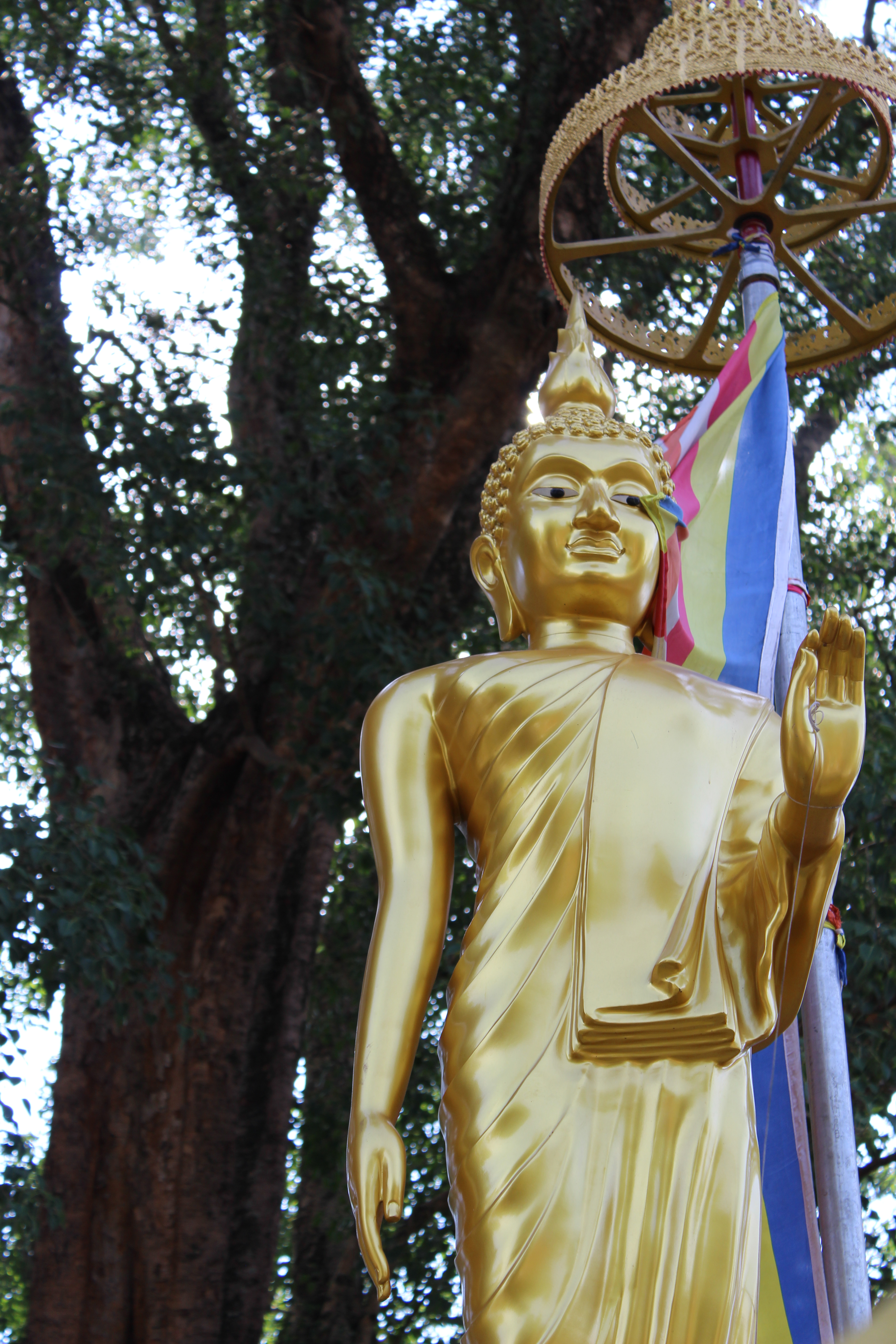
Buddhism in Sri Lanka
The zoo is one of my favorite analogies and metaphor for the human species, such that we tame ourselves and our worst impulses, in order to make of ourselves one great human zoo, a petting zoo, properly fed and cared for, so that the need to compete and the struggles with predators should be reduced to little or nothing…
I know for a fact that two unrelated mammal species raised together from infancy can easily learn to accept each other for the mutual benefit of all, so cats’ and dogs’ need to fight is only learned behavior. Even in the savannas of Africa, at least in the protected areas, many if not most species have symbiotic relationships, such that none are subject to the regular predations of any one specific species–except man. So we are the main problem of violence on this planet, as much or more than any lions, tigers or bears… (More …)
-
Dave Kingsbury
Your own experience here shows the power of adaptability we human beings have, though it can’t exactly have been plain sailing for you. Pride of ego has a lot to answer for, indeed, including our imagined superiority over the rest of life. A phrase I have particular problems with is ‘dog eats dog’. Mostly, they don’t …
-
hardie karges
Yes, I’m particularly struck by how young our civilization is, barely 10K years, and we’re at each others’ throats most of the time. As space becomes scarce, it’s really time for a new paradigm, which is fairly easy to imagine, really. The hard part is getting people to accept it!
-
-
hardie karges
Boy Scouts: be prepared. Buddhists: not so fast…

The Golden Spires of Shwedagon Pagoda
This is one of the problems I have with Buddhism, the whole ‘no-thought’ paradigm, that always seems to find currency, notwithstanding the fact that the Buddha never said anything like that, not to my knowledge, anyway, and the term sati, which has taken on the meaning of ‘mindfulness’, probably had no such lofty connotations at the time, the problem now being one of vagueness, if not deliberate obfuscation, in order to inspire awe and reverence, apparently, as if it is untranslatable to the ordinary mortal…
But it certainly is a common ordinary word in modern standard Thai, something like simple ‘consciousness’ or ‘mind’, so ‘mindfulness’ is a marketing hook to sell a fad to the West, that special sauce and some righteous hocus pocus, such that the makers of the film ‘Samadhi’ have to explain that the term is untranslatable to English, notwithstanding the fact that it is done all the time outside the rarefied circles of New Age fad religions… (More …)
-
hardie karges
Buddhism and Trump, Religion and Politics…
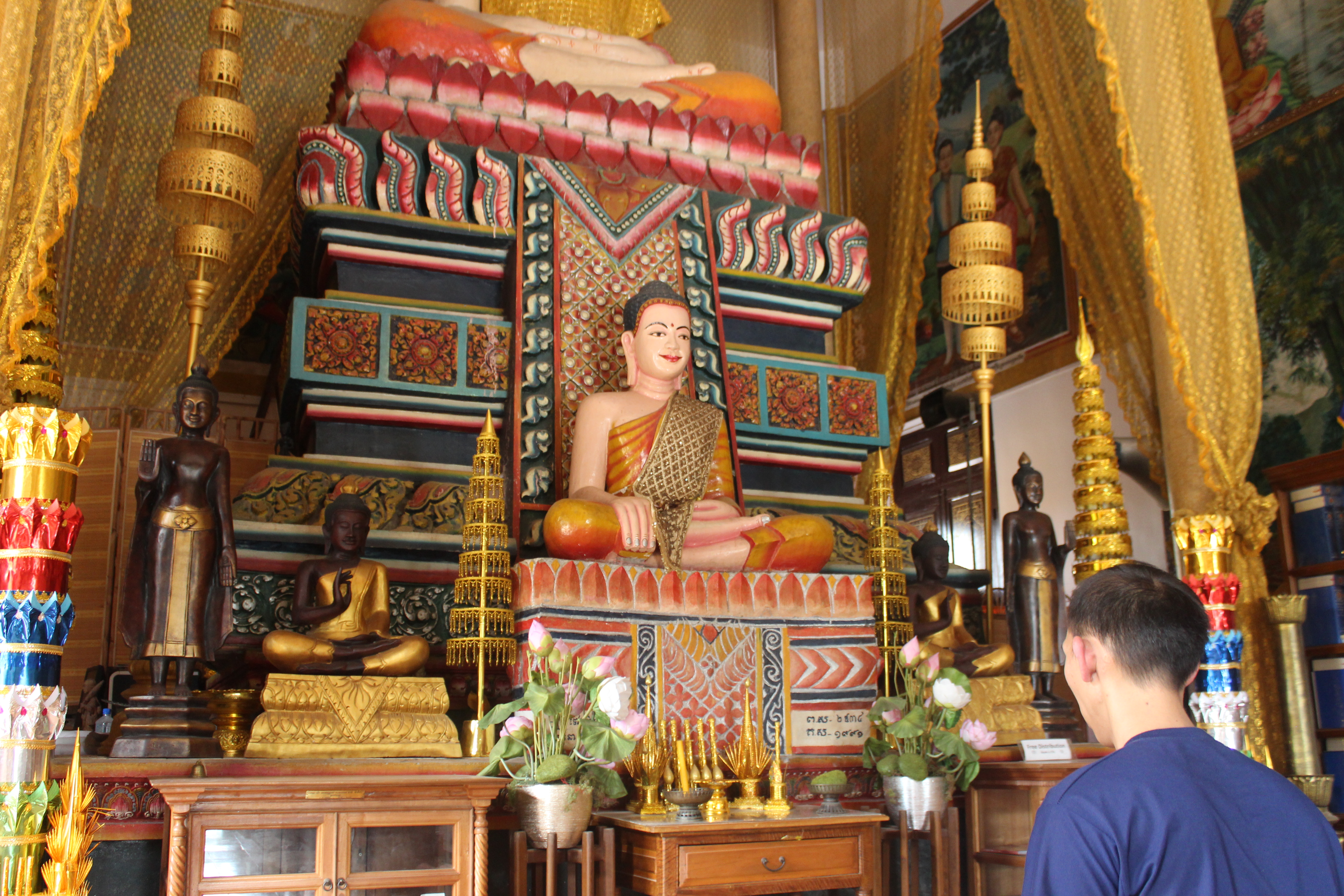 It’s easy to bemoan my fate as having no choice but to be a citizen of the same country that Donald F. Trump presides over, even if not currently resident, but bemoan even more the fact that he seems to have hijacked my mental process, so that it seems that I am almost totally incapable of thinking about anything else, except how to get this over-stuffed individual out of my life and out of my mind and hopefully even out of my country so that one day I might go back there if circumstances so warrant it…
I mean: wouldn’t I really rather be spending my time, and precious brain cells, discussing subtle points of dharma, rather than gross points of politics? Of course, though, the argument could be made that I wouldn’t even be a Buddhist if the presence of Donald Trump in his original rise in the political polls hadn’t inspired me to it, for whatever reason, as the two events were nearly simultaneous. For, like the reductios ad absurdum that Mahayana Buddhists once used to disprove the intrinsic existence of ‘stuff’, so I can define myself in opposition to a known quantity… (More …)
-
Dave Kingsbury
… we are the God species, like it or not, holding the keys to survival in the palm of one hand, while the other hand plays with its iPhone… great line, Hardie, in a piece that goes head on and wins through to something very helpful and worthwhile!
-
hardie karges
Thanks Dave. I swear I did not know previously of the book of the same title AND on a similar subject. I do now, haha…
-


 hardie karges and


 streaming consciousness...
Reply