Tagged: religion Toggle Comment Threads | Keyboard Shortcuts

  • Unknown's avatar

    hardie karges 1:34 pm on December 23, 2022 Permalink | Reply
    Tags: , , , , , , , religion, samathi,   

    Buddhism and the Bearable Lightness of Being 

    Be more like the water, more like the air, and less like the humans, obsessed with their opinions. And by this, I don’t mean to imply that we should all be ‘air-heads’ or anything else that might seem less than human or beneath our dignity. I only mean to imply that flexibility is good, and that lightness is good, i.e. the lightness of being, being without baggage, the baggage of language, which, if used properly and creatively, is one of the most beautiful things in the world.

    BUT… When used for maleficent purposes, language can be truly evil, SO… sometimes it’s better just to do without, don’t you think? Which moves us back to the subject of meditation: what it is, what it does, and how to benefit from it. Everything in Buddhism eventually comes back to meditation, if it’s done right, because that was always its chief selling point, despite all the sharper points of karma and dogma.

    People wonder why Buddhism was so well and easily accepted in China in the first millennium of the Common Era, when Taoism was already there, and when Taoism is so similar. Well, it’s often assumed that Taoism influenced Buddhism, so as to create a Buddhism “with Chinese characteristics,” haha, but it’s just as likely—or more so—that Buddhism influenced a nascent Taoism to make it what it is today.

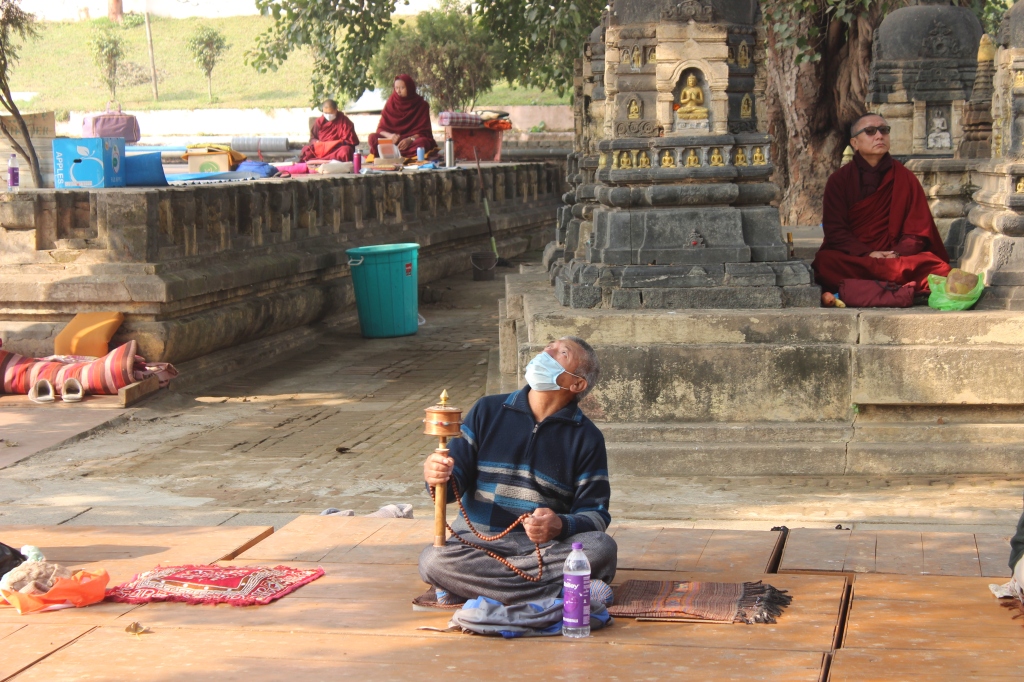
    Either way, the critical difference would be the meditation technique which defined Buddhism long before the Brahmins started promoting karma as the definition of Buddhism, in order to enhance their own superior position. Remember that the Japanese word ‘Zen’ comes from the Chinese word ‘Chan’ which comes from the Sanskrit word ‘dhyana’ which means something like ‘meditative absorption’ or ‘deep meditation’ in Sanskrit, to distinguish it from the ordinary ‘concentration’ which is also a definition of the Sanskrit/Pali word ‘samathi.’ That’s my take on the subject, anyway. Merry Christmas.

     
    • Tiramit's avatar

      Tiramit 10:14 pm on December 23, 2022 Permalink | Reply

      Thus, it is what it is. I like your take on the subject anyway and Merry Christmas to you too!

  • Unknown's avatar

    hardie karges 12:34 pm on December 16, 2022 Permalink | Reply
    Tags: , , , , religion   

    Anapanasati Meditation: Awareness of Breath 

    By focusing on the breath, you will also likely decrease the speed of breathing. But why does that matter? And is that a good thing? But first we need to ask why we focus on the breath in the first place. And the funny thing is: that answer is not easily found. Because on the one hand: we need a something steady to concentrate on, which the breath certainly is. But it is not so fixed and clocklike as we often imagine. So, perhaps this is its unique situation, that it is both voluntary and involuntary. What other bodily function can claim that?

    And the benefits of a bodily function are obvious: it’s there with you all the time. Big Ben is not, unless you live in Westminster. The other obvious bodily function to reference for meditation is the heartbeat, and I do just that sometimes, BUT: it’s much more subtle, AND: it’s totally involuntary, i.e. you can’t ‘hold’ your heartbeat in the same way that you can ‘hold’ your breath. So, maybe that simultaneous voluntary/involuntary nature of breathing is important, after all, simply because it can be manipulated if you want. But I don’t advise it.

    Because, in the sense that anapanasati is the goal here, awareness of breath, that would seem to discourage manipulation. Still, that decrease in the breath rate is a fairly reliable result, and I think that it’s to be encouraged, since calmness is also a secondary, if not the primary goal, of meditation. And that rate of heartbeat will likely decrease, also, though you’re not as likely to notice it. And that’s the main advantage of breath over heartbeat: it’s easily noticed. Still, it’s worth noting the heartbeat, especially if you’re having trouble concentrating.

    And here’s a little tip that I stumbled upon in my pursuit of meditative bliss, only to find out later that it’s often recommended: count your breaths. If that sounds a little too similar to counting sheep in order to sleep, then so be it, whatever works works. Those recommendations usually advise to re-start the count after every ten, but I’m not sure why. I don’t, and it’s probably for the same reason that they do. I want to know how long I’ve been meditating, without recourse to a smartphone or Big Ben. And that’s how you’ll know that your breaths are slowing down: the count never matches the clock. You heard it here first.

     
  • Unknown's avatar

    hardie karges 12:00 pm on December 2, 2022 Permalink | Reply
    Tags: , , , , , , , non-violence, religion, ,   

    Buddhism 499: Pacifism is not passivism… 

    This is one of the hardest lessons of Buddhism, balancing the dual extremes of not only luxury and lack, the Middle Path of Theravada Buddhism, but action and inaction, and ultimately existence and non-existence, the Middle Path of Mahayana. Given the truth that the source of much of our discontent is not to be found in the ‘outside’ world, but right in our own minds, the obvious temptation is to ignore that ‘outer’ world and simply adopt a passive approach towards it.

    But I don’t think that’s what the Buddha meant to imply. Sure, the non-violence of ahimsa is to be applied to every possible situation up to, but not including, our own self-destruction, but that does not mean that the larger world surrounding us, and which is the source of us, is to be ignored. It means not to get lost in that world exclusively, or, God forbid, attached to it, complete with cravings and unhealthy desires. And if this sounds like an abstract consideration, with scarce application to the ‘real’ world, then I can assure you that it is not.

    In fact, I avoided Buddhism for years in Thailand, judging that it was the cause of what I perceived to be the passivity of the culture, and concluding that that would not be a suitable choice for me, since I saw myself as too slow to act already, and that any further encouragement in that direction would not be suitable to my personal development. But sometimes conditions dictate causes, and other times I’m simply wrong.

    Because, compared to the dog-eat-dog USA, almost any place could be considered passive, and that’s not necessarily a bad thing, especially in the age of Global Warming and never-ending warfare. The important conditions in this day and age are perfectly suited to Buddhism, even if a more aggressive Christianity was maybe more suited to a younger less-populated Earth—maybe. In any case, that was then. This is now. This is not a good time for fighting, and it may not even be a good time for celebrating, but it is definitely a good time for getting ourselves in sync with a better and more sustainable world. We’re playing for keeps here…

     
    • jonolan's avatar

      jonolan 7:49 am on December 3, 2022 Permalink | Reply

      Consider that, in the long run, a more aggressive, combative philosophy might be better for Man as a whole and the planet in general. You say that this isn’t the time for fighting. I posit that it just might be since it’s an moderately efficient way to lower the population while, at the same time, mingling gene pools.

      • hardie karges's avatar

        hardie karges 1:40 pm on December 11, 2022 Permalink | Reply

        We can agree to disagree. I’m a pacifist. There are better ways to mix gene pools

        • jonolan's avatar

          jonolan 4:13 am on December 12, 2022 Permalink

          Certainly, to both agreeing to disagree and to the idea that there are better ways than variations of war to mix gene pools. But, not to thin them, which I find a potential real benefit at this point. 😉

          Well, I’m a big fan of smaller populations, but that involves birth control, not thinning, for me at least.

  • Unknown's avatar

    hardie karges 12:05 pm on October 30, 2022 Permalink | Reply
    Tags: , , , , , , religion, , Samma sankapppa   

    The Role of Thought in Buddhism… 

    The Buddha never taught or recommended No Thought, an idea popular in some Buddhist and all ‘non-dualistic’ groups, which should be labeled ‘non-pluralistic,’ btw, just saying. The Buddha taught Right Thought, samma samkappa. But don’t thoughts sometimes just pop up? Yes, they do. the issue here is not one of ownership, though, but the true nature of thoughts and feelings. For some reason, we tend to trust our feelings, but reserve much suspicion toward our thoughts. But are they any different, really?

    So, maybe they are as different as heart and head, but is that any different, either, really? Because those bodily locations have only been known since recently, but the concept of Mind, as citta, has been known since almost forever, and certainly since the time of Buddha. Indeed, during the Buddha’s time, and even later, there was considerable debate in Greece, and possibly India, over the location of the origin of thought, such that Plato placed it at or in the brain, while his student Aristotle placed it firmly in the heart.

    And if it seems obvious that the source of all sensations originating in the eyes, ears, nose, and mouth could only logically be mixed and matched somewhere nearby such as the gray matter that constitutes a brain, then it is equally plausible that the center could be where the pathways of the blood start and finish, itself perhaps the mechanism for mixing and matching those sensations into more complex feelings and thoughts. Modern neuroscience has come a long way since then, of course, but still we ‘listen to our hearts,’ even if we prefer to ‘use our brains’ for the heavy lifting, intellect being generally considered superior to intuition.  

    That distinction is sometimes used to differentiate men and women, to generally ill effect, but the fact remains that the two activities are intertwined. But to imagine that thoughts have no proper human origin nor intention, per the ‘non-dualist’ screed, is absurd and counterproductive, and for what purpose it is not clear. Even if Buddhism is technically non-dualist, in the sense that ‘we are one with everything’ like the joke about the monk ordering hot dogs, the modern ‘non-dualists’ go much too far in asserting that we are therefore nothing. That may pay well in the online debates, but it’s not what the Buddha said, and that is my only concern. Think good thoughts.

     
  • Unknown's avatar

    hardie karges 9:13 am on September 18, 2022 Permalink | Reply
    Tags: , , , , , religion, , , ,   

    Buddhism and the Nature of Self/Not-Self… 

    The notion of self is a linguistic convenience. But language is not reality. And this is one of the debates in Buddhism, of course, not so much the exact nature of ‘self,’ which is proscribed in Buddhism (with an ‘o,’ not ‘e’), but more the exact nature of ‘not-self,’ or ‘no-self,’ that distinction itself often at the crux of the debate, as if there were any real difference, as if it really mattered. Because what matters is that this is not the Hindu cosmic self nor the Christian eternal self, both of which are not what the Buddha envisioned for his group of followers and his emerging view of the world.

    But what exactly did he envision for the self? Not much, apparently. Best guesses are the (s)khandhas, or ‘heaps’ of causes and conditions that he enumerated to constitute the typical person sans persona that is typically referred to, though many modern Buddhists like to wax long and hard on the ego and ensuing egolessness that would obviously result from that starting point. But our concept of ‘ego’ is so tied to Freud’s concept of id, ego, and superego that it may be misleading. Because I’m sure that the Buddha had no such wild notions.

    The Freudian ego also makes the same mistake that the Buddha was trying to solve, positing self as a thing, or something, anyway, which is an independent actor on an ever-shifting stage, when the actions themselves were much more important, as modern psychology now acknowledges the behavior, rather than some elaborate tripartite self, so like verbs not nouns. The Buddha might even go a step farther and see the composite self as a collection of adjectives, thus tendencies to act, not even dignified by the actions themselves.

    I’m sure that he had our modern notion of selfishness in mind, though, so we have that much in common, what with his obsessions with craving and desire. And that’s where Buddhism has much to say about our modern consumeristic economies and lifestyles to the point that ‘stuff’ becomes the meaning of our lives. This is a trap, of course, and a never-ending cycle of unfulfillment. After all, how can things satisfy us if we ourselves are essentially non-things? Sometimes the world is too much with us. Even the Buddha and Wordsworth could agree on that. The Buddha called it samsara….

     
  • Unknown's avatar

    hardie karges 11:02 am on September 4, 2022 Permalink | Reply
    Tags: , , , , , , , , religion, sarmatha, , ,   

    Buddhism 499: Self-control and the Benefits of Meditation 

    Self-control should not be an affront to your Western freedoms. It should be the foundation of your Eastern practices. But this is a tough pill for many Westerners to swallow, because it invokes the dreaded ‘C’ word, control, mattering not to many that self-control is a totally different activity than controlling others, which for me is a hideous affair, usually. Self-control, on the other hand, is the cause and effect of some of my life’s finest moments, not the least of which are simple meditative moments, the practical foundation of Buddhism.

    And all Asian monks know this, and can attest to it fully, while Westerners resist and desist, and their meditative practices often show it, twitching and flinching while struggling to finish a half-hour of meditation, while I’ve seen even Asian laypeople sit motionless for hours. But was it sarmatha or was it vipassana or was it mindfulness meditation or was it that new style that somebody was doing on TV? And there’s TM, the one that the Beatles made famous, with their Maharishi Mahesh Yogi, and which has gone on to be bliss of choice for Hindu-style practice, complete with secret password.

    But all Buddhist practices derive from some version of anapanasati, awareness of breath, and to there they all return—eventually. And to be aware is very much within the practice of control. Because you don’t really have to do much of anything to meditate properly. But there are some things that you should definitely NOT do, and distractions are at the top of that list. Life itself can be extrapolated from this practice, also, giving meditation a central place and practice in your life. It’s simply a good approach to life, calm and collected, and likely to produce a ripple effect that radiates outward. Don’t you wish everybody would participate?

    So, if you’re looking for something like ayahuasca, then Buddhism is the wrong place to look. Because there is nothing here, really, to get excited about, and just the opposite, in fact. There is much here to get calm about—life, liberty and the pursuit of happiness, but without all the weeping wailing and gnashing of teeth. We Westerners are emotion junkies, though that doesn’t mean that we are ‘evil,’ as certain pro-Putin pushers suggest outright. What the West loves was perfect for a world growing up and reproducing itself. What Buddhism offers is perfect for a world finding itself. The future is at stake.

     
  • Unknown's avatar

    hardie karges 12:03 pm on August 7, 2022 Permalink | Reply
    Tags: , , , , , , , religion, , ,   

    Buddhism in a Hindu World: no Time for Selves and Souls… 

    You should be able to find a comfortable balance between low self-esteem on the one hand, and overt selfish egotism, on the other, in the Buddhist doctrine of anatta, non-self or no-self, same thing. But this is one of the more controversial and misunderstood of the Buddha’s teachings, and subject to much abuse by those who want to go too far in the opposite direction from egotism, by claiming that we are all ‘nobody,’ and should somehow be proud of that. And that’s fine, if that’s what you want, but that’s not what the Buddha said.

    Because in one very real sense, the Buddha’s Middle path is not just the original path between luxury and lack, or even the esoteric existence and non-existence of the later Mahayanists. It is also very much a Middle Path between the competing philosophies of Vedic Brahmanism and the Jainism of his day. Those two, in effect, defined a very real dichotomy between the lush and lavish celebratory rituals of the upper Brahmin class and the self-denial of the renunciant rishis who once made India famous as a religious center, and to some extent still do.

    So, the self vs. no-self controversy for Buddhists was never supposed to be a total refutation of all things selfie, such that we are individually nothing at all and should aspire to nothing more than the average leaf blowing in the wind. The Buddhist doctrine of anatta only means that there is no permanent eternal soul to aspire to union with the cosmic Brahmana principle, as Brahmanic Hinduism invokes, and so nothing to worry about on that count. Peace in this life in this world is to be found by knowing the truths of suffering, craving, and impermanence, and then acting accordingly. Now we can get on with our lives.

     
  • Unknown's avatar

    hardie karges 8:33 am on July 31, 2022 Permalink | Reply
    Tags: , , , , , , , Magi, magic, , , religion   

    Buddhism 498: Emptiness is the Path to Infinity 

    If you’re doing it right, then one day a sense of calmness will come over you, as the zeroes take over, and the fractions become less, a mind divided unable to reproduce itself properly, and the ensuing life even less. Because language knows no natural limit, and so will run on until stopped, vowels and consonants forming verbs and nouns like chickens and eggs, and no one knows which came first, since no one was taking notes in a class too crowded for convenience and too full for breath…

    But people wonder why meditate, since there’s so little time and so little space, that to waste any extra must certainly be counter-intuitive, but, in reality, the exact opposite is the case. Because meditation creates more time and more space in the process of killing it, such that if you really want to experience infinity, then the only way to do that is with emptiness.

    Because infinity cannot exist full of stuff, and that is fundamental to the concept, and who would want it anyway, except a kid at Christmas before the sun’s even up, learning the false lesson of abundance under the magic of the Magi, who got lost on the way to Bethlehem, but couldn’t see any reason to let a good story go to waste? So, a kid in a manger becomes the unlikely savior of humanity, when all we really wanted was a full belly and an empty mind, empty of hate and anger, with Big Ideas optional.

    But we can do that on command with a little silence and a lot of discipline, let the confusion die down and out, and be reborn in spirit every hour of every day with a little self-control and a lot of kindness, creating a world of forgiveness and reconciliation, instead of aggression and competition, for access to scarce resources, to create even more, when the obvious answer is to first consume even less. And that is the difference between Buddhism and Christianity, to consume less or produce more, when the truth lies somewhere in between.

     
  • Unknown's avatar

    hardie karges 10:25 am on July 24, 2022 Permalink | Reply
    Tags: , Brahmanists, , , , , , religion, ,   

    Buddhism is a World of Feeling, Thoughts Optional 

    Be kind to humans and other sentient beings, even when they are obnoxious, egotistic, pompous, and overbearing. And this is a tough row to hoe in the age of social media, I know, but that makes it even more important, doesn’t it? I think so. Because the pressure in this social media age for anyone who wants to be an ‘influencer,’ is to crack wise first, and smooth hard feelings later, if ever. But that’s not the correct order of things, I don’t think, not these days or ever.

    Because we are all ‘influencers,’ to some extent or other, but if we’re all sticking our egos in everyone’s faces all the time, then who is left to bear witness? So, we all have a stake in this game, regardless of whether we’re professional or not, because those lines are becoming blurred—at best. This is nothing if not a world of feeling, and I think that’s how Buddhism best makes sense. Because there was no world of reason back then, much less science, even if the Buddha was aware of the power of reason and tried to incorporate it into his practice.

    But reason at its best requires inscrutable logic, and the Indian tetralemma, in Greek, or catuhskoti, in Sanskrit, was far from perfect, and violated the Law of the Excluded Middle of Aristotelian logic, more familiar to our Western thought. But the Indian choices of ‘This,’ ‘That,’ ‘All of the above’ or ‘None of the above’ might ironically have led to the Buddha’s famous Middle Path, which Greek logic only approached with a roundabout dialectical synthesis that came much later.

    There’s more to life than logic, though, of course, and a close examination shows a classical Indian world-view heavily based on feeling and introspection, the deeper the better for the really big questions. That’s the world that the Buddha was raised in, and that was his method by trade, as prophet to the ages. When in doubt, think it out. Though many modern non-dualists may deny that the Buddha ever really intended anything, much less own his thoughts, I think it’s safe to say that he certainly did.

    If the Buddha’s thoughts had had no thinker, then I doubt we’d have Four Noble Truths and twice that number of folds and twists to our middle path of salvation, as defined by the cessation of suffering, at least partially, if never quite total. In every case, too, it’s a world of feeling and perception that is described, defined by name and form, and articulated by consciousness. The Brahmins and Brahmanists saw a world of Cosmic self in union with Brahma. The Buddha begged to differ. That’s the world he lived in, and that’s the world that he bequeathed to us.

     
  • Unknown's avatar

    hardie karges 11:44 am on July 17, 2022 Permalink | Reply
    Tags: , , , , , , , , id, , , , , religion,   

    Buddhism 101: Anger is a Warning Sign of Impending Danger… 

    Anger is like a lying dog, that, when provoked, rises up in consciousness, and strikes the nearest hand that most recently fed it. Because it’s blind, and usually vicious, hatefulness optional, and it infects everything it touches, anger does. But it’s not always so easy to recognize, because it comes in many forms, most often in concert with hatred, true, but equally conversant with deception and denigration and the other delusions of sense perception, always a prime source of suffering, no matter the particular place and time in question…

    And then there is the other ‘poison’ of Buddhism, besides hatred and delusion, which is greed, or sensual desire, with which anger is also often associated. But sometimes the symptom is worse than the disease, and this could often be one of those cases, in which the anger is worse than the moha, raga, or dvesha itself. These are also variously known as the Three Unwholesome Roots and the Three Kileshas, which are also available in a convenient Five-Pack for serious abusers, but who’s counting?

    Still, it all counts as demerit in a lifestyle that prides itself on making merit, and doing good, and so worth making a sea change in order to avoid the choppy waves, right? But that gets into issues of global warming and rising sea levels, when simply wearing a life jacket and learning how to swim might accomplish much the same thing in a much shorter amount of time. Why get a brain operation if a pill can cure the headache? That’s what I want to know.

    Hatred, delusion, and greedy attachments can take a lifetime to cease, overcome, or even diminish, much less cure, though, so in the meantime please do us all a favor and control your anger, okay? It becomes you. And there are many American Buddhist ‘teachers’ who might disagree with that, but they may not be so smart, after all, since they often look to Freud and Jung, rather than Buddha, for inspiration, as if the notion of superego were somehow scientific and Freud’s ego were what the Buddha was really talking about in denouncing the Brahmanistic cosmic atta/atman. It wasn’t. So, let go of all anger, the sooner the better. It sucks.

     
c
Compose new post
j
Next post/Next comment
k
Previous post/Previous comment
r
Reply
e
Edit
o
Show/Hide comments
t
Go to top
l
Go to login
h
Show/Hide help
shift + esc
Cancel