

Monks and Temples in Bangkok and Thonburi
Monks and Temples in Bangkok and Thonburi, part 1
Buddhism is strong in Thailand, and that means a lot, both there and elsewhere. Because it tends to shape society around it, and that can take many different forms. One of the changes that it has induced over the years is the introduction of a ‘Forest Temple’ Buddhism that has largely reinvigorated ancient Buddhism, and much for the better, I’d say. It’s hard to imagine that the long-distance-walking-for-peace tudong monks could have ever done what they have done without the prior introduction of Forest Temples to the country. Because, not only has it reinvigorated Buddhism in Thailand, but it has also spread to almost every other Theravada country, and the USA also, to the point that city temples might be seen as ‘institutional’ or corrupt, a problem which has often plagued Thailand, especially when rich kids ordain as monks for a week or two to avoid a lengthy prison sentence for assorted sins, ahem.
And that was largely my outlook when I spent two or three months in a Thai forest temple in 2016 before finally returning to college for my Buddhist Studies MA. But that judgment is not really fair and does a disservice to many fine monks and teachers across the spectrum of Thai society. Cities deserve monks, too, after all, now, don’t they? Of course they do. So, the choice is really an individual one and reflects many factors in the decision-making process, not the least of which is proximity, to family and friends and fellow members of the Buddhist sangha. Very few monks are the cave-dwellers of fable and legend. Still, some of the most dynamic teachers of the past century were indeed Forest Temple monks, including Ajahn Chah from the Northeast Isaan region of Thailand, who founded Thailand’s only International Forest Monastery near Ubon Ratchatani, which thrives to this day, and which uses the English language as the means of communication and instruction. Did I mention that Forest Temple monks are forbidden to carry money?
So, it felt somewhat unusual a month or so ago, when the Monks Walking for Peace held a weeklong conference in Thonburi, a large city suburb near Bangkok. And it was delightful, well-attended and well-connected. I quickly fell in love with both the temple and the entire neighborhood, which contains at least a healthy handful of temples, probably more. I’ll show five here, including the Wat Nang Prok, which I already showed last time during the Monks Walking for Peace conference in June. According to Wikipedia:
“The temple was presumably built in the year 1748 during the late Ayutthaya period. It is said that a wealthy Chinese merchant who lives in the neighboring Talat Phlu area named Phuk was the contributor of the temple’s building. The Vihāra (sanctuary) was in dedication to his Thai wife and the ubosot (ordination hall) was to himself. The Buddha image was later housed inside the vihāra and ubosot. The temple is named Wat Nak Prok after Luang Pho Nak Prok, the most sacred Buddha image made of bronze in Naga Prok attitude (under the shelter of a seven-headed Nāga) made of mortar housed inside the vihāra. The ubosot originally built in Ayutthaya period style is now being modified in accordance with the later restoration.” So, the Nahk of Nahk Prok is a seven-headed Naga monster. You heard it here first. There is also a beautiful and interesting Wat Nang Chee extremely close by and almost attached. Supposedly it is for nuns, but I so no one there after several visits, so I won’t comment on it.
But the temple closest to where I was staying was down a long country road in the middle of the big city and called Wat Nang Ratchaworawihan. On the other side of the khlong and almost back to the Wutthakat BTS stop, there’s another interesting temple called Wat Mai Yai Nui. BTW Temples are called wat. Canals are called khlong. Did I mention that this suburb actually pre-dates Bangkok and was once the capital of Siam before Bangkok was even a thing? Bangkok is actually called Krung Thep Mahanakorn (for short) by Thais, and canals are still an active means of transportation. Some things change slowly, and that’s what I like about Thonburi. So, the best thing about Wat Mai Yai Nui is that it’s right on the canal and boats load and unload passengers right then and there. That’s one of the nice things about a city temple. Don’t try that in the forest. The people, including monks, are friendly, too. But that’s pretty much the case everywhere.
Straight up the canal from there, Khlong Dan, is Wat Khun Chan, which is another delightful place, with stunning architecture, also from the Ayutthaya period, as most of the best of them are. But the standout temple of the neighborhood is directly across the canal and slightly on the way back to Wat Nak Prok. It is also one of the most controversial in Bangkok, Wat Pak Nam Bhasi Charoen. This is where all the nuns are, monks, too, hundreds of them, as well as a few lawsuits. Because this is a Dhammakaya temple, the original one, famous as much for its (supposed) money laundering as it is for its million-child-meditations which have been the stuff of Internet filler for years now, without many people really not knowing the back story. The leader was on the run for years, playing hide-and-seek with the law, while rich ‘friends’ (kalyanamitta) keep the new movement in the public eye as it seems set to replace the dominant Thai Buddhist sect Dhammayutika Nikaya with its own Maha Nikaya (‘nikaya’ means ‘discipline’ either as a common or proper noun). Their slogan is ‘World Peace through Inner Peace’. Sound familiar?
But I knew little or none of this the first time that I strolled blithely into the temple at the invitation of two nice older Thai ladies with whom I had just shared a bracelet session at Wat Nahk Prok with the celebrated hero of W4P Phra Piyathamoo. They were looking for something, but I can’t remember what it was. I know what I’m looking for, though. I just can’t find the words to express it. The main draw to Wat Paknam to the casual visitor, however, would likely be the huge statue of Buddha, which is visible from the distant highway and BTS elevated rail line which I use to reach this neighborhood from the distant airports, which seem almost light years away. Because this area is a world of its own, not just a product of the past, but a vision of the future to which we are headed. And I’m not too concerned about the politics of progress, as long as it is equitable and fair, any more than I am worried about the influence of money, as long as it is equitable and fair, also. I am only concerned that the tired old Buddhism of karma and rebirth give way to the new Buddhism of meditation and mindfulness. The Four Noble Truths and the Eightfold Middle Path are still the same reliable foundation of it all.
But there is more to Thonburi than the beautiful Buddhist temples and the illustrious history. I’ll get to that in Part 2. If you liked Part 1, then please LIKE and subscribe, and please stay tuned for Part 2. Thank you.


 I only know that it is more appropriate for these self-engorged capitalistic end-times than the prevailing paradigm, which is probably the cause of this effect. The original teachings of JC and the Buddha are almost superfluous at this point, anyway, what with so much cultural baggage added on over all the years, much of it far from the original teachings…


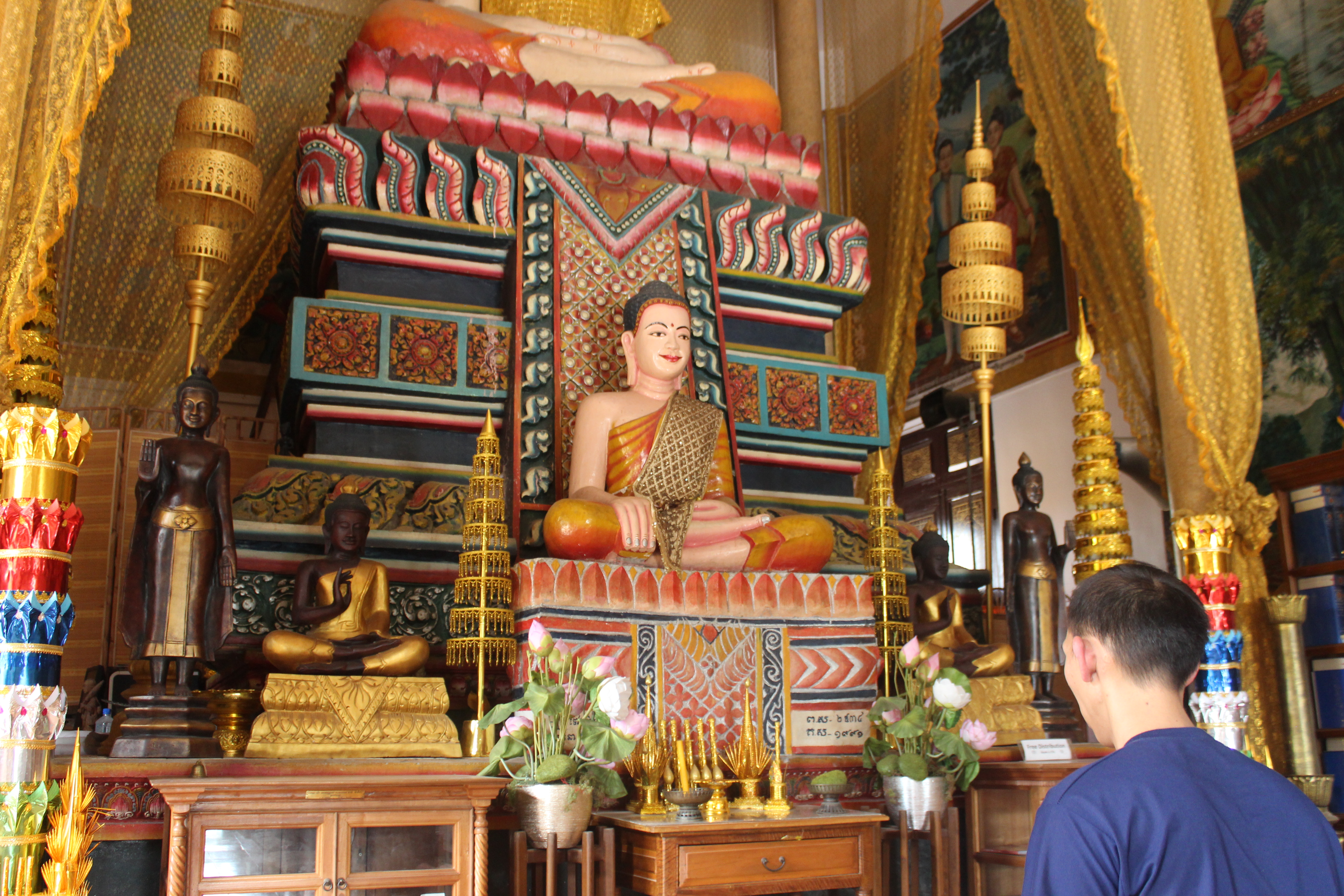 If there’s anything more annoying, as a Buddhist Studies MA student, than having to memorize lists of lists after lists full of lists from the annals of the ancients, it’s having to plow through the re-definitions of all those terms from the mouths of the moderns (is ‘anals’ a word?). This is not high scholarship. This is the business of busy-work, the intellectual equivalent of keeping that shovel moving to justify your union job, or to keep your position as the arbiter of privilege in the fan-boy chat-pages of Facebook…
 It has long been predicted that Buddhism’s future is in the West, and for better or worse, that may very well be true. So the question then becomes: what kind of Buddhism would that be? For purposes of dialog and dialectic, I see the two chief protagonists to be the Thai Forest Tradition and Zen, both of which have numerous and faithful adherents in the West, and both of which can claim some purity of faith and doctrine…
 Theravada Buddhism has it easy, when it comes to dhamma (dharma) talks, just pull out the old mind-kilesa-breath-nose-navel-‘Buddho Buddho Buddho’ playbook, rinse and repeat, hard to screw up unless you want to get into the murky afterbirth of past lives and kamma (karma), doing Yogic headstands and plotting Ptolemaic cosmic epicycles, trying to explain how anatta (non-self) somehow gets reborn, when there really is nothing there to begin with. But still they do. It’s embarrassing, especially when some of the same ones…


Reply