Tagged: language Toggle Comment Threads | Keyboard Shortcuts

  • Unknown's avatar

    hardie karges 11:43 am on March 18, 2023 Permalink | Reply
    Tags: , , , , , , , language, , , , ,   

    Buddhism 499: Suffering doesn’t have to be so sad…  

    Suffering does not mean sadness, maybe in Nepali language, but not in Buddhism. This is one of the lessons, and this is one of the discussions, about what the word ‘dukkha’ really means, and what that means for us. Many pandits try to redefine it variously as ‘stress,’ ‘disappointment,’ ‘dissatisfaction,’ ‘spot of bother,’ haha, or various and sundry other things, but in most modern SE Asian languages the word indeed is usually best translated as ‘suffering,’ however minor or apparently insignificant, which sometimes earns Buddhism the rap as pessimistic.  

    What IS significant is that you will one day die, or simply expire, from this life in this world, and whether anything goes on after that is a matter of sober conjecture. But that IS a limit to your free will and your open skies and your desire for the Christian myth of abundance. For if there is indeed an infinity and/or an eternity, then it is surely empty, and that can indeed be beautiful, just as can the various limits placed upon it. For what is a work of art if not a limit, or definition, of reality, and what is a song? They are nothing if not sublime limits placed upon an undefined eternity. 

    Thus, suffering need not be so cruel. For me it is little more than life in passive voice as much or more than active, if those grammatical terms still have meaning for you. They do for English language literary agents, I assure you, and passive voice is largely prohibited, while in Asian academic circles, it is almost required. Go figure. But I’m not advocating passivity, and that is what kept me from Buddhism for many years, the passivity that I perceived in Thailand. As always, the truth lies in the Middle Path, and the subtle balance between aggression and renunciation. There is always a way forward without resorting to extremes… 

     
  • Unknown's avatar

    hardie karges 8:16 am on March 11, 2023 Permalink | Reply
    Tags: , , , , , , , , , Kramer, language, , Passion of Christ, , , ,   

    The Passion and Dispassion of Buddhism…  

    Buddhism in Sri Lanka

    There is no worse slavery than the slavery to your passion(s). And that’s a tough pill to swallow, because we tend to think of our passions as our pleasures, as though it’s only natural to be obsessed and conflicted. It’s not. But that shows the path that western culture has taken, in which our passions, which once meant ‘suffering,’ now are the focal point of our lives, and full of positive connotations—even if it kills us. So, with the ‘passion of Christ’ fully articulated as his suffering, in defeat, with no victory implied or intended, then Buddhism and Christianity are not so far apart, at least not superficially, at least not originally.  

    For both see suffering as seminal. The differences only become apparent when we realize that Christianity and the West make of suffering (i.e. passion) something to be encouraged, and sought, not something to be avoided and mitigated, as in Buddhism. The examples are many: samsara, for instance. This is a word that in the time of Buddha meant, and still means (in modern Nepali), ‘the world.’ And the Buddhists made something distinctly negative of that term, it now symbolizing the drudgery and misery of incessant rebirths. But most westerners, and especially Christians, are famous for their (our) ‘love of life’ and the world, too, of course.

    So, is the Christian belief in (and desire for) some sort of ‘eternal life’ really any different from the Buddhist rebirth? Only in that one is desired and the other abhorred, it would seem. So, if it’s not surprising that Buddhism and Christianity spring from similar roots, given their shared Indo-European proto-language and homeland, it IS a bit surprising that they’ve diverged so far from that initial starting point, and in apparently opposite directions. What would cause that? Good question. There would seem to be nothing in the physical landscape to explain the divergence, though the cultures encountered, and conquered (Indo-Europeans didn’t lose too many wars, except among themselves), differ quite radically.

    Considering that they went both ways from the Yamnaya Horizon’s original Pontic steppes, West and East, to Europe and north India, respectively, they would have encountered light-skinned ‘old Europeans’ on the one hand, and dark-skinned Indus Valley people on the other. That’s the biggest difference between the two groups right there, and may be significant, with respect to the caste system and perhaps more. But my own pet theory is that West and East were mostly playing out a dialectic of ideas, that likely dates back to 4000-3000BCE around lively campfires on high steppes and with spirited discussions.

    In this theory that dialectic is still being played out today, albeit in more ways than could ever have been imagined in the years BCE. The important thing is to not become a slave to your passions, though, even when you enjoy them, or when they cause you suffering. I’m reminded of Kramer’s statement to the ‘Soup Nazi’ in the old Seinfeld TV show: “You suffer for your art.” Touche’. Freedom FROM is the important thing in life after all, even more than freedom TO. Does it really matter whether you get the espresso or tamarind flavored ice cream today? Enjoy… 

     
  • Unknown's avatar

    hardie karges 7:15 am on March 3, 2023 Permalink | Reply
    Tags: , , , , , language, , , ,   

    Buddhist Karma and the Middle Path to Salvation   

    You want good karma? Help a beggar to eat. That’s good karma. Because karma literally means ‘acts’ or ‘actions’, though it is often used almost synonymously with the English word ‘fate,’ as though it were all about some sort of predestination. But no, that’s a derivative meaning which may or may not always apply. The most important thing is right actions, or samma kammanta, as specified in the Eightfold Path that concludes the Four Noble Truths of Buddhism. 

    And that’s the important thing, to perform good acts, the other steps along the path, not unlike the Ten Commandments of Christianity, including right speech, right livelihood, and, of course, the basics: do not kill, do not steal, and for god’s sake don’t mess with your neighbor’s partner! Is nothing sacred? And if the Christians like to phrase that as ‘thou shalt not covet,’ then the Sanskrit is not so much different. They’re related languages and people, after all, and the Buddha puts ‘craving’ up there as the main cause of suffering. 

    But where East and West might truly differ, though, is in the speed and willingness to act. Because if we in the West see our active ‘go go go’ lifestyles as a normal and predictable outcome of our sojourn upon this planet, I can assure you that not everyone sees life and the world that way, least of all the rishis for which India is so famous, not to mention the pandits, gurus, swamis, and acharyas. And so, there’s a hidden message for them here also: Do something! After all, you can’t sit in a cave all your life, can you? Can you? 

     
  • Unknown's avatar

    hardie karges 9:19 am on February 26, 2023 Permalink | Reply
    Tags: , , , , language, , ,   

    Buddhism and the Case for a Monkhood… 

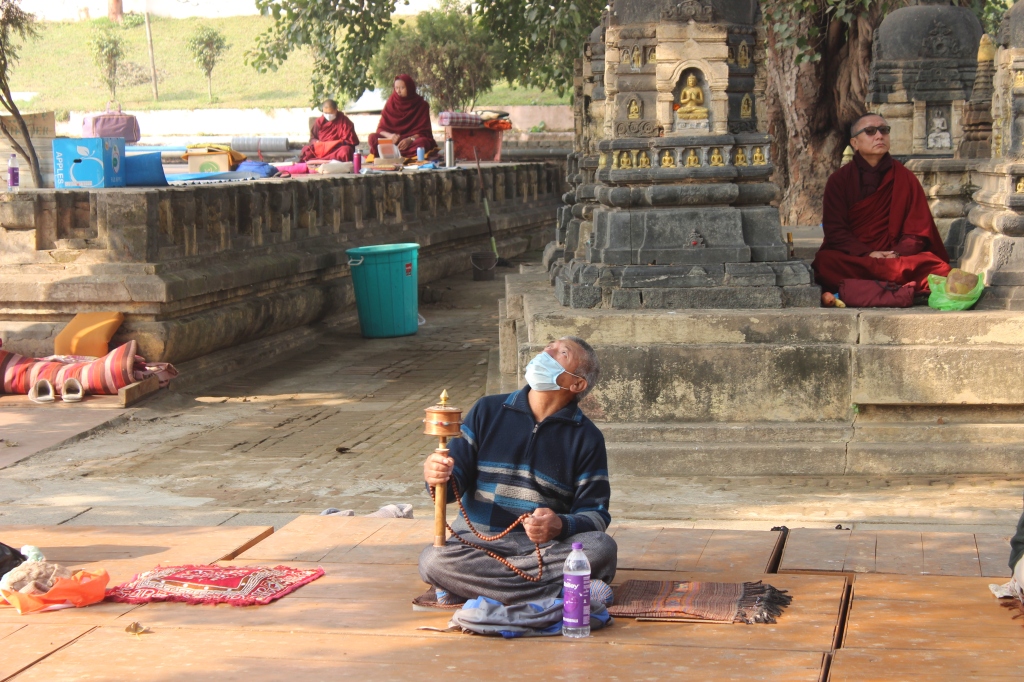
    Some people think that there is something mystical or magical about monks chanting, in this case the Buddhist scriptures. But really it started as a way to memorize sutras that were not written for 500 years. And this is interesting in a few different ways and for a few different reasons. Firstly, it speaks to the issue of whether the Buddha actually said the things that are attributed to him. After all, if it wasn’t initially written, then how can we be sure? To which I would quickly add: even if it were written, how could you be sure that the Buddha actually said it? Ever heard of ‘fake news’? 

    The fact is that, given the times and the circumstances, memorization was a perfectly acceptable way of recording documents, which is the ultimate goal, after all, since nothing was being prepared for print, only some poorly defined remote abstract history, and of which only time itself would later determine the parameters. And if memorization is acceptable, or even superior, to easily stainable documents, then certainly a large group of literate and disciplined monks would be the perfect way to do it, meeting regularly to iron out any differences in the accurate transmission of such important information. 

    Secondly, it shows that not only were monks charged with a task of utmost importance, but that it was rigorous and highly demanding, thus giving the lie to the idea that monks were always intended to be ‘kept’ as pure and pristine specimens, virgins to the world and unashamed of it. No, they had a job. And lastly, it speaks to the notion of whether the Buddha himself even existed in this life in this world. Conspiracy theorists love nothing so much as to recreate history to their predilections and post-election dictates. 

    But, obviously, if monks have been chanting the same words in an unbroken line of descent from the original 2500 years ago, then that is proof, in and of itself. Yes, there were some breaks here and there, but those were rigorously mitigated, such that though Thailand received the original dharma from Sri Lanka, when things went awry there, the renaissance dharma went back to Thailand to make sure that they had it right. This is serious stuff.  

    But I like the sound of monks chanting, also, and even credit the sound of that on my ears in Mongolia in 2013 as an impetus to my impending initiative towards Buddhism. While listening, it felt like something Matrix-like moved, and ultimately that would be me. Still there is a larger issue of why writing was eschewed for so long when it was obviously the wave of the future, but that probably says more about India itself than Buddhism. Conservatism is not always a bad thing in uncertain times. Buddhism was all about discipline and training long before anything else, so more like kung fu than koans… 

     
    • quantumpreceptor's avatar

      quantumpreceptor 12:42 pm on February 28, 2023 Permalink | Reply

      Well said Hardy. Being a monk is not easy now was mit easy then and will not be in the future. Memorizing the teachings is a gift that when passed on only expands the blessing. I love your writing keep it up!

      QP

    • hardie karges's avatar

      hardie karges 8:15 pm on February 28, 2023 Permalink | Reply

      Thank you!

    • gederedita's avatar

      gederedita 12:08 am on March 2, 2023 Permalink | Reply

      I just know this temple from this blog. Iseen from the film but i dont know di temple located. I am lucky to find your blog, Hardie karges.

      • hardie karges's avatar

        hardie karges 5:33 am on March 2, 2023 Permalink | Reply

        This temple is in Bhutan, near the town of Paro. It’s usually called the ‘Tiger’s Nest.’ Thanks for your comment.

  • Unknown's avatar

    hardie karges 10:24 am on February 5, 2023 Permalink | Reply
    Tags: , , , , , Graeber, , John Locke, Kadiaronk, language, , , , Wengrow   

    Buddhism, Craving, and the Path to Enlightenment… 

    When you realize that you and your cravings are the cause of most of your problems, then you are on the path to enlightenment. And that’s the Second Noble Truth, more or less, so fundamental to the practice of Buddhism. After all, most Buddhists worldwide don’t meditate, and many physically can’t, but anyone can train their mind. That’s the heart of the Buddha’s original message, not rebirth, past lives, or even emptiness. Control yourself, and not only will the world be a better place, but you will be a better person.

    But there’s that ugly word ‘control’ again, the same word and concept which cause so much consternation among us Westerners for whom freedom is sacrosanct, and for whom control is the enemy. And that may be fine for the wide-open skies of Montana, but that might not work in all situations. Because, like it or not (I don’t especially like it), the world is becoming a crowded place, and the paradigms of a previous era may not all be appropriate now.

    Whether we take our cues from John Locke or the now-famous Native American scholar Kadiaronk, immortalized in The Dawn of Everything, by Wengrow and Graeber, the result is the same: a freedom is best understood by its limits—by definition. Most importantly, though, is the difference between self-control and control of others. This is where politics meets philosophy, and we find our place in the universe. Then there’s also that word ‘enlightenment’ again, which implies a duality between darkness and light despite any objective standard of reference.

    And that’s the word often revered to the same extent that control is reviled, but not always. Because words themselves can be as dangerous as their deliverance, and seldom do they live up to our expectations. But once they became our operating system, then so it will be until we find something better. Because, ultimately, language is just the interface, and there are more important things to be accomplished. When you realize that your worst curse just might be your greatest blessing, then you are on the path to enlightenment…

     
  • Unknown's avatar

    hardie karges 1:34 pm on December 23, 2022 Permalink | Reply
    Tags: , , , , , language, , , samathi,   

    Buddhism and the Bearable Lightness of Being 

    Be more like the water, more like the air, and less like the humans, obsessed with their opinions. And by this, I don’t mean to imply that we should all be ‘air-heads’ or anything else that might seem less than human or beneath our dignity. I only mean to imply that flexibility is good, and that lightness is good, i.e. the lightness of being, being without baggage, the baggage of language, which, if used properly and creatively, is one of the most beautiful things in the world.

    BUT… When used for maleficent purposes, language can be truly evil, SO… sometimes it’s better just to do without, don’t you think? Which moves us back to the subject of meditation: what it is, what it does, and how to benefit from it. Everything in Buddhism eventually comes back to meditation, if it’s done right, because that was always its chief selling point, despite all the sharper points of karma and dogma.

    People wonder why Buddhism was so well and easily accepted in China in the first millennium of the Common Era, when Taoism was already there, and when Taoism is so similar. Well, it’s often assumed that Taoism influenced Buddhism, so as to create a Buddhism “with Chinese characteristics,” haha, but it’s just as likely—or more so—that Buddhism influenced a nascent Taoism to make it what it is today.

    Either way, the critical difference would be the meditation technique which defined Buddhism long before the Brahmins started promoting karma as the definition of Buddhism, in order to enhance their own superior position. Remember that the Japanese word ‘Zen’ comes from the Chinese word ‘Chan’ which comes from the Sanskrit word ‘dhyana’ which means something like ‘meditative absorption’ or ‘deep meditation’ in Sanskrit, to distinguish it from the ordinary ‘concentration’ which is also a definition of the Sanskrit/Pali word ‘samathi.’ That’s my take on the subject, anyway. Merry Christmas.

     
    • Tiramit's avatar

      Tiramit 10:14 pm on December 23, 2022 Permalink | Reply

      Thus, it is what it is. I like your take on the subject anyway and Merry Christmas to you too!

  • Unknown's avatar

    hardie karges 9:29 am on November 20, 2022 Permalink | Reply
    Tags: , , , language   

    Good Karma: the Gift that Keeps on Giving… 

    Good karma occurs every day that you make a donation and someone benefits from it besides yourself. If you benefit from a gift, then there is another word for that: business, transaction, you name it. But the word ‘karma’ itself means ‘action,’ and so we Westerners have our own version of this admonition: ‘Actions speak louder than words,’ and so they do. But the word generally has a negative connotation, i.e. ‘bad karma,’ or something like cruel fate. So, what we want, then, is good karma, which necessitates good actions, and which has a connotation similar to ‘good luck.’

    For me, I’ve detected at least two different extant forms of karma as practiced in Buddhism, probably best exemplified by the Tibetan and Theravada forms, but which I tend to think of as ‘heavy’ and ‘lite,’ in order to avoid strict definitions and casual dismissals. Because I respect all forms of Buddhism, even if I personally prefer a mix of the original Theravada and the most recent secular, so something like the original ascetic discipline combined with the latest scientific knowledge, anything but silly superstition.

    The heavy karma version, best exemplified by Tibetan Buddhism, follows you around like some entity counting your transgressions, ready to give your performance a score which will determine whether you escape the wheels of samsara and rebirth to find a place in some better world, or whether you will ultimately be reborn to go another round in this hellscape. Now I won’t go into the ironies of the differing Eastern and Western approaches to Heaven and Hell. Suffice it to say that for me, this is beyond the bounds of science, so holds little sway in my life choices.   

    For me the important thing is to give, of your (non) self, your time, and of course: your money, because this is nothing if not a green imperfect world, far in concept from the perfect world of pure white light, as we imagine it. And if that seems like making a deal with the devil, then so be it. At least it’s a devil we know. But time is of the essence. To wait until the ‘time is right’ is often to miss the point entirely: time is an imperfect dimension, as are they all, and the human dimension especially so. We’re afflicted with disease, old age, poverty, and death, but these are conditions which can be mitigated. Give. It’s good karma.

     
  • Unknown's avatar

    hardie karges 12:06 pm on November 13, 2022 Permalink | Reply
    Tags: , , , , , , language, , ,   

    Buddhism and Survival of the Species 

    Buddhism is more than just a religion or philosophy. It is a method for planetary survival, and that’s why we’re here right now. Because I care about planetary survival, and I hope that you do, too. And by ‘planet,’ I specifically mean the human race, since I have no doubt that the rock itself can continue to provide for itself, regardless of whether humans had ever shown up to sully the mix. But we are like DNA, and DNA is like language, and so we must cross our T’s and dot our I’s and make sense of random mutations.

    As soon as our survival was assured, we humans set about killing each other. And the coincidence of this with the invention of language may have not been so coincidental at all. Thus, once adopted, language has somehow become intrinsic to our existence, and so it is necessary to make our peace with it. Buddhism is famous for meditation, of course, and so that is one way of dealing with language, by losing it—powerful. Because for all the rap about insight, mindfulness, and ‘calm abiding,’ the one thing common to all meditation is silence. Guided meditation is something else.

    Christianity was fine when the human race was still young, and the need to breed was still arguably extant. But with eight billion people (and counting), the passion of Christ has long since been replaced by the passion of mice, breeding like rabbits and eating like wolves. This is not what the world needs right now. We’re a successful species, unless we continue to kill ourselves. I don’t think a species has ever gone extinct by mass suicide. But we could become the first, regardless of stated intents. Buddhism is one way to resolve this issue favorably, by choosing inner peace over mass consumption…

     
  • Unknown's avatar

    hardie karges 9:13 am on September 18, 2022 Permalink | Reply
    Tags: , , , , language, , , , ,   

    Buddhism and the Nature of Self/Not-Self… 

    The notion of self is a linguistic convenience. But language is not reality. And this is one of the debates in Buddhism, of course, not so much the exact nature of ‘self,’ which is proscribed in Buddhism (with an ‘o,’ not ‘e’), but more the exact nature of ‘not-self,’ or ‘no-self,’ that distinction itself often at the crux of the debate, as if there were any real difference, as if it really mattered. Because what matters is that this is not the Hindu cosmic self nor the Christian eternal self, both of which are not what the Buddha envisioned for his group of followers and his emerging view of the world.

    But what exactly did he envision for the self? Not much, apparently. Best guesses are the (s)khandhas, or ‘heaps’ of causes and conditions that he enumerated to constitute the typical person sans persona that is typically referred to, though many modern Buddhists like to wax long and hard on the ego and ensuing egolessness that would obviously result from that starting point. But our concept of ‘ego’ is so tied to Freud’s concept of id, ego, and superego that it may be misleading. Because I’m sure that the Buddha had no such wild notions.

    The Freudian ego also makes the same mistake that the Buddha was trying to solve, positing self as a thing, or something, anyway, which is an independent actor on an ever-shifting stage, when the actions themselves were much more important, as modern psychology now acknowledges the behavior, rather than some elaborate tripartite self, so like verbs not nouns. The Buddha might even go a step farther and see the composite self as a collection of adjectives, thus tendencies to act, not even dignified by the actions themselves.

    I’m sure that he had our modern notion of selfishness in mind, though, so we have that much in common, what with his obsessions with craving and desire. And that’s where Buddhism has much to say about our modern consumeristic economies and lifestyles to the point that ‘stuff’ becomes the meaning of our lives. This is a trap, of course, and a never-ending cycle of unfulfillment. After all, how can things satisfy us if we ourselves are essentially non-things? Sometimes the world is too much with us. Even the Buddha and Wordsworth could agree on that. The Buddha called it samsara….

     
  • Unknown's avatar

    hardie karges 8:33 am on July 31, 2022 Permalink | Reply
    Tags: , , , , , , language, Magi, magic, , ,   

    Buddhism 498: Emptiness is the Path to Infinity 

    If you’re doing it right, then one day a sense of calmness will come over you, as the zeroes take over, and the fractions become less, a mind divided unable to reproduce itself properly, and the ensuing life even less. Because language knows no natural limit, and so will run on until stopped, vowels and consonants forming verbs and nouns like chickens and eggs, and no one knows which came first, since no one was taking notes in a class too crowded for convenience and too full for breath…

    But people wonder why meditate, since there’s so little time and so little space, that to waste any extra must certainly be counter-intuitive, but, in reality, the exact opposite is the case. Because meditation creates more time and more space in the process of killing it, such that if you really want to experience infinity, then the only way to do that is with emptiness.

    Because infinity cannot exist full of stuff, and that is fundamental to the concept, and who would want it anyway, except a kid at Christmas before the sun’s even up, learning the false lesson of abundance under the magic of the Magi, who got lost on the way to Bethlehem, but couldn’t see any reason to let a good story go to waste? So, a kid in a manger becomes the unlikely savior of humanity, when all we really wanted was a full belly and an empty mind, empty of hate and anger, with Big Ideas optional.

    But we can do that on command with a little silence and a lot of discipline, let the confusion die down and out, and be reborn in spirit every hour of every day with a little self-control and a lot of kindness, creating a world of forgiveness and reconciliation, instead of aggression and competition, for access to scarce resources, to create even more, when the obvious answer is to first consume even less. And that is the difference between Buddhism and Christianity, to consume less or produce more, when the truth lies somewhere in between.

     
c
Compose new post
j
Next post/Next comment
k
Previous post/Previous comment
r
Reply
e
Edit
o
Show/Hide comments
t
Go to top
l
Go to login
h
Show/Hide help
shift + esc
Cancel