

Tagged: Vajrayana Toggle Comment Threads | Keyboard Shortcuts
-
hardie karges
-
hardie karges
Buddhism 401: The Science of Silence…

No experience is truly bad if it teaches a valuable lesson. This is gospel in the Dalai Lama’s Vajrayana tradition of Buddhism, I think, and seems to mesh well with all of them, something of a quick lesson in karma, when initial results might not be encouraging. Because none of us are in this for cheap tricks and quick thrills but settled in for the long run of sublime moments and partial fulfillments which leave themselves open for further development.
The important thing is not what we get but what we give. Life is not transactional. Life is about fulfillment, not about feeling full, but about feeling satisfied at the spiritual rewards of suffering and its many lessons available for the simple taking. This is available in complete silence without any further methods of extracting the good from the fruit other than simple meditation. Precious moments are often wasted in mindless banter and useless argument, when silence will usually suffice.
In fact, Buddhism could almost be known as a faith of silence, in silence, in an age when engagement, by means of speech, is rewarded as currency in the physical medium of social media. ‘Silence is violence,’ some say with no proof, and it’s true that there is no place left to go to escape the howls from the house-holders and the homeless, but there is no reason to surrender the quiet life of contemplation, either. For millennia deep contemplation was the closest we could come to truth, and science will never change all that, but it can certainly change some. There is a science of silence, also.
-
Dylan Raines
If no experience is truly bad, is no experience truly good? Is believing too much in our own subjective judgment of good and bad perhaps the problem?
-
hardie karges
I think you’re probably right, yes, a duality we could probably do well without. Thanks for your comment!
-
-
-
hardie karges
Buddhism and the Cessation of Suffering…

Wealth has nothing to do with the money in your pocket or your bank account. It has to do with the quality of your thought. That’s why Buddhism is at least semi-renunciative, because there are more important things in life than money. And if that’s what the Bhutanese government official meant when he said something to the effect that Bhutan has no GNP Gross National Product, instead they have GNH Gross National Happiness, then I think that’s what he meant, not that Bhutan is the happiness country in the world, something which would be extremely hard to prove, anyway.
But, it’s been said a thousand times before, and it’ll be said a thousand times more, that there’s more to life than money, and nothing could be truer. Because, if it’s all about money, then how much is enough? At that point, you’ve defined life as something quantitative, and not qualitative, and that’s never good, the artificial thirst and hunger that inhabit the material body in the material world. In Buddhism, this lust is usually associated with thirst, so trsna or tanha in Sanskrit and Pali.
In that sense, it’s natural, so nothing to be ashamed of, but still it’s definitely something to mitigate the extremes of, in order to mitigate the suffering. And I think that’s largely implicit in Buddhism by the use of the term ‘cessation of suffering’ and not ‘cure’. Because I don’t really think that anybody is really looking for a miracle cure with traditional Buddhism the way they might be with Christian Science or even Vajrayana Buddhism, but that’s exactly what the Buddha had in mind, I feel sure. Keep the parties to a minimum and keep the suffering to a minimum for a good and happy life. That’s the middle path.
-
hardie karges
Buddhism Meditation and Emptiness

Meditation is the art of open heart and open mind, closed mouth, eyes optional. To me it’s almost amazing how many Theravada Buddhists don’t meditate at all, but I suppose that speaks to the time and the place as much as anything, as well as the ultimate goals and prime motives. Because a Thai citizen or resident doesn’t really need a motive to be Buddhist, except to be good and be social and contribute to the overall well being of the populace. If you’re already Buddhist, then you don’t really need a reason to be Buddhist.
But a Westerner needs a reason to be Buddhist, and so for many of us that’s long been a choice of Zen or Vajrayana (Tibetan), two of the more exotic versions of the field, and so an attraction to those for whom an attraction is helpful. The only problem is that the Buddha himself might not recognize either of them as representative of his teachings. For us street-corner philosophers, that’s plenty of motivation by itself, the simplicity and veracity of the original message. So, now that Theravada is re-branding itself as Vipassana, pure and simple, that accomplishes a necessary goal, to get Buddhism back to its root without worrying about word games and past lives.
Because Theravada Buddhists were always the best meditators, even if many never did it. And meditation can accomplish with practice what precepts and concepts can only suggest with words. You can talk about shunyata—emptiness—all day and not know much more than what you started with. Or you can sit silent unflinching for an hour while concentrating on breath and know quite a great deal, without uttering a word. It’s an acquired taste.
-
hardie karges
Buddhism and the Pursuit of Truth(s)
Absolute truth is a difficult subject. But right speech is easy: honesty and politeness, no trash talk, samma vaca. Most truths are relative at best, anyway, and that includes science, but it goes double for superstition. Because science acknowledges its limitations up front, and that’s the best that you can do. Buddhism is pretty good about that, also, at least in its earliest purest phase, when control of the self (not-self) was primary and gods were kept in their place—somewhere else.
Buddhist truths are limited to only a very few ‘truisms,’ which is probably more accurate than the notion of absolute truth. Those pretty much consist of the presence of suffering, the main cause of suffering which is the bad habit of craving, and the way out of that condition, which is the Middle Way, between luxury and lack, and strict adherence to the Eightfold Path. One key element of that is samma vaca, right speech. Then there’s right actions, right intentions, right views, right livelihood, and so forth.
Add to that the acknowledgement of change, or impermanence, and the deleterious effect that has on us, and you’ve got the basics of original early Buddhism, before the verbal antics of Zen or the elaborate trappings of Vajrayana. It’s pretty simple, really, just do good things and watch your tongue, say good things or you could just say nothing at all. That works, too. Don’t worry about absolute truths. Buddhist Noble Truths are more than enough of a guide for living this life.
-
hardie karges
Buddhism 499: Causes and Conditions…
It’s not enough to temporarily alleviate a bad situation, but better to permanently change the causes and conditions that created it. This gives the lie to the dismissive notions that Buddhism is only interested in the ‘present moment’, and that ‘thoughts have no thinkers’, and other casual self-disses that imply that Buddhism is superficial and unconcerned with deeper meanings. The Buddha never said that, and nothing could be further from the truth. Those are popular modern themes, but the historical reality is quite different.
In fact, Buddhism has been extremely concerned with causes and conditions since day one. And if that’s readily apparent in the earliest Theravada Buddhism, it’s a frank obsession by the time of Vajrayana. Never is there a call to cease suffering without a simultaneous call to end the causes of suffering. I think it’s even fair to say that this was likely something of a revelation in that pre-scientific time. Because in that era prior to the scientific era of experimentation, deep contemplation was the next best thing.
Even Einstein knew that from his deep thought experiments, and the Socratic dialogs of Plato at or around the same time as the Buddha’s sutras were a dualistic echo of the same approach. It requires deep thinking and difficult training, not just a fly catcher nabbing a thought or two on their way through the garden to the kids’ pool. It’s even very possible that it was Buddhist monks who invented (yes, invented) the zero, something which would not catch on in the West for almost 2000 years. It first existed as a concept in shunya, before making the jump to higher math. How do you transfer the liquids between two full containers? You need an empty container. That’s a zero. Think about it. Then meditate. That’s a zero.
-
hardie karges
Buddhism is the Middle Path between Jainism and Brahmanism…

Brahmanism is what we now call ‘Hinduism’, but that term didn’t really exist way back when, only recently applied by the Brits to the plethora of sects and devotions which now constitute Hinduism. But it was in the midst of the Upanishad era at the time of the Buddha, which would redefine the previously Indra-based fire rituals which had reigned during the Vedic times. And with the advent of the new Upanishadic orientation, the resulting resemblance to Buddhism was profound—but still distinct.
And so was Jainism distinct from both of them, at the same time that it shares much with them. But remember, that the ‘Hinduism’ that the Jain reacted to in the 6th century BCE is not the same as modern Hinduism, either, and that is partly because of this same three-way dialogue. Jainism was largely a reaction against the Brahmanists’ fire sacrifices, they being extreme nonviolent vegetarians. But many modern Hindus are also vegetarians, with Buddhists characteristically somewhere ‘in between.’
That’s the Middle Path, specifically between the extreme asceticism of the Jains and the lavish rituals of the ‘Hindus’, but also between the many gods of Hinduism and the total lack of them in Jainism. Technically Buddhists don’t really have them, either, but, you know… Later versions of Buddhism were not so strict about that, such as the Tibetan version of Vajrayana, which came direct from India sometime after the 5th century and attested by Padmasambhava in the 8th century.
But both Jains and Hindus were crazy about souls, Jains finding them everywhere and Hindus finding them cosmic, Atman, preferably in union with the cosmic dharma principle Brahman. But Buddhism found little of value in any of that, and so chose non-self anatta. So, they all evolved into different sects with different orientations, and we generally all get along nicely. The main difference is that Hinduism tilted toward a nationalism which international Buddhism could never assimilate. And Jains, ‘winners’ in Sanskrit, were ultimately the losers.
-
hardie karges
Buddhism: It’s a Process…

I am not the same person as yesterday, and I will be a different person tomorrow. I am not DNA code. I am skandhas, anatta, annicca, that is: I am a ‘heap’ of causes and conditions, nothing permanent, always changing. So don’t get too attached to yourself or to anyone else, because tomorrow offers no guarantees. Oh, and one more thing: there’s no soul, at least nothing like what the Christians or Hindus have in mind, eternal and/or cosmic, though Buddhism usually allows for at least a limited sort of rebirth.
After all, we don’t want to get too dreary now, do we? Certainly not. But the principles listed here are foundational to Buddhism. And so, life and the world are at least somewhat illusory, at least in their most obvious manifestations as part of the visual and sensory feast that constitute our world of perceptions. But there is another principle that is even more important to some of us as Buddhists, and that’s the concept of the Middle path, which can be applied to almost anything, including itself, that hypothetical middle path which defines Buddhism by its very lack of definition.
And such is the history of Buddhism, as it evolves almost dialectically, from thesis to antithesis to synthesis, only to start the process all over again. It is in that view that Buddhism emerged in the first place, as the middle path between the excesses of Hinduism and the extreme renunciation of Jainism. And it is that process which continues today, as Mahayana offers an alternative to the original Theravada, and to which Vajrayana and Zen start the process all over again. Now the original Theravada Buddhism would like to remake itself as Vipassana: meditation, that is, first and foremost. I like that idea.
-
hardie karges
Buddhist Love is not like Falling in Love, Sorry…

No, Buddhist love is nothing like the weeping and wailing and gnashing of teeth that often accompanies Christian ceremonies, whether birth or death or the multicolor gray area in between, mostly sex. Buddhist love, metta, is just a whole lot like friendship, and there’s nothing wrong with that. So, Platonic love, then maybe? I think Plato would be cool with that, maybe too cool. And that’s what falls short for a lot of people, for whom devotion is the primary practice of their religion.
It just doesn’t have the feeling of total surrender required for the religious experience in many people’s minds. But that’s Buddhism: cool, baby, cool. The devotional aspects were the last major additions to the three major canons of Buddhism, and long after the original discipline orientation of Theravada and the transcendental orientation of Mahayana. So, it’s no coincidence that the Tibetans got their Vajrayana straight from the source of India, which is primarily devotional to this day, whether of Shiva or Vishnu, no matter the object. Devotion is the important thing for the devotee.
But whether the two additional ‘vehicles’ may or may not have added something important to Buddhism, the core practice of discipline and dana (giving) remain unchanged. Upgrade the meditative practice of anapanasati to vipassana, and BOOM! You’ve got a rebirth of the original Buddhism with or without the doctrine of Rebirth to the non-Self (?!). Ouch. Yep, that’s better now, just to avoid questions that have no good answers. Too many cooks ruin the broth. The kindness is more important than the love.
-
hardie karges
Buddhism: Meditation, not Mysticism…

Buddhism was never intended to be mystical. Buddha was very rational in his take on life and suffering. Any mysticism came later, mostly in the Vajrayana Buddhism of Tibet that came directly from India, not China, and which had taken firm hold in that country by the Eight Century CE. And while that ‘school’ of Buddhism is often included in the Mahayana tradition which traveled through, and was greatly influenced, by China, such is not the case with Vajrayana, which derives from a later, maybe the last, Indian Buddhist tradition, before it succumbed to the coup de grace by the invasive Mughals, after centuries of losing ground, and followers, to the Brahmanist Hindus.
About the only thing that all the Mahayana schools have in common, in fact, is that they are not of the original Theravada tradition, which originated in India and found fertile ground in southeast Asia, mostly. And if the Vajrayana tradition is famous for its multiple levels of heaven and hell, its Tantric yab-yum, mudras and mantras, then Theravada (aka Hinayana), is best known for its lack of all that, and concentration on meditation, especially, to the extent that it’s sometimes known by that most famous meditation technique Vipassana. Meanwhile the Mahayana Buddhism of China is probably best defined by its transcendent Buddha and the vast Emptiness of reality, both more recent developments.
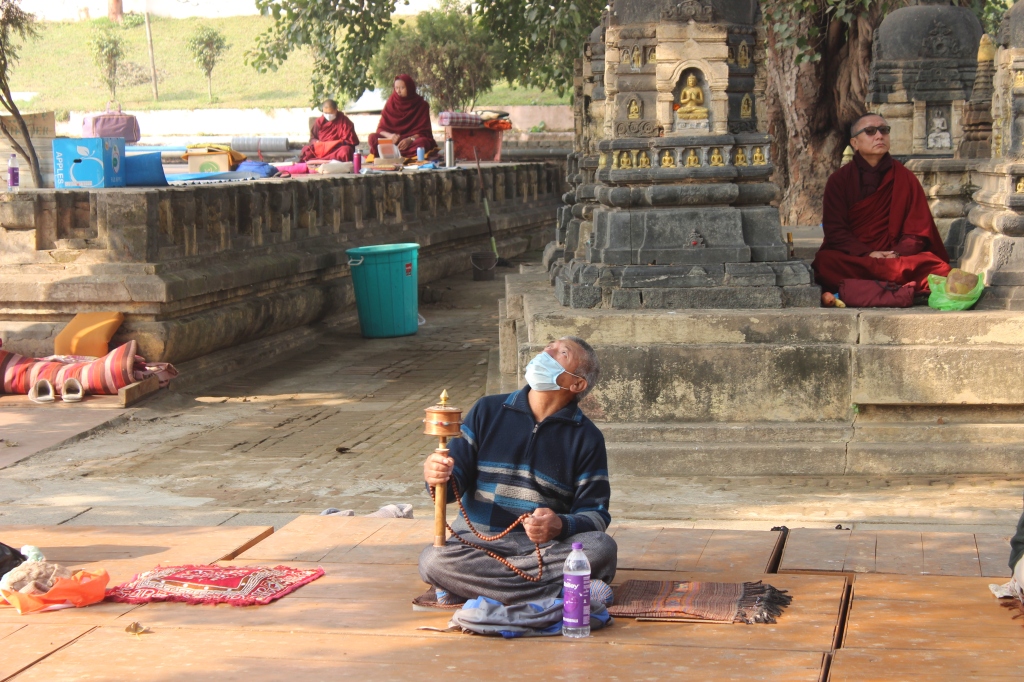
Many famous Chinese monks, Fa Xian and Xuanzang foremost among them, even made long arduous trips to India just to get it right, like Charlemagne realizing his 8th century French language wasn’t proper Latin. And mostly I believe that meant learning meditation, and some other disciplines, which Theravada monks usually excel at, and Chinese monks often suck at—to this day. In fact, I didn’t really even know what meditation was until I attended some Theravada-based meditation retreats in Southeast Asia, intended for Asians, not Westerners. When you see a layman sitting silent unflinching for two or three hours lost in no-thought: that’s meditation. The monks are even better at it. Now I get it. Get it.


 hardie karges and



 streaming consciousness...
Reply