Tagged: sati Toggle Comment Threads | Keyboard Shortcuts

  • Unknown's avatar

    hardie karges 2:24 am on October 19, 2025 Permalink | Reply
    Tags: , , , , , , , , sati   

    Buddhism and Mindfulness: Smrti and Samadhi… 

    Multi-tasking is a myth, the idea that you can do two or more actions at one and te same time. ‘Monkey mind’ is more accurate. Mindfulness is not a myth. But what is it exactly? There are as many definitions as there are commentators. But the original meaning of the Pali word sati, from which the word mindfulness derives in the Buddhist tradition, refers merely to consciousness, or awareness, or conscious awareness, if you want to be a smarty-pants.

    Which is not a bad idea, considering that the original Sanskrit word was indeed smrti, before that got shortened by the early Buddhists to sati. Did you know that Sanskrit is related to the English language through Indo-European connections? But when the onlookers in the crowd around your motorcycle wreck in Thailand ask each other, “does he have sati?” They’re asking if you’re conscious, not whether you’re mindful. The modern Buddhist connotations, especially in the West, gravitate more toward the woo-woo style of Buddhism, as if mindfulness were something more than mere awareness, or consciousness. But it’s not, not really.

    The awareness or consciousness involved in mindfulness really only differs in degree, not kind. The more you do it, the better it gets. If that means meditation, then more power to you. A half hour in the morning should last you half a day, easy. It’s a lot like re-booting the computer to reset the sequence, to get a fresh start, like a writer’s legendary ‘fresh eyes’. No need for monkey mind, this and that, altogether now; just do one thing at the thing, in the correct order and sequence. Now make a mental note. That’s all. Samadhi is the next step along the path to liberation.

     
  • Unknown's avatar

    hardie karges 4:34 am on June 29, 2025 Permalink | Reply
    Tags: , Denisovan, Floresiensis, , , , , , , , sati, , ,   

    Buddhism, Meditation, and the Zero… 

    We are all conditioned by language. So, try to watch your tongue. That is not a Zen koan, but it could be, since they speak to the same issue. Language is not always a solution.  Often it is the problem. And that places it largely outside the Western world’s system of knowledge and transactional engagement. Because, when Mark Z says that he wants to see engagement on Facebook posts, he’s not talking about flirtation and sweet talk (though that’s okay, too, I’m sure). He’s talking about verbal exchange, to the point of sparring and verbal disembowelment.

    That’s why many people love Facebook. And it’s why just as many hate it and go on to other social media. Because language is the world’s preeminent weapon, likely the reason why homo sapiens, aka homo vehemens, was able to defeat the Neanderthals and Denisovans and Floresiensis so handily and bodily. They had a not-so-secret weapon. The rest is history. The talkers got the spoils of war, and the others got shallow graves. And so, it is today. High-tech is our language.

    Enter Buddhism and the meditation that defines it. Like the zero, shunya, that gave its name to Emptiness, shunyata, we need that empty space to make sense of things. We need that empty space to return to our natural pre-linguistic awareness, sati, which predates the ‘monkey mind’ that language sometimes produces, and which must be held in check by concentration and attention. The world outside is limited, changing, and full of stuff. The world inside is infinite, eternal and empty. We only need that emptiness to hold it all in perfect place notation. That’s what zero is for. That’s what meditation is for.

     
  • Unknown's avatar

    hardie karges 2:32 am on June 15, 2025 Permalink | Reply
    Tags: Bing Crosby, Buddha's Brain, , dopamine, , , limbic system, , , neurons, pre-frontal cortex, Richard Mendius, Rick Hanson, sati,   

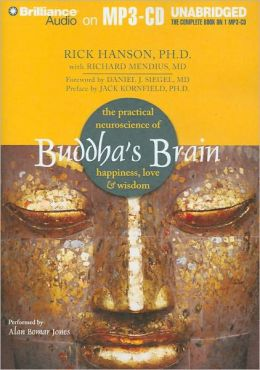
    BOOK REVIEW: “Buddha’s Brain”: by Rick Hanson and Richard Mendius 

    This book has been out there a while, about twenty years, but not only did I just now discover it, but I suspect that many people who’d like to ingest this kind of knowledge and information are more interested than inspired, because it’s not easy knowledge to ingest, without resorting to woo-woo and juju, which ultimately does not hold up to peer-reviewed scrutiny. Because this is the point where spirituality meets science, and the path is not for the weak hearted. The basic idea is that your mind, and by extension your brain, or vice-versa, in effect control the keys to your happiness, and that is the path of your salvation. To accomplish this Hanson the neuroscientist PhD and Mendius the MD mix and match metaphors and math to navigate this path for you. But where to begin?

    They begin with what could be considered the mantra for this entire book, a quote so powerful that I used it as a standalone quote on my Facebook page: “Neurons that fire together, wire together,” meaning in short, that you can create a neural network that facilitates your happiness with the same ease and simplicity that you can go to a doctor, or a university, or a friend’s house for after-dinner drinks that might lead to the love of your life, and that sort of happiness. But wouldn’t any of those go better and easier with the kind of mental attitude and predisposition that almost guarantees success? You can create that. And, if that goes against the belief in ‘Thoughts without Thinkers,” well, so be it. That was never meant to be a call to inaction, but more like a generality, or a palliative, or a reminder to ‘not think too much.’

    But, there must be a place in our lives for ‘right thoughts’ and ‘right actions’ and this is a good place to begin, i.e. mind training. Unfortunately, our brains and therefore minds have a negativity bias for survival, so this must be at least partially overcome, since it quickly leads to the suffering of separateness and a world of simulation which is very different from the present moment that largely defines sati, mindfulness. Because the second dart is often worse than the first dart, as explained here, i.e. our reactions are worse than the actions which have caused the negative effects that we are trying to mitigate. It’s a vicious circle, the dog chasing its tail when the tail is not the problem; the chasing is the problem. It is here that meditation can come to the rescue to reboot the action-reaction sequence with a solid dose of silence as salve and salvation.

    If happiness is the goal, then we need to ‘accent the positive,’ or ‘Ac-Cent-Tchu-Ate the Positive’, if you prefer, all thanks to Bing and the Andrews Sisters and Johnny Mercer, while avoiding any and all clichés and giving a break to Mr. In Between, haha. Because  as Buddhists we can seriously identify with that, all extremities duly avoided by Buddhist writ long unwritten. But meditation can only create a level playing field, per its role as the zero shunya of shunyata which is so important to the advanced transcendental Buddhism of Mahayana. Once the fires are calmed, then the neuroaxis can begin to do its thing, with the brain stem, limbic system, and pre-frontal cortex, etc. Sounds complicated, but guess what? It doesn’t have to be. It can be as simple as not responding to that first dart, adding your second dart to the karmic mix which, once established, becomes increasingly hard to shake.

    And, if non-response sounds like ‘spiritual bypassing’, then, once again, so be it. That’s the whine of psychiatrists who fear a loss of revenue. Buddhism is a religion of at least partial renunciation. Because there are (at least) two wolves in every heart: Love and hate. Love and hate create us and them. The only cure is empathy, easier said than done, true, but not too hard. Just add kindness, and compassion. The compassion is to cure suffering, and the kindness is to bring happiness. Kindness is pre-frontal. Enlarge your circle. Meditate. Make it frontal. Control your attention; basal ganglia seek attention. It’s the power of meditation; sati leads to wisdom. Rapture and joy bring dopamine. Fast gamma waves bring singleness of mind. Relax the Self: don’t take things personally. Self is a convergence of many neural networks. It’s a process, always changing. Any questions? Don’t think too much. Chill. It’s worth the read. I give it a four.

     
  • Unknown's avatar

    hardie karges 4:35 am on April 20, 2025 Permalink | Reply
    Tags: , , , , , , , , , sati,   

    Buddhism and Mindfulness, Language and Life… 

    ‘Mindfulness’ is a tricky term, full of modern marketing. I prefer ‘consciousness,’ the original meaning to the same word in Pali, sati. Now that may seem like a minor quibble, but I prefer to keep superstitions and general ‘woowoo’ and ‘joojoo’ to a minimum for easier acceptance. Because I don’t want Buddhism to be something magical and mystical, even if that brings in some fervent fanatics full of vim and vigor. But it rules out science and that is the problem for me. Religion and science should be perfectly compatible, and that is best accomplished by staying off each other’s turf.

    Maybe it’s an impossible task, I suppose, but it’s still worth trying, I think. Because already a certain stratum of words has been ‘Buddhafied’ and elevated to a meaning that doesn’t conform to that of the ordinary world and its ordinary usage of the word. I’m not worried about the extra work of cataloging two meanings in my mind, but I’m concerned that we’re losing something by avoiding that original meaning. So, when samsara comes to mean ‘endless cycle of rebirths’, rather than its original meaning as simply ‘the world’ (e.g. in modern Nepali), well, something has changed, and not always for the better. You can check to see if that original meaning still works in every case, and it does AFAIK, but with a difference—authenticity.

    Only rarely does a word totally change meaning within the historical period, like the English word ‘passion’, for instance, once suffering, now a kind of special love, for us silly westerners, of course. In modern standard Thai, the word that now means ‘mindfulness’ is sati, from the Pali, but there it simply means consciousness. When I was lying on the side of the road after a motorcycle accident near Wiang Papao, no one was asking if I was mindful. They were asking if I was conscious. There’s a difference. Original early Buddhism was very down to earth. Transcendence came later. For me mindfulness is the opposite of mindlessness, pure if not simple.

     
  • Unknown's avatar

    hardie karges 4:36 am on March 23, 2025 Permalink | Reply
    Tags: , , , , , , , , sati   

    Buddhist Sati: Enjoy the Mindfulness… 

    Sometimes the best thing to do is nothing, absolutely nothing. Just do it mindfully, with intent and purpose. But this is the hardest thing for a Westerner, European or American, to comprehend, that sometimes we don’t need to be jumping up and down, racing around, and blowing things up, that indeed sometimes it’s preferable to chill, baby, chill, and let things proceed one step at the time with clear and simple awareness, rather than obsess about populating Mars instead of making our own planet earth more livable.

    So, the Mars freaks blow things up in midair, invent self-driving cars, accelerate them zero to sixty in four seconds, bore tunnels under cities, insert chips in your brains, and what have they accomplished? Not nearly enough, and far too much, all at the same time. Have the sick been healed? Have the homeless been given housing? Has anyone even tried? True, the poor may always be with us, but that’s no excuse for not trying to help. Jesus knew that, and the Buddha did, also.

    I’d like to go to Mars, too, truth be told, but only when the time is right, and the opportunities exist for anyone to share in that dream, if they are so inclined. But I made a conscious decision that renunciation would be preferable than for the world to continue on its path of mindless consumption. Enter mindfulness, the opposite of mindlessness. Do things consciously, one thing at a time, without fear nor favor. If something isn’t broken, then don’t pretend to fix it, just to satisfy transient desires. Live like there is no tomorrow, calm and steady, because there may not be…

     
  • Unknown's avatar

    hardie karges 4:40 am on December 1, 2024 Permalink | Reply
    Tags: , , , , , , , , neuron, , , sati, ,   

    Buddhism 202: Thoughts and Thinkers 

    Buddhism in Bhutan

    Samma sankappa, one of the Buddhist Four Noble Truths, is Right Thought = Good Thought, not No Thought. For no thought, maybe samma samadhi is better, Right (Good) Meditation. It’s very popular for New Age-y Buddhists to talk about ‘thoughts without thinkers and/or ‘thoughts that think themselves’, as if they were both particle and wave out there floating around looking for a pickup gig, but that implies that thoughts are bad, and the Buddha never said anything like that.

    I think that the confusion comes with the role of language in thought, and its somewhat checkered past. Because no one would dare say anything bad about sati, i.e. consciousness, mindfulness, or awareness. That’s sacrosanct in Buddhism. And it’s a form of thought, also, but without language. Dogs do it; cats do it. All animals do, to a greater or lesser degree. But: like Boolean logic, we invented language, and now that we have it, it’s hard to go back, at least not full time. And there’s no real reason to.

    Because thought can be a good thing, and the linguistic variety is likely the most powerful type, BUT: it can also be destructive, both to society and to the personality, aka ‘self’. On the metaphysical plane, not only is it not ‘non-dual’, with its definitive subjects and objects, but it’s also argumentative and unsettling, arguably war’s greatest weapon. And while I don’t advocate a return to the ‘non-dual’ lives of bonobos and chimps, I do strongly advocate daily meditation. Because, no matter how powerful linguistic thought can be, its non-linguistic cousin meditation can be much more peaceful. That’s samadhi.

    But this can be a contentious subject for debate, because, on the one hand, thoughts DO just pop up sometimes unannounced and often unwanted. And we DON’T always have total recall, much less immediate recall. But that doesn’t mean that we are passive listeners and watchers of thoughts as they pass in and out of our brains or minds, for lack of better words to portray a very abstract subject. Remember the old saying: ‘Practice makes perfect’? Well, neuroscientists have one, also: ‘Neurons that fire together, wire together.’ That means that we establish neural pathways that can be considered our own, in that they are distinct from that of others. So, yes, to a certain extent, thoughts have thinkers, and thinkers have thoughts. We’re the living proof.

     
  • Unknown's avatar

    hardie karges 9:17 am on April 15, 2023 Permalink | Reply
    Tags: , , , , , , , , sati, ,   

    Buddhist Mindfulness: No Shortcuts to Salvation  

    Mindfulness, sati, requires some awareness of the unpleasant details, also, unfortunately or fortunately, for this is the nature of existence, the existence of suffering and the ways to ameliorate it, on a path to cessation, if not the twenty-five-dollar cure that we’ve grown so accustomed to expect, in some binary fashion, now you see it and now you don’t, as if there were indeed magic bullets that can hit every target, with never a miss—at least in theory. 

    But, until someone can bio-engineer us with eternal life or create us a Virtual Reality so perfect that we can’t tell the difference, then the (not-so?) harsh reality is that each and every one of us will die, later if not sooner, peaceably if not in agony. And this is the truth of Buddhism, that suffering is ubiquitous, and implacable, if not the all-embracing disastrophe that it so recently was. But that was likely due to the dubious emboldenment of patriarchy, in distinct contrast to the previous matriarchal survivalists that sustained us for so many millennia. 

    But the point is that Buddhism is not pessimistic, but realistic, and the obvious corollary would be that the silly-eyed optimism of capitalistic Christianity is itself the cause of many of our problems, especially global warming, for which it is singularly unprepared to offer a credible solution, given the demands of economic growth. But Buddhism can offer that solution: conscious mindful existence that accentuates self-sufficiency, not the excesses of abundance and infinity that capitalism and Christianity demand.  

    In other words: less can indeed be more, in quality if not quantity, and that is the important consideration, now, isn’t it? Yes, I think that it is. And that is also the cautionary tale with so-called ‘mindfulness.’ Be careful which way you turn your gaze of awareness, because you will have to deal with the circumstances in your field of vision. And that is good. Buddhism in its origins never pretended to transcendence. This is the real world we find ourselves in, and that is the challenge… 

     
  • Unknown's avatar

    hardie karges 9:23 am on April 2, 2023 Permalink | Reply
    Tags: , , , , , , , sati,   

    Buddhism 101: Meditation with no Mediation, except the Middle Path… 

    If you’re sipping tea while doing meditation, then it’s not really meditation, unless you’re meditating on the tea itself. And that’s a very nice thing to do, I hear, and it would seem, though I’ve never directly participated in it myself, it being a thing very Zen-like, and my own practice being something very different from that, a more-or-less traditional form of Buddhism. But the result should be the same: a calm and peaceful form of abiding, insight optional. 

    The point is to be very aware of all things that are occurring, and with as few distractions as possible. So, in a tea meditation ceremony, the point is to be aware of all things involved in the ceremony, from the preparation to the smell to the little buzz of brain neurons firing. In traditional meditation the point is to concentrate on the breath or something else innocuous yet transcendent, to liberate the mind from its usual task of struggling for survival in a dog-eat-dog world.  

    In either case, traditional silent meditation or a more elaborate ceremony, the point is to be attentive to the point of hyper-attention and to not be distracted. Because, to be distracted is to disrupt the whole point of the meditation, which is sati, or awareness, and samadhi, a term variously translated as something in the range of feelings from absorption to transcendence, so akin to dhyana, the term from which the Chinese chan and Japanese zen derive. I still prefer traditional meditation, seated, serious, and silent, with some misgivings about guided meditations, but very open to more active but silent forms such as the tea ceremony and walking meditation.

    The problems arise with the lack of definition and subsequent degeneration of the form, but not to the point of dismissal. Walking meditators just might need to decide whether to walk fast or slow. A brisk walk can be very satisfying, but I’m not sure that it’s meditation. It’s probably best to master the art of silent sitting before any experimentation. The point is to reboot consciousness, starting at zero, with a fresh outlook on life, language optional, because language is the classic conundrum. We can’t live with it and we can’t live without it. Be safe out there.

     
  • Unknown's avatar

    hardie karges 2:31 pm on October 23, 2022 Permalink | Reply
    Tags: , , , , , , , sati,   

    Buddhism and McMindfulness… 

    There is nothing mystical about meditation. It is a practical and helpful tool for self-improvement. It gets the woo-woo treatment big time, though, from the wannabe pandits and acharyas matching it up with ‘mindfulness’ and ‘lovingkindness’ for the big Buddhist-Christian one-two punch guaranteed to put McMindfulness in your sacred space and muesli in you breakfast nook. Did someone mention the New Age and/or Wellness communities?

    Because that’s what Buddhism is, of course, to the average American and/or Western European, one of a dozen or two systems (dare I say ‘disciplines?) on tap to inspire you to the next level of awareness, sati, which is precisely the same word so often translated as ‘mindfulness’ for its salutary effect on the brain’s language centers. And at the same time, it also guarantees a course to be taught somewhere in the cool part of town, thereby guaranteeing the acceptance and continuance of such a tradition regardless of its intrinsic connection to Buddhism—or not.

    Because, in the debate over just how much of Buddhism can be downloaded to the surrounding community without concern over cultural appropriation or misappropriation of intent and purpose, meditation is the one thing that definitely CAN be offloaded for the layman’s typical—even commercial—applications. Like yoga for Hindus, meditation is the one aspect of Buddhism which is truly universal, and which does NOT require a secret handshake. You simply follow certain techniques for certain effects.

    The names can be confusing and causes and effects can be conflated and even reversed, such that one technique is called by its desired effect, but the techniques are generally similar, just sit down, STFU, and concentrate—on not much, either some one thing internally or the whole broad spectrum externally. Some techniques uses mantras, as made famous by Maharishi Mahesh Yogi’s Transcendental Meditation™ (pun intended), but many Theravada Buddhists simply repeat the name “Buddho, Buddho, Buddho.”

    As Carlos Castaneda’s Don Juan character often said: “Stop the internal dialogue.” When that happens, then you have returned to proto-consciousness and thereby recover something which you had lost with language, sati and samadhi, awareness and concentration (one-pointedness). In the process, then, you will hopefully receive samatha, calmness, or vipassana, insight, but the technique is similar. What you do with it is up to you. Being nice to people is always a good place to start.

     
    • SoundEagle 🦅ೋღஜஇ's avatar

      SoundEagle 🦅ೋღஜஇ 4:42 pm on November 5, 2022 Permalink | Reply

      Dear Hardie Karges,

      Your post entitled “Buddhism and McMindfulness…” is very enjoyable to read and definitely timely and topical. Thank you very much. I concur with you about the issues regarding McDonaldization and appropriation.

      I would like to inform you that one of my latest posts can be of considerable interest to you, for I have distilled a great deal of observations and conclusions along similar themes. It concerns being present in the moment with awareness and (engaged) mindfulness. This highly engaging and expansive post is entitled “🔄📈📉 Change Rules and Moment Matters: How to Stay in the Moment 🔖🕰️🔂“, published at

      🔄📈📉 Change Rules and Moment Matters: How to Stay in the Moment 🔖🕰️🔂

      The said post opens with this paragraph:

      A spiritual outlook with a minimalist perspective on life that is conducive to happiness is often predicated on living in the present moment through mindful awareness emancipated from the vagaries of the subconscious and the itinerants of the mind.

      This post discusses mindfulness, meditation, spirituality, religion, Nature and so on. I welcome your input since I am curious to know what you make of my said post as well as your perspectives on those matters discussed in my post. I look forward to savouring your feedback there!

      There are many quotations distributed throughout the post. The quotees include Buddha, Thích Nhất Hạnh, Jon Kabat-Zinn, Werner Hans Erhard, Jack Kornfield and Elizabeth Thornton.

      Thank you once again for your pertinent and cogently written post.

      Wishing you a mindful and suitably productive November doing or enjoying whatever that satisfies you the most, both intellectually and spiritually!

      Yours sincerely,
      SoundEagle

      • hardie karges's avatar

        hardie karges 11:52 am on November 13, 2022 Permalink | Reply

        Thanks for your comments. Sorry to get back to you so slowly, but I’ve been traveling (and my laptop is dying). I’ll try to take a closer look at this now. Thanks!

        • SoundEagle 🦅ೋღஜஇ's avatar

          SoundEagle 🦅ೋღஜஇ 4:23 pm on November 13, 2022 Permalink

          Dear Hardie Karges,

          You are welcome. The 13th of November is World Kindness Day! Wishing you a productive November and a wonderful week doing or enjoying whatever that satisfies you the most, whether intellectually, artistically, physically, spiritually or emotionally!

          I look forward to your submitting a comment to my said post as a token of your visit.

          Yours sincerely,
          SoundEagle

  • Unknown's avatar

    hardie karges 10:39 am on July 3, 2022 Permalink | Reply
    Tags: , , , , , sati, smrti   

    Buddhist Mindfulness is more than Mind Fun… 

    As a practical matter ‘mindfulness’ is probably best described as ‘awareness,’ conscious deliberate thought, one thing at the time, not ‘monkey mind,’ i.e. not mindlessness. That’s a direct translation of the Pali word sati, Sanskrit smrti, from which the associated terms originally derive. Despite the parody of ‘McMindfulness,’ it’s sometimes nice to have an almost strictly Buddhist term to stand alone on its own, even if it’s almost equally a curse.

    Because this is where the common sense often ends and the superstitions begin, the minute that you shift away from the common-sense definition and toward one that seems to carry meaning beyond which that was originally intended. But that’s what religion often does, for reasons good or bad, depending on your outlook and orientation. But just because we can give names to certain mental states and conditions doesn’t mean that they actually exist, just because we thought it so. This is one of the problems of language.

    Still, we all know what it means to ‘lose consciousness,’ and that’s exactly what it means to lose ‘sati’ in at least a couple of modern SE Asian languages. Conversely to be conscious, small letter ‘c,’ is exactly what it means to ‘have’ sati in those same languages. I think that it’s good to know that, to know that ‘mindfulness’ was never originally intended as some transcendental transect or shortcut toward bliss, but a normal state that has always been healthy and desirable.

    Because that is the ultimate goal of Buddhism: little ‘b’ bliss, aka ‘happiness,’ alive and awake and oriented toward the simple goals of health and wholesomeness. If some people think it’s negative, that’s only in relationship to Christianity with its half-full cup always overflowing, while Buddhism acknowledges straight-up that we’re all gonna’ die, ain’t no ‘ifs,’ ‘ands,’ ‘buts,’ nor ‘whys.’

    That simple difference means that Buddhism is yer better bet in the fights against Global Warming and poverty, since, if there’s less that runneth over, then there’s more to go around. I’d say that’s a helluva deal, no extra charge for the ‘to go’ cup, haha. And that’s what we really want, isn’t it, a solution to some real-life problems in the real world of beauty and imperfection? Of course, it is…

     
c
Compose new post
j
Next post/Next comment
k
Previous post/Previous comment
r
Reply
e
Edit
o
Show/Hide comments
t
Go to top
l
Go to login
h
Show/Hide help
shift + esc
Cancel