Tagged: meditation Toggle Comment Threads | Keyboard Shortcuts

  • Unknown's avatar

    hardie karges 2:53 am on August 6, 2023 Permalink | Reply
    Tags: , , , , , , mantra, meditation, , , , , , , ,   

    Space is the Place–to Meditate…  

    The one who can control himself, can control the world—his world…

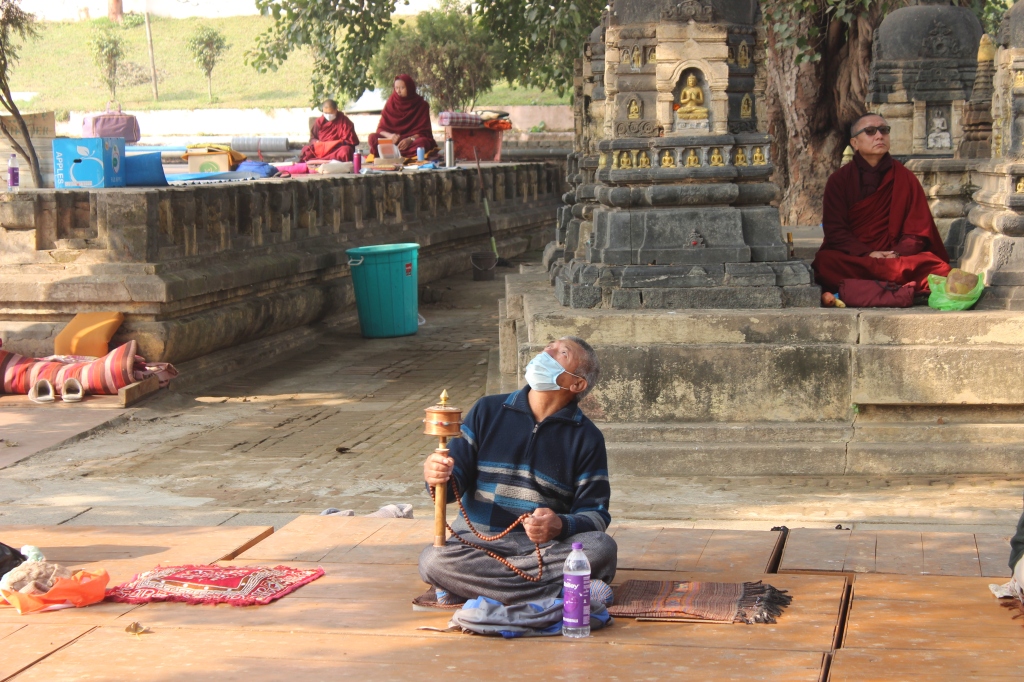
    You don’t have to go anywhere to meditate, except inside. Much is made in the modern New Age movements of all the different kinds of meditation, which, according to the books and blogs can easily number into the dozens, if not hundreds. But most of those sources aren’t really Buddhist, not in any strict sense. Still, a quick survey reveals a plethora: mindfulness, spiritual, focused, movement, mantra, transcendental (TM), progressive, loving-kindness, visualization, guided, mantra, present moment, Vipassana, chakra, yoga, and ‘candle-gazing.’ That’s a lot of bliss, and we’re only getting started. 

    And that’s the problem, of course, that meditation is often marketed as some kind of bliss machine, when nothing could really be further from the truth. With the possible exception of Vipassana, i.e. ‘insight,’ none of the above could really even be considered Buddhist, which seems to originate with ‘anapanasati,’ awareness of breath, before subdividing into ‘samatha,’ calm abiding, and the aforementioned Vipassana, which puts the goal first and foremost, the insight that one expects to get from the practice.  

    Now, I’m not sure where ‘guided meditation’ originated, but that is unheard of in strict Theravada Buddhism, where silence reigns supreme and strict stillness is the foundation for that. Now, I suspect that guided meditation is chiefly a modern Western-promoted permutation, for Westerners who just can’t stand silence, but will happily sit for a story, but I could be wrong, since Tibetan meditation seems very eclectic and certainly could incorporate some spoken word(s).  

    But for me meditation is silent, emptiness incarnate, and guided meditation is a hybrid form which incorporates a ‘dharma talk’ into the practice itself, certainly not a bad thing, BUT: silence is still golden, at least in my book. If you have a problem with silence, then you should really work on that if you really want to delve deep into Buddhism. Because, as I said in the opening statement, “you don’t have to go anywhere to meditate, except inside.” And that’s the trick, to go inside yourself, where thought becomes anti-thought and talk becomes anti-talk. Thus, everything is shown to be the opposite of what it seems, and that is not a bad thing. “Meditate for at least twenty minutes a day, unless you don’t have time, and then meditate for an hour.” That says it all. 

     
  • Unknown's avatar

    hardie karges 3:49 am on July 29, 2023 Permalink | Reply
    Tags: , , , commerce, , , meditation, , planet,   

    Buddhism and the Decline of Planet Earth  

    Buddhism in Bhutan

    I don’t think that Buddhism is superior to Christianity. But I think that it is the right idea in the right time and in the right place: Here and Now. Because they’re both dealing with situations in progress and in process that are constantly changing and needing updates, but which are both necessary and good and fulfilling a function and that must be fulfilled. It’s the timing that is most crucial. 

    As if the Buddha could almost see that Asia would be an overcrowded and possessive morass of humanity within a couple thousand years and that renunciation might be a really good way of dealing with that—in advance. As if Jesus could almost see that in his neck of the woods violence would take on new meaning as a way of life, unless people could somehow be convinced that that would be unnecessary and highly undesirable, if we could all somehow see that we are brothers and sisters capable of our own strong bonds of love and connection. 

    It’s all aspirational, of course, but if that’s the best we can do, then so be it. So, if the Buddha’s best-laid plans failed to produce a meditative non-possessive Asia, and Christianity could only sublimate the urge for violence into the urge for commerce, then so be it. At least East and West could agree on the commerce. But now the needs are different, since we are largely the victims of our own success and are on the verge of destroying our home planet Earth, rather than finding the proper ways of living with it and in it. And that is the precipice upon which we stand, overlooking the abyss of our own making, with vastly reduced options for a successful outcome.  

    If we could have only somehow frozen world population and consumption at 1954 levels, the year of my birth, then the outcome might have been easy. But income levels were not equal and many people were still in a state of colonial servitude. I see Buddhism as the best chance for a successful outcome, given 2023 circumstances, renunciation and dispassion and all that goes with Buddhism. If nothing else, it can be a way of dealing with a situation that nobody can effectively change. But we must try. Buddhism can at least help deal with that sinking feeling that comes with reduced expectations. That is one of its specialties. Believe me.

     
  • Unknown's avatar

    hardie karges 4:58 am on July 22, 2023 Permalink | Reply
    Tags: , , , , meditation, , , upekkha   

    Upekkha and the Buddhist need for Equanimity 

    Buddhism is all about dispassion, not passivity. They’re not the same thing. Dispassion is to handle things with calmness and little emotion, arguably the best way to deal with pressing events, and certainly the best if you’re Buddhist. The Buddhist term usually reserved for such moments is UPEKKHA, often translated ‘equanimity,’ that itself was maybe best translated originally as ‘balance.’ Meanings go through many iterations in their process of becoming ‘Buddhist.’  

    Thus, many words have different meanings in normal speech and Buddhist speech. Some of the best known of these are: ‘mindfulness,’ samsara,’ ‘nirvana,’ and ‘aryan’. But, they’re all good, just specialized meanings, of course. ‘Passivity’ is not good, though, not in my opinion, and that is the curse of Buddhism, that people not only use it to escape the ordinary world, but that they teach that as doctrine and faith, to which no further questions need be asked. Do nothing: that is good. But I don’t buy it.

    I’ll have to admit that it’s much more acceptable than it used to be, though, given the mess we’ve made of this planet, but still, I think it’s too early to pull the plug on all hope of making this world a better place. And that’s my mandate, to make myself a better person, and THEN make this world a better place to live. I think that a reasonable interpretation of the Eightfold Path. It’s also the main distinction between the early Theravada form of Buddhism and the later Mahayana. Let’s not give up on this world while there’s still so much hope and promise, though obviously a few bumps in the road. Ouch!

     
  • Unknown's avatar

    hardie karges 5:15 am on July 16, 2023 Permalink | Reply
    Tags: , , , , , meditation, , Right Aspiration, , , , ,   

    Buddhist Right Speech 

    Right speech (samma vaca) is easy, because you really don’t have to say anything. That’s the point. But if you do say something, then, say something nice. Most of Buddhism is that way. You don’t have to promote anything. you don’t have to do anything. But if you do something, then do something good. Say something good. Be something good. Because you don’t know until you try it. 

    I’m referring to the Buddhist Eightfold Path, of course, that final Nobel Truth after the previous three others which showed the suffering of the world, its main cause—craving, and its main treatment—release from craving. The rest are the Eightfold Path, something like the Eight Commandments, in which the sage advices are a bit sager, like Right View, Right Aspiration, Right Action (karma), Right Livelihood, Right Effort, Right Mindfulness, and Right Concentration (meditation).  

    Buddhism is not a controlling religion. If it were, then it would want to control the moments of the day, minute, and hour: prayer at such-and-such a time, meals at such-a-time, etc., as if these were the important thing of religion. But when a Buddhist says that he wants control, then he wants self-control, a measure of forbearance against predatory life and logic that are certain to happen if our flanks are left unguarded. More importantly, this is a freedom FROM, not a freedom TO, and that means all the difference in the world… 

     
  • Unknown's avatar

    hardie karges 5:22 am on July 8, 2023 Permalink | Reply
    Tags: , , , , , , meditation, , Pure Lands, , , ,   

    The Buddhist Middle Path and Historical Dialectic    

    I advise the aggressive to be meeker, the meek to be braver, the brave to be patient, and the patient to be aggressive, full circle. See what I did there? The Middle Path is not necessarily a straight line to fulfillment, with predictable outcomes and guaranteed repayment options. So, the Middle Path is a circle? Haha, no, not really, or only metaphorically. The Middle Path is a zigzag dialectic, from extreme to extreme, which theoretically should grow less and less extreme as entropy kicks in and the pendulum swings with less vigor now than the initial first few thrusts AND more centrality… 

    I consider the Buddha’s Middle Path to be an early precursor to what took final fruit as Hegelian dialectic, in which a Thesis is challenged by an opposing Antithesis, which then resolves into a higher and finer Synthesis—which then becomes the new thesis, and the process goes on through time. Thus an inert Middle Path becomes a dynamic Middle Path, and the whole process becomes alive. And if you’re chuckling right now and thinking that the Buddha couldn’t possibly have intended all that, then you’re probably right but that doesn’t mean that it’s wrong… 

    And I offer the history of Buddhism itself as proof: if the narrow renunciation and discipline-based practice of the early Theravada practitioners is the original Thesis, then the later florescence of the much larger and broader-based Mahayana school, with their transcendent Buddha and Pure Lands would be the antithesis. But if the higher synthesis would then be the mystical magical Vajrayana school, its antithesis as the new synthesis has yet to claim that title, so that may be premature. It IS a very popular school, though, even for ex-Christian Westerners, so time will tell. Things take time.

     
  • Unknown's avatar

    hardie karges 5:53 am on July 1, 2023 Permalink | Reply
    Tags: , , , , , meditation, , ,   

    Buddhist Suffering and the Need for Change  

    Language is tricky. Buddha implied that suffering should be expected, and accepted, while in the process of cessation, but that doesn’t mean to embrace it. Good Buddhists don’t embrace anything, and that’s good, because you just might be wrong, and, anyway, to embrace something is to crave it, which is the predominant cause of that same suffering that we are most trying to avoid. There are other causes of suffering, also, according to the Buddha, but the implications are not always clear. Because one of the causes is change itself, which by most modern reckoning can be a positive way of easing suffering, and certainly not a cause of it. 

    So, I’d have to deviate from the Buddha’s teaching there, if only for a minor correction, and if only for a minute. But it does illustrate a major difference between early Theravada Buddhism and later Mahayana (Big Rig, haha) Buddhism. That Large Vehicle of Buddhism was, and is, intended to open Buddhism up for the benefit of the diverse masses, and not just a few select disciples who spend much of their days—and their lives—immersed in chanting the sutras and meditating upon self processes to refute self realities. Got that? It’s complicated. 

    But the upshot is that Early Buddhism is oriented toward self-renunciation, by way of self-enlightenment, and mental training, while Mahayana Buddhism is all about the Bodhisattva vow to forego self-enlightenment until we can all be enlightened, a noble goal indeed. And the two are not mutually exclusive. I see it as a process of: First I save myself, then I save the world. That’s a lofty goal, to be sure, but not entirely impossible, and probably preferable to the Indian stages of life in which I satisfy my life goals, and then I renounce. But when do we save the world? 

    There’s the rub, tough friction in a world of science fiction. Nobody can be bothered with saving the world, at least not until they’ve saved their own precious race. So, the world teeters on the brink of extinction, while everyone counts his money and counts his offspring and that of his brothers. The Universe doesn’t care. That’s just a myth and a cheap talking point. It may be that ignorance is indeed what this world needs more than anything else, if all we can do is make war with the knowledge we’ve gained. The clock is ticking. Every vote counts. 

     
  • Unknown's avatar

    hardie karges 4:09 am on June 24, 2023 Permalink | Reply
    Tags: , , , , , meditation, , , , ,   

    Buddhism, Love, and the Middle Path to Survival  

    Europeans and Americans live to fall in love, and many other countries and languages aren’t much better. Live to fall, wow! In the Thai language the equivalent expression would be to get ‘lost in love,’ not much different. But Buddhist metta is better than that, all the best parts of love and none of the bad, friendship mostly. You can be kind and still be balanced. But this is a hard lesson to teach, because we’re hooked on passion like junkies on the hard stuff, and there’s not too much that we can do about it, even if we wanted to. Or can we? Of course, we can. And it’s no accident that the original meaning of the word ‘passion’ is ‘suffering,’ just like that for which Buddhism is so famous. 

    It’s just that at some point we started to like all that excess emotion, just like we began to ‘love our lives,’ while Eastern ascetics continued to renounce the pleasures of flesh and fish, just as they continue to do to this very day. I suppose that the Western attitude is that if we try hard enough, we just might create that eternal life that Jesus promised us all along. Does Virtual Reality count? It might have to, if we’re serious about that as our goal…or, maybe we could just train our minds and tame our desires to a more acceptable level that allows for plenty of free time and a healthy dose of creativity, also. 

    Bingo, the Middle Path is always the solution, not passivity nor stress tests, just good honest old-fashioned hard work, complete with rationality, such that extremes of thought and opinion are rejected in favor of more conciliatory positions. In other words, you might gain less than the wildest stock option, but in return, you are also likely to lose less if your risks fall short of the mark. But that’s more than a conservative business portfolio decision. That’s a principle of life: make steady gains going forward, with always the option to change direction with any new information that accompanies the passage of time. That’s the Buddhist Middle Path. We’re playing for keeps here. 

     
  • Unknown's avatar

    hardie karges 3:53 am on June 17, 2023 Permalink | Reply
    Tags: Al Capone, Better Call Saul, , , Mao Zedong, meditation, , , ,   

    Don’t Mistake Buddhism’s Kindness for Weakness  

    Don’t mistake kindness for weakness. Because kindness comes from a place of strength, and weakness is a point of no return. And if that first statement is first attested from Al Capone, and first noticed by me on ‘Better Call Saul,’ well, that does nothing to diminish its importance. Because truth is truth and meanings are important. And kindness is arguably the trademark of Buddhism, in which aggression is foregone in favor of forbearance, and there are those who would love to take advantage of that situation. But that is one of the conundrums of civilization, is it not?  

    Not only that the things we love most are at the mercy of the things we love least, but that somehow the good guys must rise to the top and maintain love, peace and happiness—at the barrel of a gun. So, the obvious solution is that the peace lovers and freedom fighters must rule by smarts and not bullets. Is that possible? Or is there another way? There probably is, but must that be by means of a society so tightly controlled that there is little or no freedom of movement in the process? Xi Jinping cracks a smile, while Mao Zedong takes it all in style. 

    Wouldn’t it be nice if people simply had no desire to harm others, rather than having the means to do so expressly forbidden to them by law? It sounds like a paradise, but it’s not impossible. It involves more than simply keeping people’s bellies full, though. People need some sort of psychological satisfaction, also. That’s where religion and philosophy come in, where patriotism leaves off and before egotism takes over. Somehow people need to feel that everything is right with the world, beyond their nutritional and social requirements, and monetary requirements, too. But how is that best accomplished? That’s why we’re here. The Middle Path never quits, but it does take some time. Persevere. 

     
  • Unknown's avatar

    hardie karges 3:11 am on June 9, 2023 Permalink | Reply
    Tags: , , , , , , , , meditation,   

    The Difference Between Buddhism and Hinduism  

    The difference between Hinduism and Buddhism might best be seen in the Buddhist monk’s hairstyle: Emptiness! Haha. And while that may seem like the ultimate in silliness, there’s more than a little bit of truth there. But first, let me clarify that Buddhist monks are typically, i.e. almost always, shaved bald, ditto for nuns, while Hindu pandits, acharyas, and especially rishis, are known for their wild locks and their elaborate rituals, yagyas. Buddhists typically chant, the same words that their predecessors chanted, some 2500 years ago.  

    That’s how the sutras were composed and recorded, long before the advent of written text in the Indian subcontinent. And Emptiness, shunyata, was always at the heart of the doctrine, even if its full articulation followed the previous anatta ‘no self’ doctrine, which was one of the early prime tenets of Buddhism, and which was in direct opposition to the Hindu belief in Atman, something of a cosmic self, which transmigrates eternally, on a good day, unless it is lucky enough to obtain release from this pit of samsara. Note that to this day, eastern religions want to escape the world, while western religions typically want eternal life in this world. 

    But the difference between Hinduism and Buddhism is in the details. While Hinduism is about celebration and ecstasy, Buddhism is typically about austerity and discipline. And, at the risk of losing converts to Hinduism, I’d have to agree. To be a full-fledge Hindu, you really have to be born there with a caste affiliation. They’ve tried constantly to subvert Buddhism that way, also, but with varying success. Mostly they succeeded in killing it, in India, at least, while the more nationalistic Hinduism was left to take up its cause with an ascendant Islam. Buddhism is universal. Hinduism is not. Buddhism is the Middle Path between Hinduism and Jainism. But that’s another story.

     
    • Balance Thy Life's avatar

      Balance Thy Life 3:14 am on June 9, 2023 Permalink | Reply

      Interesting article highlighting the differences between Hinduism and Buddhism. The comparison between the hair of Buddhist monks and Hindu pandits was amusing yet insightful.
      founder of balance thy life https://balancethylife.com

  • Unknown's avatar

    hardie karges 4:44 am on May 20, 2023 Permalink | Reply
    Tags: , Buddhist poisons, , meditation, , ,   

    Fear, Poisons, and Spiritual Bypassing in Buddhism  

    Fear should not be mistaken for hatred or anger. Fear is easily cured by friendship, metta. Fear, as bad as it is, at the least, is not a sin of aggression, and so is much more easily cured, as long as it is caught in time, before it morphs into fear and/or anger, and thousands of kindergarteners lying dying in pools of blood on sacred school grounds. The only Buddhist form of love is really metta, friendship, Platonic love, without craving nor attachment, always forgiving and conciliatory.  

    So, there is a reason why fear is not one of the prime Buddhist ‘poisons’ in the same way as greed, hatred, and delusion. And that is because it is essentially harmful only to the actor who is victim to the farce, and so, not any crime of aggression is actually committed. The others all hurt somebody—someone else—where fear does not, not necessarily, if dealt with in time. If this is a sin, then it is a sin of the heart, of feeling, of emotions, which are largely kept hidden and therefore not subject to further scrutiny. 

    This might be an example of ‘spiritual bypassing,’ though, a trendy claim favored by psychologists when dealing with personal problems by plaintiffs who favor silence over the confrontation, with emotions, that many psychologists prefer. So, that’s why I hold back my full blessings, though they may certainly have a point. But the counterpoint is that that same accusation could be leveled at meditation, also, which is arguably Buddhism’s greatest contribution to world culture and history. As always, the true path lies in the middle… 

     
c
Compose new post
j
Next post/Next comment
k
Previous post/Previous comment
r
Reply
e
Edit
o
Show/Hide comments
t
Go to top
l
Go to login
h
Show/Hide help
shift + esc
Cancel