Tagged: Mahayana Toggle Comment Threads | Keyboard Shortcuts

  • Unknown's avatar

    hardie karges 2:27 am on November 9, 2025 Permalink | Reply
    Tags: Brahminism, , , , , , , , , Mahayana, , predetermination,   

    Buddhism and the Conundrum of Change 

    Change is not a cause of suffering if things are getting better all the time. That’s the Buddha’s only conceptual mistake, and that’s what makes him so real. The Mahayanists tried to make him perfect, as some transcental manifestation should be, but the historical Buddha was first and foremost a real person with real-world problems, which he tried to renounce, of course. Some modern women take offense to the fact that he left his wife and child behind, but that must be seen within the context. They were well cared for.

    But his conceptual blunder, just like Einstein’s ‘cosmological constant’, Jesus’s birds with nests but no barns, and Plato’s perfect dictatorship, show his intrinsic humanity. Everything is subject to revision, and everything is subject to change, even concepts. That is a conceptual necessity, since it can never be proven one way of the other, anyway. But if life is predetermined, then there is no reason to act, either good or bad, and karma loses meaning. Change may appear to be a cause of suffering, if your high status is diminished, but that probably says more about superficial status than change itself.

    Christianity thrives on the optimism that change hopefully brings, of course, and the Buddha was certainly right to call BS on that, of course, even if Christianity as such didn’t exist at the time. Bhahmanism did, though, and there are very real similarities. Eternal life is a plaything of children, and we have better things to do, reincarnation ditto. This life and this world require nothing but kindness and compassion.

     
  • Unknown's avatar

    hardie karges 5:53 am on October 26, 2025 Permalink | Reply
    Tags: , arhat, , , , , , Mahayana, , ,   

    Buddhism In an Imperfect World. The world outside… 

    The world outside may be cruel and cold, but the world inside can be perfect. This is implicit in the Buddhist teachings, Theravada especially, before the Mahayana emphasis on the Bohisattva’s sacrifice of enlightenment until all sentient beings can join in the awakening. And, if that seems selfish of the Theravadins, then it’s not, not really. It’s simply a recognition that the challenges are many and the awakenings are few, in an imperfect world, with few Bodhisattvas available, so maybe being a satisfied arhat might be better.

    Because, even if the world were infinite, with no need for competition, there would still be the challenges of hate, anger and greed. Those are the kileshas that haunt all of us, rich or poor, no matter our status or our position in life. And competition is a function of greed, no matter that there might be an infinite abundance, somehow somewhere. No alpha male is worried about getting his share of the offerings. He wants them all, or at least a controlling interest, no matter that there is plenty to go around.

    That is the difference between us and the animal kingdom, the ability to reason and ration any scarcity of resources fairly amongst all interested parties. That is why the alpha male is an anachronism in the world of humans, strutting his stuff as if he were king of the jungle. For the human race to advance, we must leave the jungle behind, and any notion of a warrior ethos that defines us. It doesn’t. It only divides us.

     
  • Unknown's avatar

    hardie karges 2:22 am on October 12, 2025 Permalink | Reply
    Tags: , , Mahayana, , ,   

    Buddhism 302: Save Yourself, then Save the World 

    Fight the war within your heart and so leave the world at peace. That largely summarized the original Buddhist philosophy in a nutshell, with regard to the world at large, at least. Everything is perfect in its imperfection. It is just what it is, so accept it, and make the best of it. In other words: save yourself, then save the world. First Theravada, then Mahayana. It is useless to try to save the world when you yourself have accomplished nothing yet in your own life.

    And, by accomplishment, I don’t mean the acquisition of stocks and bonds, or stocks and grains and the ties that bind families together. I mean the ability to take that or leave that, all in an appropriate context. Some people still diss the Buddha, because he left his wife and son behind, but I think that they prospered well enough in the arftermath, and the alternative would have been far more disastrous. The Buddha never made any money, but no one was more accomplished. You could say the same for Jesus or Plato, I think.

    Opinions fall flat in the face of reality. It is useless to crave certainty. The only certainty in life is death. Gather flowers along the path. Don’t be in such a hurry. Life is in no rush. The waiting is the best part. Once you grasp something, you will only want more. These are among the many messages that the Buddha left us with, and they all work well, about the need for giving and not craving, the acceptance of change and the inevitability of death. Don’t just stand there. Do something good. More importantly: don’t do anything bad.

     
  • Unknown's avatar

    hardie karges 2:47 am on August 10, 2025 Permalink | Reply
    Tags: , , , , , Mahayana, ,   

    Buddhism to Order: Save Yourself, then Save the World… 

    Extinguish the fires inside, then extinguish the fires outside. Or, as I sometimes like to say it: save yourself, then save the world. And this is the basic difference between Theravada and Mahayana Buddhism, and much the very reason why Mahayanist (Large Vehicle) Buddhists like to call Theravadins ‘Hinayanists’ (Small Vehicle) Buddhists, as if there were something ‘lesser’ about training your mind rather than wasting much time and energy trying to train the world top act better.

    But I don’t see it that way. I just see it as dealing with first things first. If you are truly capable of training yourself to a high state of Buddhahood, then you have nothing to lose by turning your attentions to the problems of the world as a Bodhisattva for hire—cheap, haha. But most people will never reach that level of Enlightenment. And anyone who claims that they have attained that level is probably mistaken—by definition. A truly enlightened person, or Bodhisattva, would never make such claims, for fear of diminishing the others with their own paths.

    That doesn’t mean that you should surrender all politics to the shenanigans of autocrats and scammers. Just don’t pretend that that’s the final destination for all mankind. The path never ends. Even when politics are at their smoothest and best, there are still probably thousands of sleights and injustices to rectify and make whole. To fight for what’s right is the hardest thing in the world, since fighting itself is so wrong. But when our survival is at stake, then that is what we must do sometimes.

     
  • Unknown's avatar

    hardie karges 2:32 am on June 15, 2025 Permalink | Reply
    Tags: Bing Crosby, Buddha's Brain, , dopamine, , , limbic system, Mahayana, , neurons, pre-frontal cortex, Richard Mendius, Rick Hanson, ,   

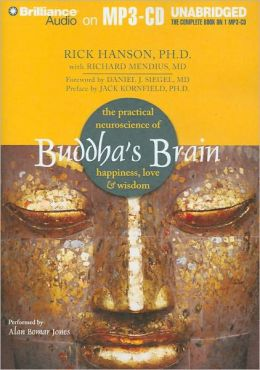
    BOOK REVIEW: “Buddha’s Brain”: by Rick Hanson and Richard Mendius 

    This book has been out there a while, about twenty years, but not only did I just now discover it, but I suspect that many people who’d like to ingest this kind of knowledge and information are more interested than inspired, because it’s not easy knowledge to ingest, without resorting to woo-woo and juju, which ultimately does not hold up to peer-reviewed scrutiny. Because this is the point where spirituality meets science, and the path is not for the weak hearted. The basic idea is that your mind, and by extension your brain, or vice-versa, in effect control the keys to your happiness, and that is the path of your salvation. To accomplish this Hanson the neuroscientist PhD and Mendius the MD mix and match metaphors and math to navigate this path for you. But where to begin?

    They begin with what could be considered the mantra for this entire book, a quote so powerful that I used it as a standalone quote on my Facebook page: “Neurons that fire together, wire together,” meaning in short, that you can create a neural network that facilitates your happiness with the same ease and simplicity that you can go to a doctor, or a university, or a friend’s house for after-dinner drinks that might lead to the love of your life, and that sort of happiness. But wouldn’t any of those go better and easier with the kind of mental attitude and predisposition that almost guarantees success? You can create that. And, if that goes against the belief in ‘Thoughts without Thinkers,” well, so be it. That was never meant to be a call to inaction, but more like a generality, or a palliative, or a reminder to ‘not think too much.’

    But, there must be a place in our lives for ‘right thoughts’ and ‘right actions’ and this is a good place to begin, i.e. mind training. Unfortunately, our brains and therefore minds have a negativity bias for survival, so this must be at least partially overcome, since it quickly leads to the suffering of separateness and a world of simulation which is very different from the present moment that largely defines sati, mindfulness. Because the second dart is often worse than the first dart, as explained here, i.e. our reactions are worse than the actions which have caused the negative effects that we are trying to mitigate. It’s a vicious circle, the dog chasing its tail when the tail is not the problem; the chasing is the problem. It is here that meditation can come to the rescue to reboot the action-reaction sequence with a solid dose of silence as salve and salvation.

    If happiness is the goal, then we need to ‘accent the positive,’ or ‘Ac-Cent-Tchu-Ate the Positive’, if you prefer, all thanks to Bing and the Andrews Sisters and Johnny Mercer, while avoiding any and all clichés and giving a break to Mr. In Between, haha. Because  as Buddhists we can seriously identify with that, all extremities duly avoided by Buddhist writ long unwritten. But meditation can only create a level playing field, per its role as the zero shunya of shunyata which is so important to the advanced transcendental Buddhism of Mahayana. Once the fires are calmed, then the neuroaxis can begin to do its thing, with the brain stem, limbic system, and pre-frontal cortex, etc. Sounds complicated, but guess what? It doesn’t have to be. It can be as simple as not responding to that first dart, adding your second dart to the karmic mix which, once established, becomes increasingly hard to shake.

    And, if non-response sounds like ‘spiritual bypassing’, then, once again, so be it. That’s the whine of psychiatrists who fear a loss of revenue. Buddhism is a religion of at least partial renunciation. Because there are (at least) two wolves in every heart: Love and hate. Love and hate create us and them. The only cure is empathy, easier said than done, true, but not too hard. Just add kindness, and compassion. The compassion is to cure suffering, and the kindness is to bring happiness. Kindness is pre-frontal. Enlarge your circle. Meditate. Make it frontal. Control your attention; basal ganglia seek attention. It’s the power of meditation; sati leads to wisdom. Rapture and joy bring dopamine. Fast gamma waves bring singleness of mind. Relax the Self: don’t take things personally. Self is a convergence of many neural networks. It’s a process, always changing. Any questions? Don’t think too much. Chill. It’s worth the read. I give it a four.

     
  • Unknown's avatar

    hardie karges 4:46 am on January 26, 2025 Permalink | Reply
    Tags: , , , , , , , , Mahayana, , , , , ,   

    Buddhism 202: True Love Can Save the Planet 

    The truest love is metta, friendship, without the burden of possession. That’s a hard sell to a teenager with a bone he’s trying to drive home, but it’s true nevertheless, for long-term or short, which is the proof of its purity. Powerful passions may produce plentiful babies, but without lovingkindness, most of those efforts will be largely lost before the high school graduation exercises, and that’s what’s important. Because we’re no longer the young planet that we once were, raw and untamed and unpopulated.

    Now the danger is over-population and the possibility that we might become victims of our own successes, as Global Warming would seem to suggest. So, a different attitude than constant growth is recommended for long-term survival. This means a more thoughtful and less cavalier attitude to our relationship with others, gentler and kinder, less aggressive and careless. If that overlooks the reality that sometimes Buddhism can be too passive, then so be it. The alternative is worse—uncontrolled aggression.

    That’s the reason that I became a Buddhist, to save myself, then save the world. That’s my motto and mantra that also sums up the transition from early self-centered Theravada Buddhism to later society-centered Mahayana Buddhism, not that such a generality explains much about either of them. But the motto and mantra still work, for me, at least. Be kind, first and foremost, and the world will become a kinder place in return. That’s karma.

     
  • Unknown's avatar

    hardie karges 8:16 am on September 7, 2024 Permalink | Reply
    Tags: , , , , , , , , Mahayana, , , , , , ,   

    Buddhism: It’s a Process… 

    I am not the same person as yesterday, and I will be a different person tomorrow. I am not DNA code. I am skandhas, anatta, annicca, that is: I am a ‘heap’ of causes and conditions, nothing permanent, always changing. So don’t get too attached to yourself or to anyone else, because tomorrow offers no guarantees. Oh, and one more thing: there’s no soul, at least nothing like what the Christians or Hindus have in mind, eternal and/or cosmic, though Buddhism usually allows for at least a limited sort of rebirth.

    After all, we don’t want to get too dreary now, do we? Certainly not. But the principles listed here are foundational to Buddhism. And so, life and the world are at least somewhat illusory, at least in their most obvious manifestations as part of the visual and sensory feast that constitute our world of perceptions. But there is another principle that is even more important to some of us as Buddhists, and that’s the concept of the Middle path, which can be applied to almost anything, including itself, that hypothetical middle path which defines Buddhism by its very lack of definition.

    And such is the history of Buddhism, as it evolves almost dialectically, from thesis to antithesis to synthesis, only to start the process all over again. It is in that view that Buddhism emerged in the first place, as the middle path between the excesses of Hinduism and the extreme renunciation of Jainism. And it is that process which continues today, as Mahayana offers an alternative to the original Theravada, and to which Vajrayana and Zen start the process all over again. Now the original Theravada Buddhism would like to remake itself as Vipassana: meditation, that is, first and foremost. I like that idea.

     
  • Unknown's avatar

    hardie karges 4:18 am on July 13, 2024 Permalink | Reply
    Tags: , , John Donne, Mahayana, , , ,   

    Buddhist Theravada, then Mahayana: Save Yourself, then Save the World  

    The immediate goal is personal peace and contentment. The long-term goal is universal friendship. Or to put it another way: first you save yourself, then you save the world, in some sort of secure Theravada foundation ultimately giving rise to new Mahayana fruits and icing on the cake. Because, ultimately, we all have to live together, in increasingly diverse circumstances, and the way to secure our mutual survival is to work together toward fulfillment. If we limit the cessation of suffering to the boundaries of so-called ‘self’, then we still have a long way to go as a society. 

    ‘No man is an island,’ said the English writer John Donne in 1624, and truer words have ne’er been spoke, especially since the world population has sex- or sep-tupled since that early date, and the count shows few signs of slowing. So, for someone to be content in his own little bubble of bliss is to ignore the larger demands of society and is ultimately passive, if not outright selfish, regardless of whether the Buddha said to be an island unto yourself, or a lamp. That confusion apparently comes from the similarities of the Pali/Sanskrit words dvipa and dipa, respectively, and the inability to prove anything that wasn’t originally written down.  

    But the confusion is almost serendipitous, in that both will work with a Theravadin self-centered island opening up to a broader society-centered light which might shine outward onto others once the mortal temporary self has flipped the switch to the coveted ‘on’ position. Thus, John Donne has nothing on the Buddha for the sublime play of his words nor the intent of his meaning. When you’ve gotten your own act together, then help the world. ASAP. Please. 

     
  • Unknown's avatar

    hardie karges 4:11 am on July 6, 2024 Permalink | Reply
    Tags: , , , , , , Mahayana, , , retribution, , ,   

    Buddhism 499: Revenge is not Sweet…   

    Retribution is not necessary. Equanimity is a path for all situations and all times. This is central to Buddhism, if not foundational. Because the foundations are mostly personal, but it’s implicit that once you’ve attained some level of release from your own suffering that you will contribute to do the same for the world. And while this may be more pronounced in the Mahayana tradition of Bodhisattvas, it also applies to all the rest, in substance, if not style. 

    That’s explicit in the tradition of dana, which Theravada Buddhism relies on for its everyday existence, since monks are forbidden to work, at least not in any official capacity. That’s for ‘householders.’ Monks are homeless, by design, making a mockery of the disdain in which we in the west typically hold them, our India relations elevating the concept to a high plain of spirituality as rishis or even maharishis in the Hindu tradition, or arahant in the Buddhist Theravadin tradition. 

    Even more important is ahimsa, non-violence, which holds true for all the India-based spiritual traditions. And while I’m sure their armies have had their own mistakes and misgivings over the years, at least give them the credit for not glorifying it or reveling in it. Because that’s what revenge and retribution imply, whether stated or not. Retribution is a function of karma, which you’ve brought on yourself, so no violence against others is either implied or intended. Stay cool. Don’t react, unless someone’s life is at stake. And, even then, don’t be proud of it. Be forgiving… 

     
    • jmoran66's avatar

      jmoran66 7:14 pm on July 6, 2024 Permalink | Reply

      That’s the roots of jai yen here in Thailand, I would think.

      • hardie karges's avatar

        hardie karges 12:01 am on July 7, 2024 Permalink | Reply

        Cool heart, yes…

  • Unknown's avatar

    hardie karges 3:41 pm on June 30, 2024 Permalink | Reply
    Tags: , , , , , Mahayana, , , , , , , , , ,   

    Buddhist Love is not like Falling in Love, Sorry…     

    No, Buddhist love is nothing like the weeping and wailing and gnashing of teeth that often accompanies Christian ceremonies, whether birth or death or the multicolor gray area in between, mostly sex. Buddhist love, metta, is just a whole lot like friendship, and there’s nothing wrong with that. So, Platonic love, then maybe? I think Plato would be cool with that, maybe too cool. And that’s what falls short for a lot of people, for whom devotion is the primary practice of their religion. 

    It just doesn’t have the feeling of total surrender required for the religious experience in many people’s minds. But that’s Buddhism: cool, baby, cool. The devotional aspects were the last major additions to the three major canons of Buddhism, and long after the original discipline orientation of Theravada and the transcendental orientation of Mahayana. So, it’s no coincidence that the Tibetans got their Vajrayana straight from the source of India, which is primarily devotional to this day, whether of Shiva or Vishnu, no matter the object. Devotion is the important thing for the devotee. 

    But whether the two additional ‘vehicles’ may or may not have added something important to Buddhism, the core practice of discipline and dana (giving) remain unchanged. Upgrade the meditative practice of anapanasati to vipassana, and BOOM! You’ve got a rebirth of the original Buddhism with or without the doctrine of Rebirth to the non-Self (?!). Ouch. Yep, that’s better now, just to avoid questions that have no good answers. Too many cooks ruin the broth. The kindness is more important than the love.  

     
c
Compose new post
j
Next post/Next comment
k
Previous post/Previous comment
r
Reply
e
Edit
o
Show/Hide comments
t
Go to top
l
Go to login
h
Show/Hide help
shift + esc
Cancel