Tagged: Hardie Karges Toggle Comment Threads | Keyboard Shortcuts

  • Unknown's avatar

    hardie karges 4:46 am on January 26, 2025 Permalink | Reply
    Tags: , , , , Hardie Karges, , , , , , , , , ,   

    Buddhism 202: True Love Can Save the Planet 

    The truest love is metta, friendship, without the burden of possession. That’s a hard sell to a teenager with a bone he’s trying to drive home, but it’s true nevertheless, for long-term or short, which is the proof of its purity. Powerful passions may produce plentiful babies, but without lovingkindness, most of those efforts will be largely lost before the high school graduation exercises, and that’s what’s important. Because we’re no longer the young planet that we once were, raw and untamed and unpopulated.

    Now the danger is over-population and the possibility that we might become victims of our own successes, as Global Warming would seem to suggest. So, a different attitude than constant growth is recommended for long-term survival. This means a more thoughtful and less cavalier attitude to our relationship with others, gentler and kinder, less aggressive and careless. If that overlooks the reality that sometimes Buddhism can be too passive, then so be it. The alternative is worse—uncontrolled aggression.

    That’s the reason that I became a Buddhist, to save myself, then save the world. That’s my motto and mantra that also sums up the transition from early self-centered Theravada Buddhism to later society-centered Mahayana Buddhism, not that such a generality explains much about either of them. But the motto and mantra still work, for me, at least. Be kind, first and foremost, and the world will become a kinder place in return. That’s karma.

     
  • Unknown's avatar

    hardie karges 3:35 am on January 19, 2025 Permalink | Reply
    Tags: , , , , , , Hardie Karges, , , , , ,   

    Buddhist Meditation for Beginners: Silence, Blessed Silence… 

    When you can sit still for one hour without saying a word or moving a muscle, then you are a meditator. And I don’t really even care what ‘kind’ of meditation you do, I only grudgingly allowing that there are different kinds, I from the old ‘anapanasati’ school, long before Theravada was rechristened ‘Vipassana’ and long before Vajrayana became ‘crazy wisdom’ while the Buddha rolled over in his ashes and checked his phone to see what year it is. “Yep,” he supposedly said, “pretty much right on schedule.” Haha.

    I only draw a line between silent meditation, true meditation, and ‘guided meditation,’ which I consider to be something else entirely. And I don’t mean to imply that that’s bad, because it’s not. It’s just more like a ‘dharma talk’ than mediation IMHO. So, there’s certainly nothing wrong with that, since the definition of such is so broad and inclusive that it can be almost anything, so long as it revolves around the Buddha and Buddhism. But meditation is something different, and if you’re not doing it silently, then you’re missing out on something good—and important. And that’s silence.

    Because silence, I think, is the shunya, zero, that qualifies for the important category of ‘emptiness’ so revered in later Buddhism, and I like it. It’s possible that Buddhist monks even invented the numerical zero, but this is not the place for that discussion. But, if ‘American Buddhism is Buddha-flavored Christianity,’ as someone once said (me), then this is the litmus test.

    Because psychological therapy is famously ‘talk therapy’ and this is something so different that those practitioners can, and do, make a case of ‘spiritual bypassing’ while they claim that ‘thoughts have no thinkers’, thus having some cake while eating it, too. Cool, since it’s an open doctrine, subject to interpretation. But don’t miss the forest for the trees. Good thoughts are essential to good and proper Buddhism, but silent meditation is, also. It’s not a case of one or the other. Talking can sometimes soothe the overwrought mind, but sometimes silence can do it better. And that largely defines Buddhism.

     
  • Unknown's avatar

    hardie karges 4:09 am on January 12, 2025 Permalink | Reply
    Tags: , artificial-intelligence, Hadron Collider, Hardie Karges, introspection, machine-learning, , , , , ,   

    Buddhism 499: Finding Strength in our Mutual Weaknesses… 

    To know your weaknesses is to know your heart, and from there derives your strength. But it may be a tough sell in this day and age of winners and losers with little in between, still the Buddha’s truth holds true. We are but accidents of fate and creatures of chaos, the ‘good genes’ largely wasted on pretentious and presumptuous pretenders to power, while the rest of us use our mindfulness not as a weapon, but as a tool of deep introspection, probably a better term than ‘self-knowledge’ and the next best thing to hard science, which requires group effort.

    But much can be accomplished with deep introspection, and the best part is that the proof is in the perception, rather than the dictates of science, which will likely always fall short of the requisite proofs which can only be attained at the Hadron Collider. And still, that is not enough, because our brains gnaw at the edges of the known universe like rats with a ball of cheese that is self-expanding. But, at some point we have to take a rest and live our lives and create a society that responds to human needs, not the scientific ones.

    Because we live in a simulation, neural not digital, and this is my great revelation of the modern age, where Buddhism meets science and Virtual Reality is an apt metaphor. So, this life and this world are not an illusion, as often cited, but a simulation, which is a very bit different, without the ring of falseness which haunts the other term. This neural simulation, a twin of the ‘real’ world, is as it should be, but far from the quarks and tachyons which clamor for recognition in the collider. But our neural simulation requires no Collider, but only mindfulness, patient recognition that this is exactly how it should be, no matter how short it may fall from ultimate reality. Don’t think too much…

     
  • Unknown's avatar

    hardie karges 5:03 am on January 5, 2025 Permalink | Reply
    Tags: , , , , Hardie Karges, , , , , Robert Wright, The Matrix, ,   

    Book Review: ‘Why Buddhism is True’ by Robert Wright… 

    Okay, I owe this review to Robert Wright as payback, because, while others at my Buddhist college were ‘oohing’ and ‘aahing’ back in 2017 over the release of his book ‘Why Buddhism is True’, I was extremely skeptical—and quite vocal about it. Why? Well, first, there’s the title: ‘Why Buddhism is True’. It seemed phony to me, as phony as some rock-and-roll band calling themselves ‘Nirvana’. Don’t push my buttons. Then there’s the Matrix glom-on right in the First Chapter. Or was it the Introduction? Are you serious? That’s certain proof of amateur hour for me. Last, but not least, there’s professional jealousy. Wright is first and foremost a journalist. So, what makes him the best person to write this book?

    Because, even back then, I knew that that’s the $64k question that any self-respecting literary agent would ask you before rejecting you, without telling you about the ‘journalist’s exemption’. Now I know, older but wiser (and with an MA in Buddhist Studies plus a recently published novel based on the travels of Buddhist pilgrim Fa Hien, hint hint). But his book is pretty darn good. So, I owe Mr. Wright a heartfelt apology. And that’s not a quick and easy decision, because he’s pressing his luck by reducing Buddhism to meditation, when many, if not most, of the world’s Buddhists, meditate very irregularly—IF EVER!

    But he pretty much left the Matrix references behind (‘Dharma film’, indeed!), and moved right on to other topics, some of which still stretched credulity, but served as some kind of Buddha’s Greatest Hits collection, if nothing else, so that’s probably a plus for the lightly initiated. After all, Buddhism has come a long way from its early Theravada discipline, Mahayana metaphysics of Emptiness, and Vajrayana mysticism. Now there are Vipassana, koans, and ‘crazy wisdom’, instead. Wright even devotes an entire chapter to ‘How Thoughts Think Themselves,’ one of my pet peeves in the modern Buddhist canon. But Wright handles it with journalistic equanimity, making clear that there are ways of justifying that attitude, without necessarily seeing all thoughts as falling into that category.

    But my favorite part of the book is the attention given to the possibilities of a simulated reality for us here in this life in this world, as alluded to in ‘Chapter 11: The Upside of Emptiness’, in which he argues that it is a psychological necessity to project ‘essence’ for long-term survival and human evolution. And while I would prefer to draw parallels between our neural simulations and the digital simulations of Virtual Reality, the bottom line is the same: it’s better than ‘illusion’ and nihilism is prohibited. Nirvana is similarly and summarily dismissed as the overriding raison-d’etre of Buddhism, while mentioning the unmentionable: we’re talkin’ ‘bout death here, y’all.

    Then there’s the title, which I assumed was editorial overreach on the part of Simon & Schuster, in the vein of the previously mentioned ‘Thoughts w/o Thinkers’, ‘Hardcore Zen’, ‘Universe in a Single Atom’, and other such pseudo-Buddho titular nonsense, but no: this is Wright’s chosen title, which he is prepared to defend as indicating its psychological appropriateness, something like samma ditthi, right view; nothing like absolute truth, so that’s cool. Wright is casual too, sometimes even funny, witness the title to Chapter 13: ‘Like Wow, Everything is One (at Most)’, haha. I like that. Bottom line: sometimes a well-traveled journalist is preferable to a star-spangled Rinpoche, especially when that guru is telling you to vote for the orange guy with the big bulge and the bankroll. I like honest brokers. Wright is worth the read. R.I.P. Kurt. The last Matrix movie sucked.
     
  • Unknown's avatar

    hardie karges 5:00 am on December 29, 2024 Permalink | Reply
    Tags: biology, , , Hardie Karges, , , , , ,   

    Applied Buddhism: the Present as Precedent… 

    Let go of the past. Embrace the future. Accept the present as the only thing we can truly know from direct experience. And this I know from experience, having been at the losing end of many debates on the subject, I once a proponent of the losing idea that time, like space, has three dimensions: past, present, and future. But now I can see clearly that those are really only one, or maybe three-in-one, if you prefer, the only remaining question being whether space is truly three dimensions, or whether it, too, is really only one, or maybe two, if we see the world as composed of drops rather than crystals, circles rather than cubes.

    So, how can you embrace the future, then, if it’s really only a simulated version of the present? I think of it as Emptiness, or shunyata, which is literally the zero in intermittent mathematical placement notation or potentially the final zero(s) which are capable of multiplication to infinity, and which are arguably a necessity for human existence, that clear blue sky which not only implies oxygen, but life, as much or more than the green of its fruit or the red of its roots, that ultraviolet of infinity as important and ubiquitous as the infrared of black-hole gravity. That’s the past; lose it.

    So, we see everything through the eyes of the here, and the now, which color everything in tones which they are comfortable with, and knowledgeable of, in some vast neural simulation which only vaguely resembles the particle/waves of consciousness and biology which lie at the root of all existence. This is not illusion, though, so much as it is a neural twin of ultimate reality, like VR’s digital twins, so that we can live, and move, and have our being with a minimum of obstacles to movement and awareness, and so happiness, which is all we are really capable of, even on the best of days.

     
  • Unknown's avatar

    hardie karges 4:48 am on December 22, 2024 Permalink | Reply
    Tags: , , , Hardie Karges, ,   

    Buddhism and the Middle Path of Least Resistance… 

    The Middle Path can be tricky, it seems, to avoid being sucked into the seductions of the sideline. Streams flow smoothest at the center. But the edges are where the fun occurs, apparently, giving rise to the word ‘edgy’ and the pleasures therein, pushing envelopes and sealing deals, and leaving nothing to the imagination but fantasy. Why do we love hot coffee or iced coffee but detest the tepid middle temps? We love extremes, even at the risk of self-harm. So, in a very important way, the Middle Path is not something tricky and difficult and a test to one’s patience, at all, but is really the easiest and most convenient path.

    We often make life hard in our quest for abundance and diversions, stacking up stuff in piles all the while with no real plan to utilize them, much less to ever dispose of them. But this is often unnecessary. I know it’s almost cliché by now, but how much do you really need? We often assume ‘the more the better’, but that puts all other clichés to shame, and nothing indeed could be further from the truth. For this I speak from personal experience, while passing no judgment against the predominant capitalist economies of the West and their wannabes.

    But it can be a trap and largely defines the Buddhist concept of ‘craving’, which is generally to be avoided. But that’s not just stuff in the closet but stock in trade. The first thought I had when starting to do business, was my exit plan. And, not surprisingly, that’s the part that I did best, defining the timeline as a function of the overall business plan, and therefore leaving with few regrets, and even less stock in trade, while being largely successful, for what I wanted to accomplish. The Buddhist Middle Path is not so different, really. To say that it is the path of least resistance would not say nearly enough, but neither would it be totally wrong. To go with the flow can be good sometimes.

     
  • Unknown's avatar

    hardie karges 7:37 am on December 15, 2024 Permalink | Reply
    Tags: , Buddhist precepts, , Hardie Karges, , , , , , ,   

    Buddhism in the Balance: Giving is primary… 

    We own nothing but the experiences of a few hours days weeks months and years upon this planet. We can spend them in mindless consumption or quiet contemplation. The choice is yours. Because, bottom line: you don’t have to do anything, but keep your body alive. But, beyond maintaining the body in an active state, there is no specific call to action. In fact, it’s much more important what you don’t do than what you actually get around to doing in your precious time in this life on this earth.

    Don’t lie, don’t cheat, don’t kill, don’t steal; these are the commandments of Christianity and the precepts of Buddhism, as well, which seems obvious, until you imagine what must have come before. It wasn’t always pretty. I think that is what is obvious. Neither set of rules and regs says anything about doing this or doing that, though, until you get into the higher levels of commitment, and for Buddhism, that’s right thoughts, right words, right actions, etc., simple. That’s not rocket science. And the main blessed action is to give.

    Because giving serves two purposes, both of equal value. On the one hand, you are helping others. On the other hand, you are reminding yourself that your needs are few and possessions are often unnecessary. In fact, we often become possessed by our very possessions, which seems counter-intuitive, but accurate. Therefore, possessions are really no better than mindless consumption, short-term satisfaction or longer-term, but the result is often the same: we become addicted to the rush, whether the rush of sensation or the rush of satisfaction, for something which often offers no deep level of satisfaction at all. Quiet contemplation is often better.

     
  • Unknown's avatar

    hardie karges 12:17 am on December 3, 2024 Permalink | Reply
    Tags: , , , , , Hardie Karges, , , literature, , ,   

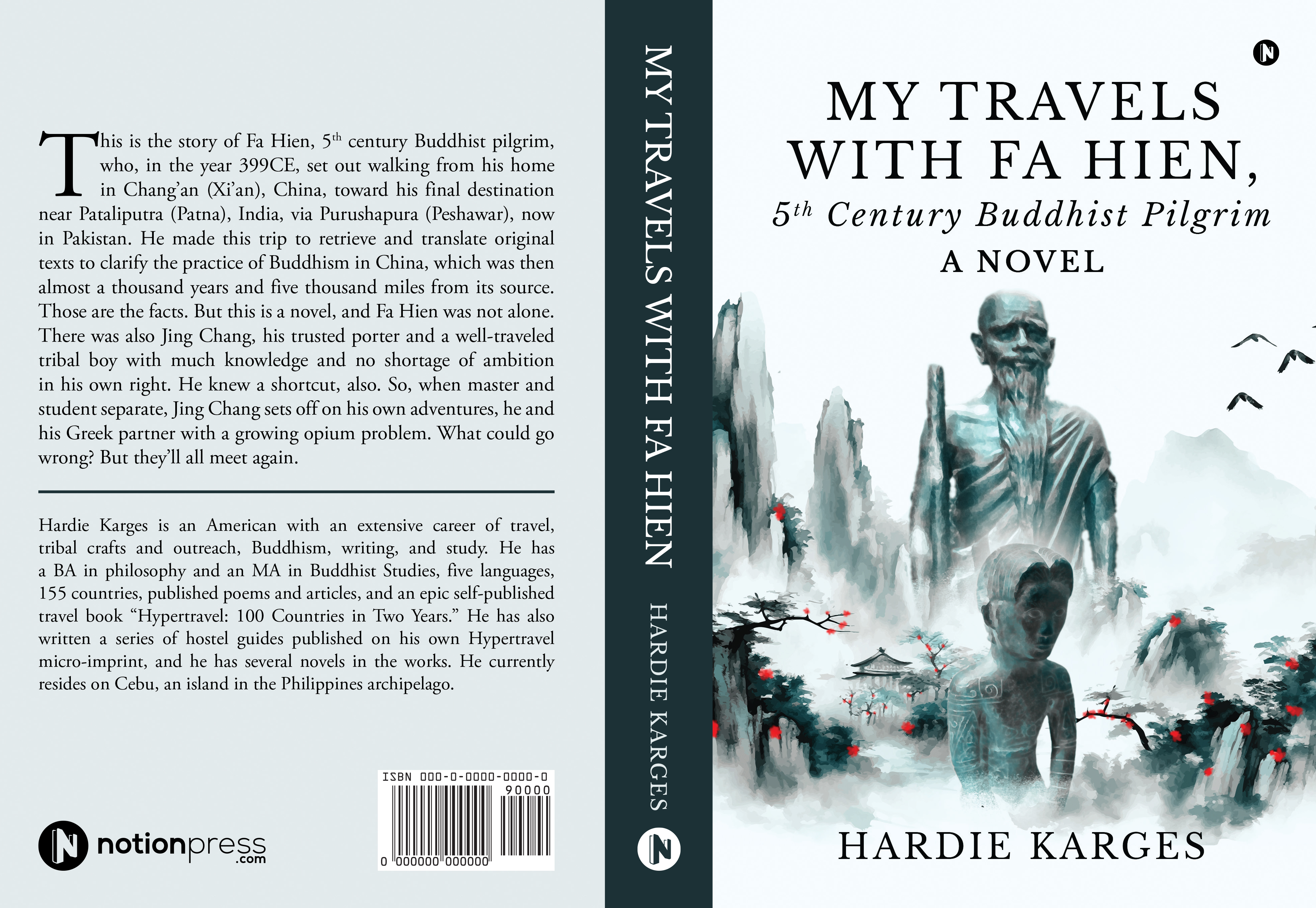
    My Travels with Fa Hien, 5th century Buddhist Pilgrim: Kindle E-book now available 

    Coming soon to an Amazon near you!

    I am happy to announce that the book “My Travels with Fa Hien, 5th Century Buddhist Pilgrim”, is now available in Kindle E-book at Amazon US (others soon) as well as physical copies there and at Notion Press, Flipkart, and bookstores in India. This is the true story of the 5th century Buddhist pilgrim on a 5000 mile trip from central China to eastern India via what is now Pakistan and the mountains and valleys that lie between. In the course of his travels, not only does Fa Hien complete his mission to find the true origins of Buddhism, while translating its sacred texts, but his crew manage to have adventures of their own in the process. This occurs while Rome falls and Europe enters its Dark Age on the other side of the world. It’s a travel book; it’s a dharma book; and it’s a history book, all in one. This is my tribute to Buddhism, Asia, and multiculturalism at its finest. A portion of all sales will go to charities in India. For more information and samples, please join my Fa Hien Facebook group. Enjoy.

    My involvement with this project began with the completion of an MA in Buddhist Studies, at the age of 65, after a long history of travel that covered some 155 countries, during which I studied language and cultures, while buying folk art. Much of that occurred at or after the age of 55 as documented in my own travel epic “Hypertravel: 100 Countries in Two Years,” published in 2012. After that I spent several years compiling travel guides to world hostels, again published on my own micro-imprint. As my interest in Buddhism grew, I attended retreats and spent time in temples and monasteries in Thailand and Myanmar, before finally entering International Buddhist College in south Thailand as an MA candidate in 2017. I completed my MA in 2019, while studying on campus and online, with much travel in Asia.

    Then came the pandemic. After a growing interest in the story of Fa Hien I finally started writing the manuscript in late 2020 in Guatemala and finished the first draft in early 2022 in Lumbini, Nepal, the birthplace of the Buddha himself. After many rewrites and a 2023 sabbatical waiting for further inspiration, I finally finished the book with several new chapters in 2024. Upon careful consideration I decided to publish the book in India, which is the setting for much, if not most, of the book. Unlike the West, also, Fa Hien is known widely there, even if he never gained the hero status that his imitator Xuanzang did in China with the classic epic ‘Journey to the West’. I’d like to change all that and give credit where credit is due, for the sake of Buddhism and travel. A portion of all sales will go to charities in India. For more information and samples, please join my Fa Hien Facebook group. Enjoy.

     
  • Unknown's avatar

    hardie karges 4:40 am on December 1, 2024 Permalink | Reply
    Tags: , , , , Hardie Karges, , , , neuron, , , , ,   

    Buddhism 202: Thoughts and Thinkers 

    Buddhism in Bhutan

    Samma sankappa, one of the Buddhist Four Noble Truths, is Right Thought = Good Thought, not No Thought. For no thought, maybe samma samadhi is better, Right (Good) Meditation. It’s very popular for New Age-y Buddhists to talk about ‘thoughts without thinkers and/or ‘thoughts that think themselves’, as if they were both particle and wave out there floating around looking for a pickup gig, but that implies that thoughts are bad, and the Buddha never said anything like that.

    I think that the confusion comes with the role of language in thought, and its somewhat checkered past. Because no one would dare say anything bad about sati, i.e. consciousness, mindfulness, or awareness. That’s sacrosanct in Buddhism. And it’s a form of thought, also, but without language. Dogs do it; cats do it. All animals do, to a greater or lesser degree. But: like Boolean logic, we invented language, and now that we have it, it’s hard to go back, at least not full time. And there’s no real reason to.

    Because thought can be a good thing, and the linguistic variety is likely the most powerful type, BUT: it can also be destructive, both to society and to the personality, aka ‘self’. On the metaphysical plane, not only is it not ‘non-dual’, with its definitive subjects and objects, but it’s also argumentative and unsettling, arguably war’s greatest weapon. And while I don’t advocate a return to the ‘non-dual’ lives of bonobos and chimps, I do strongly advocate daily meditation. Because, no matter how powerful linguistic thought can be, its non-linguistic cousin meditation can be much more peaceful. That’s samadhi.

    But this can be a contentious subject for debate, because, on the one hand, thoughts DO just pop up sometimes unannounced and often unwanted. And we DON’T always have total recall, much less immediate recall. But that doesn’t mean that we are passive listeners and watchers of thoughts as they pass in and out of our brains or minds, for lack of better words to portray a very abstract subject. Remember the old saying: ‘Practice makes perfect’? Well, neuroscientists have one, also: ‘Neurons that fire together, wire together.’ That means that we establish neural pathways that can be considered our own, in that they are distinct from that of others. So, yes, to a certain extent, thoughts have thinkers, and thinkers have thoughts. We’re the living proof.

     
  • Unknown's avatar

    hardie karges 4:40 am on November 24, 2024 Permalink | Reply
    Tags: ashrama, , , Hardie Karges, , , , , , , , sannyasin, , ,   

    Buddhism 399: Homelessness and the Joy of Giving… 

    Give more than you take. That will be more than enough, and the world will be a better place. That is the essence of almost all religions, Buddhism included, regardless of whether you consider Buddhism first and foremost a philosophy, as I tend to think. But philosophies don’t usually include a call to action, whereas religions usually do. Buddhism doesn’t do that, though, not specifically, but it is implicit in the practice, the original practice. That’s why you’ll see orange or yellow-robed shaved-head monks walking through the markets at daybreak in almost every Theravada country in SE Asia, requesting alms for subsistence, usually food. This giving is usually known as dana.

    This harkens back to an even earlier practice in India wherein long-haired rishis and sannyasins wearing similar saffron clothing but usually without a group of like-minds, would make similar rounds, a practice which continues to this day. The difference is not only that the former are Buddhist and the latter Hindu, but the former have rules and regular routes, and are often registered for this activity, whereas the latter are more likely free and on their own, often in the last phases of life according to the four Hindu ashramas of student, householder, forest dweller, and renunciant—nice.

    But the important thing is the giving. So, instead of seeing a renunciant as a societal parasite reduced to begging, we should see them as symbols of purity, offering laypersons the opportunity to experience the same bliss of renunciation that they not only symbolize but incarnate. It’s only ironic that they themselves often consider themselves—and call themselves—homeless, no pun intended. Because that is the little joke they play on all of us, that the poorest people of the West are linguistically identified with the holiest of the East. I only wish that Western practitioners would follow the same precepts. The food is usually pretty good, at least in Thailand.

     
c
Compose new post
j
Next post/Next comment
k
Previous post/Previous comment
r
Reply
e
Edit
o
Show/Hide comments
t
Go to top
l
Go to login
h
Show/Hide help
shift + esc
Cancel