
Tagged: anapanasati Toggle Comment Threads | Keyboard Shortcuts

  • Unknown's avatar

    hardie karges 3:35 am on January 19, 2025 Permalink | Reply
    Tags: , anapanasati, , , , , , , , , , ,   

    Buddhist Meditation for Beginners: Silence, Blessed Silence… 

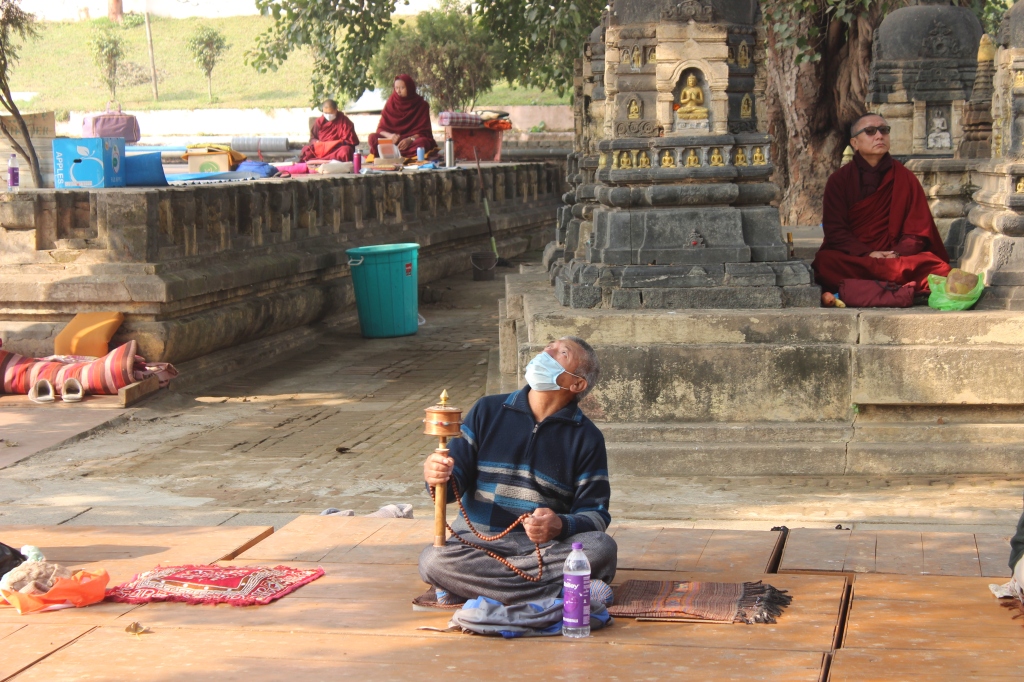
    When you can sit still for one hour without saying a word or moving a muscle, then you are a meditator. And I don’t really even care what ‘kind’ of meditation you do, I only grudgingly allowing that there are different kinds, I from the old ‘anapanasati’ school, long before Theravada was rechristened ‘Vipassana’ and long before Vajrayana became ‘crazy wisdom’ while the Buddha rolled over in his ashes and checked his phone to see what year it is. “Yep,” he supposedly said, “pretty much right on schedule.” Haha.

    I only draw a line between silent meditation, true meditation, and ‘guided meditation,’ which I consider to be something else entirely. And I don’t mean to imply that that’s bad, because it’s not. It’s just more like a ‘dharma talk’ than mediation IMHO. So, there’s certainly nothing wrong with that, since the definition of such is so broad and inclusive that it can be almost anything, so long as it revolves around the Buddha and Buddhism. But meditation is something different, and if you’re not doing it silently, then you’re missing out on something good—and important. And that’s silence.

    Because silence, I think, is the shunya, zero, that qualifies for the important category of ‘emptiness’ so revered in later Buddhism, and I like it. It’s possible that Buddhist monks even invented the numerical zero, but this is not the place for that discussion. But, if ‘American Buddhism is Buddha-flavored Christianity,’ as someone once said (me), then this is the litmus test.

    Because psychological therapy is famously ‘talk therapy’ and this is something so different that those practitioners can, and do, make a case of ‘spiritual bypassing’ while they claim that ‘thoughts have no thinkers’, thus having some cake while eating it, too. Cool, since it’s an open doctrine, subject to interpretation. But don’t miss the forest for the trees. Good thoughts are essential to good and proper Buddhism, but silent meditation is, also. It’s not a case of one or the other. Talking can sometimes soothe the overwrought mind, but sometimes silence can do it better. And that largely defines Buddhism.
     
  • Unknown's avatar

    hardie karges 3:41 pm on June 30, 2024 Permalink | Reply
    Tags: anapanasati, , , , , , , , , , , , , , ,   

    Buddhist Love is not like Falling in Love, Sorry…     

    No, Buddhist love is nothing like the weeping and wailing and gnashing of teeth that often accompanies Christian ceremonies, whether birth or death or the multicolor gray area in between, mostly sex. Buddhist love, metta, is just a whole lot like friendship, and there’s nothing wrong with that. So, Platonic love, then maybe? I think Plato would be cool with that, maybe too cool. And that’s what falls short for a lot of people, for whom devotion is the primary practice of their religion. 

    It just doesn’t have the feeling of total surrender required for the religious experience in many people’s minds. But that’s Buddhism: cool, baby, cool. The devotional aspects were the last major additions to the three major canons of Buddhism, and long after the original discipline orientation of Theravada and the transcendental orientation of Mahayana. So, it’s no coincidence that the Tibetans got their Vajrayana straight from the source of India, which is primarily devotional to this day, whether of Shiva or Vishnu, no matter the object. Devotion is the important thing for the devotee. 

    But whether the two additional ‘vehicles’ may or may not have added something important to Buddhism, the core practice of discipline and dana (giving) remain unchanged. Upgrade the meditative practice of anapanasati to vipassana, and BOOM! You’ve got a rebirth of the original Buddhism with or without the doctrine of Rebirth to the non-Self (?!). Ouch. Yep, that’s better now, just to avoid questions that have no good answers. Too many cooks ruin the broth. The kindness is more important than the love.  

     
  • Unknown's avatar

    hardie karges 6:19 am on March 10, 2024 Permalink | Reply
    Tags: anapanasati, , , , , , , , , , , , , , ,   

    Buddhism at the X-roads: More Dharma, Less Drama 

    To live from sensation to sensation is to live like an animal. To follow dharma is to live like a human. Because, despite the attraction of the so-called ‘present moment,’ which may or may not be real, the Buddha prized reason and rationality above almost all else, easily verified by his insistence on recognition of the causes and conditions underlying all actions and motivations. He may or may not have said something supporting the ‘present moment,’ but I’m not sure what or when that would have been. 

    Bottom line: reason(s) and rationality are to be prized above almost all else in Buddhism, the one possible exception being the need for, and insistence upon, meditation. And, for me, this is where that ’present moment’ comes into play, it being almost the perfect metaphor for that suspension of belief and disbelief which is meditation, all thought suspended in favor of pure awareness, of breath, if nothing else, anapanasati, the original meditation of which all others have subsequently derived.  

    Meditation is so fundamental to Theravada Buddhism that it has recently almost become re-branded as Vipassana, or ‘insight meditation,’ all the other disciplines involved in the practice of Buddhism notwithstanding. And this is likely what the Chinese Buddhist pilgrims Fa Xian (Hien) and Xuanzang found above all else, silent meditation, since almost nothing else was written, and was almost too heavy to carry once they had it transcribed from the original Pali or Sanskrit into Chinese.  

    But how do you transcribe meditation into any language for inclusion in a book which someone may or not read at some point in history? Meditation was largely independent of written vinaya (discipline), and that is what had sustained Buddhism for around 1000 years by that time. And that’s what sustains it today, all the opinions and debate on Facebook and elsewhere notwithstanding. Original Buddhism required only silence, and concentration, no apps or other accessories necessary. 

     
  • Unknown's avatar

    hardie karges 2:53 am on August 6, 2023 Permalink | Reply
    Tags: anapanasati, , , , , , mantra, , , , , , , , ,   

    Space is the Place–to Meditate…  

    The one who can control himself, can control the world—his world…

    You don’t have to go anywhere to meditate, except inside. Much is made in the modern New Age movements of all the different kinds of meditation, which, according to the books and blogs can easily number into the dozens, if not hundreds. But most of those sources aren’t really Buddhist, not in any strict sense. Still, a quick survey reveals a plethora: mindfulness, spiritual, focused, movement, mantra, transcendental (TM), progressive, loving-kindness, visualization, guided, mantra, present moment, Vipassana, chakra, yoga, and ‘candle-gazing.’ That’s a lot of bliss, and we’re only getting started. 

    And that’s the problem, of course, that meditation is often marketed as some kind of bliss machine, when nothing could really be further from the truth. With the possible exception of Vipassana, i.e. ‘insight,’ none of the above could really even be considered Buddhist, which seems to originate with ‘anapanasati,’ awareness of breath, before subdividing into ‘samatha,’ calm abiding, and the aforementioned Vipassana, which puts the goal first and foremost, the insight that one expects to get from the practice.  

    Now, I’m not sure where ‘guided meditation’ originated, but that is unheard of in strict Theravada Buddhism, where silence reigns supreme and strict stillness is the foundation for that. Now, I suspect that guided meditation is chiefly a modern Western-promoted permutation, for Westerners who just can’t stand silence, but will happily sit for a story, but I could be wrong, since Tibetan meditation seems very eclectic and certainly could incorporate some spoken word(s).  

    But for me meditation is silent, emptiness incarnate, and guided meditation is a hybrid form which incorporates a ‘dharma talk’ into the practice itself, certainly not a bad thing, BUT: silence is still golden, at least in my book. If you have a problem with silence, then you should really work on that if you really want to delve deep into Buddhism. Because, as I said in the opening statement, “you don’t have to go anywhere to meditate, except inside.” And that’s the trick, to go inside yourself, where thought becomes anti-thought and talk becomes anti-talk. Thus, everything is shown to be the opposite of what it seems, and that is not a bad thing. “Meditate for at least twenty minutes a day, unless you don’t have time, and then meditate for an hour.” That says it all. 

     
  • Unknown's avatar

    hardie karges 12:34 pm on December 16, 2022 Permalink | Reply
    Tags: anapanasati, , , ,   

    Anapanasati Meditation: Awareness of Breath 

    By focusing on the breath, you will also likely decrease the speed of breathing. But why does that matter? And is that a good thing? But first we need to ask why we focus on the breath in the first place. And the funny thing is: that answer is not easily found. Because on the one hand: we need a something steady to concentrate on, which the breath certainly is. But it is not so fixed and clocklike as we often imagine. So, perhaps this is its unique situation, that it is both voluntary and involuntary. What other bodily function can claim that?

    And the benefits of a bodily function are obvious: it’s there with you all the time. Big Ben is not, unless you live in Westminster. The other obvious bodily function to reference for meditation is the heartbeat, and I do just that sometimes, BUT: it’s much more subtle, AND: it’s totally involuntary, i.e. you can’t ‘hold’ your heartbeat in the same way that you can ‘hold’ your breath. So, maybe that simultaneous voluntary/involuntary nature of breathing is important, after all, simply because it can be manipulated if you want. But I don’t advise it.

    Because, in the sense that anapanasati is the goal here, awareness of breath, that would seem to discourage manipulation. Still, that decrease in the breath rate is a fairly reliable result, and I think that it’s to be encouraged, since calmness is also a secondary, if not the primary goal, of meditation. And that rate of heartbeat will likely decrease, also, though you’re not as likely to notice it. And that’s the main advantage of breath over heartbeat: it’s easily noticed. Still, it’s worth noting the heartbeat, especially if you’re having trouble concentrating.

    And here’s a little tip that I stumbled upon in my pursuit of meditative bliss, only to find out later that it’s often recommended: count your breaths. If that sounds a little too similar to counting sheep in order to sleep, then so be it, whatever works works. Those recommendations usually advise to re-start the count after every ten, but I’m not sure why. I don’t, and it’s probably for the same reason that they do. I want to know how long I’ve been meditating, without recourse to a smartphone or Big Ben. And that’s how you’ll know that your breaths are slowing down: the count never matches the clock. You heard it here first.

     
  • Unknown's avatar

    hardie karges 11:02 am on September 4, 2022 Permalink | Reply
    Tags: , anapanasati, , , , , , , , sarmatha, , ,   

    Buddhism 499: Self-control and the Benefits of Meditation 

    Self-control should not be an affront to your Western freedoms. It should be the foundation of your Eastern practices. But this is a tough pill for many Westerners to swallow, because it invokes the dreaded ‘C’ word, control, mattering not to many that self-control is a totally different activity than controlling others, which for me is a hideous affair, usually. Self-control, on the other hand, is the cause and effect of some of my life’s finest moments, not the least of which are simple meditative moments, the practical foundation of Buddhism.

    And all Asian monks know this, and can attest to it fully, while Westerners resist and desist, and their meditative practices often show it, twitching and flinching while struggling to finish a half-hour of meditation, while I’ve seen even Asian laypeople sit motionless for hours. But was it sarmatha or was it vipassana or was it mindfulness meditation or was it that new style that somebody was doing on TV? And there’s TM, the one that the Beatles made famous, with their Maharishi Mahesh Yogi, and which has gone on to be bliss of choice for Hindu-style practice, complete with secret password.

    But all Buddhist practices derive from some version of anapanasati, awareness of breath, and to there they all return—eventually. And to be aware is very much within the practice of control. Because you don’t really have to do much of anything to meditate properly. But there are some things that you should definitely NOT do, and distractions are at the top of that list. Life itself can be extrapolated from this practice, also, giving meditation a central place and practice in your life. It’s simply a good approach to life, calm and collected, and likely to produce a ripple effect that radiates outward. Don’t you wish everybody would participate?

    So, if you’re looking for something like ayahuasca, then Buddhism is the wrong place to look. Because there is nothing here, really, to get excited about, and just the opposite, in fact. There is much here to get calm about—life, liberty and the pursuit of happiness, but without all the weeping wailing and gnashing of teeth. We Westerners are emotion junkies, though that doesn’t mean that we are ‘evil,’ as certain pro-Putin pushers suggest outright. What the West loves was perfect for a world growing up and reproducing itself. What Buddhism offers is perfect for a world finding itself. The future is at stake.

     
  • Unknown's avatar

    hardie karges 11:58 am on October 25, 2020 Permalink | Reply
    Tags: anapanasati, , Bunuel, , STFU, Thay, , , ,   

    Zen and the Art of Dishwashing… 

    We are not slaves to the objects of our desire as much as we are slaves to desire itself. The objects come and go. And isn’t that just like us? I mean, to desire for the sake of desiring, as much as any object as the supreme goal, or maybe we can call it ‘cet obscur objet du desir,’ if I may borrow the title of the famous film by Luis Bunuel to illustrate my point.

    And as in that film the object is not only unattainable, ultimately, but is constantly changing its face, such that “What follows is a tale of cruelty, depravity and lies — the very building blocks of love.” (Wikipedia) So is this simply our fate, as Westerners, especially, to bite off more than we can chew, simply for the pleasure of the sensation of the food inching its way slowly down our throats, and only gradually entering our stomachs?

    There it triggers the feeling of fullness, if only for a moment, and begs the question as to whether that is really enough, or not, since consciousness comes with no gas gauges, just feelings, often random, of completion or vacuity, in this case, in addition to sensations of tastiness or disgust. So are we left to desire for the sake of desiring, in the same way that one might misinterpret Thich Nhat Hanh’s invocation to “wash dishes to wash the dishes” as “wash dishes for the sake of washing dishes,” which is not correct.

    And I will admit that I misinterpreted that advice for years, as if he were advocating mindlessness as mindfulness. Now I know that he is a master of Zen, but I never knew that he was that Zen! And he’s not, in the sense that Zen sometimes goes too far in its linguistic riddling, in the hope that enlightenment might somehow magically result if we can only prove language to be the trickster that it is, full of bluff and bluster, but ultimately empty. And that may be true, but that does not mean that there are no meanings.

    But Thich Nhat Hanh was not advising mindless dish washing, even though others may also have misinterpreted it that way, no salve to my chastened ego (https://www.researchgate.net/publication/281608722_Washing_Dishes_to_Wash_the_Dishes_Brief_Instruction_in_an_Informal_Mindfulness_Practice). What he was really advising was to make the best of mundane situations, and be aware of just that, AND ONLY THAT (ouch), when in the process of doing it (if you’re feeling bored, you can always increase the speed. Walking meditation can be fast or slow).

    For meditation I personally advise sitting on a cushion, on the floor, lotuses optional, ditto mantras and mudras, eyes closed, body unflinching, for at least twenty minutes, more if you can. This is what I call STFU meditation. It may not be as famous as anapanasati or vipassana, or any of the other myriad of styles and subjects, but it accomplishes much the same thing, and that is to shut off the internal dialogue, at least for a spell (!), and return to pre-linguistic proto- or paleo-consciousness to reboot the program. All systems work better after rebooting (hint: try counting breaths, if you feel it’s otherwise just not working).

    And so it is with desire. As much as Western culture rewards the act of ‘being in love with love,’ ultimately it is not only wasteful, consumptive, and useless, but even destructive, e.g. global warming. But don’t torture yourself. To chase illusions is only human: usually futile, sometimes rewarding, almost inevitable. This is life, a passing show. Stay safe.

     
  • Unknown's avatar

    hardie karges 11:08 am on September 27, 2020 Permalink | Reply
    Tags: , anapanasati, Bhavana, , , jhana, , , , ,   

    Meditation and Mediation, Buddhism on the Half-Shell… 

    The best meditation requires no app. Only silence can solve the problems caused by language. Not that I don’t find ‘guided meditations’ interesting, I just don’t think that they are the best form of meditation.

    Not that there need be many forms of meditation in the first place, but that comes with the turf, the modern commercial turf, that just one more thing under the tree will get us through the next year with flying colors, the colors of Christmas and New Year in joy and celebration of what I am not sure, but it seems that abundance is the common theme, my cup running over and all that jazz, eternal life and all that rap.

    But is the ‘special insight’ of ‘vipassana’ really some sort of qualitative improvement over the ‘awareness of breathing’ in anapanasati? Is there really any difference between the ‘calm abiding’ of ‘samatha’ and the ‘concentration’ of ‘samadhi’?

    Self-described experts go on and on about the ‘four different kinds’ of meditation like bloggers slicing and dicing adverbs and artichokes for the special garnish to Sunday brunch, to be ladled over with the special sauce of ‘mindfulness.’

    Then there is the ‘mental development’ of bhavana holding lengthy sessions, while the ‘trance-like states’ of ‘dhyana’ and ‘jhana’ morph into entire schools of Chinese Chan and Japanese Zen, so that entire cultures can be exported overseas a millennium later, and Alan Watts can make a living without ever having to plant rice, much less harvest it.

    So I suppose that there is a difference between a ‘one-focus’ meditation and a ‘field-focus’ meditation, but I’m really not sure, if the underlying concentration is upon the breath, or if you’ve got a really quiet place, then worth noticing the heartbeat, which our ears normally block out as background noise.

    But there seems to be a more significant distinction between meditation ‘upon’ something and meditation for meditation’s own sake. And this is where guided meditation comes in, because it is certainly a meditation upon something, if it is meditation at all.

    And I’m not sure who started this, because I have practiced the art in formal and semi-formal settings in three SE Asian countries, all of the Theravada school of Buddhism, and I can assure you that there was no bloke holding forth at the time. But I do see this online with monks of the Tibetan school, and saw it myself with a Western ex-monk of the same school in Nepal. So which is better, guided or silent?

    That I can’t say, but when I discussed all this with research neurologists interested in measuring the effects of meditation on the brain, all they wanted to know was, “Were you able to stop the internal dialogue?” To which I giddily responded something like, “Yes.” To which they responded with a dubious, “Do you understand this concept?” “Of course. That’s all I remember of Don Juan’s ‘Tales of Yaqui Power.”

    Guided meditation won’t do that, so you still need silent meditation IMHO. But to be a good Buddhist, more important than the sutras, the precepts, and all the meditations are the simple acts of kindness and compassion, ‘metta karuna’…

     
    • openmind123omega's avatar

      David Cole 4:46 pm on September 27, 2020 Permalink | Reply

      Sādhu… Thanks!

      • hardie karges's avatar

        hardie karges 5:14 pm on September 27, 2020 Permalink | Reply

        Welcome!

c
Compose new post
j
Next post/Next comment
k
Previous post/Previous comment
r
Reply
e
Edit
o
Show/Hide comments
t
Go to top
l
Go to login
h
Show/Hide help
shift + esc
Cancel
