
Tagged: Theravada Toggle Comment Threads | Keyboard Shortcuts

  • Unknown's avatar

    hardie karges 5:22 am on July 8, 2023 Permalink | Reply
    Tags: , , , , , , , , Pure Lands, , Theravada, ,   

    The Buddhist Middle Path and Historical Dialectic    
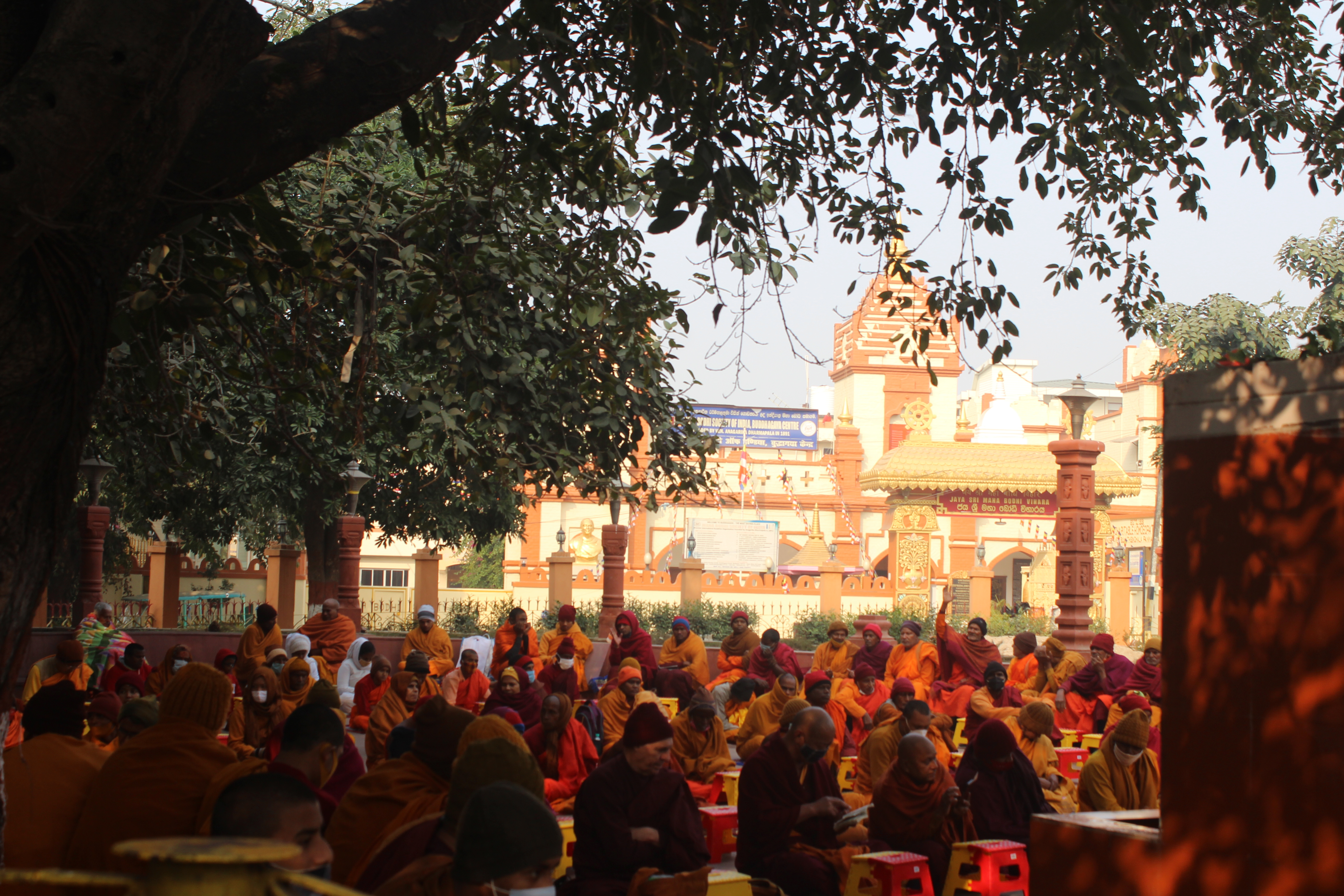
    I advise the aggressive to be meeker, the meek to be braver, the brave to be patient, and the patient to be aggressive, full circle. See what I did there? The Middle Path is not necessarily a straight line to fulfillment, with predictable outcomes and guaranteed repayment options. So, the Middle Path is a circle? Haha, no, not really, or only metaphorically. The Middle Path is a zigzag dialectic, from extreme to extreme, which theoretically should grow less and less extreme as entropy kicks in and the pendulum swings with less vigor now than the initial first few thrusts AND more centrality… 

    I consider the Buddha’s Middle Path to be an early precursor to what took final fruit as Hegelian dialectic, in which a Thesis is challenged by an opposing Antithesis, which then resolves into a higher and finer Synthesis—which then becomes the new thesis, and the process goes on through time. Thus an inert Middle Path becomes a dynamic Middle Path, and the whole process becomes alive. And if you’re chuckling right now and thinking that the Buddha couldn’t possibly have intended all that, then you’re probably right but that doesn’t mean that it’s wrong… 

    And I offer the history of Buddhism itself as proof: if the narrow renunciation and discipline-based practice of the early Theravada practitioners is the original Thesis, then the later florescence of the much larger and broader-based Mahayana school, with their transcendent Buddha and Pure Lands would be the antithesis. But if the higher synthesis would then be the mystical magical Vajrayana school, its antithesis as the new synthesis has yet to claim that title, so that may be premature. It IS a very popular school, though, even for ex-Christian Westerners, so time will tell. Things take time.

     
  • Unknown's avatar

    hardie karges 5:53 am on July 1, 2023 Permalink | Reply
    Tags: , , , , , , , , Theravada   

    Buddhist Suffering and the Need for Change  

    Language is tricky. Buddha implied that suffering should be expected, and accepted, while in the process of cessation, but that doesn’t mean to embrace it. Good Buddhists don’t embrace anything, and that’s good, because you just might be wrong, and, anyway, to embrace something is to crave it, which is the predominant cause of that same suffering that we are most trying to avoid. There are other causes of suffering, also, according to the Buddha, but the implications are not always clear. Because one of the causes is change itself, which by most modern reckoning can be a positive way of easing suffering, and certainly not a cause of it. 

    So, I’d have to deviate from the Buddha’s teaching there, if only for a minor correction, and if only for a minute. But it does illustrate a major difference between early Theravada Buddhism and later Mahayana (Big Rig, haha) Buddhism. That Large Vehicle of Buddhism was, and is, intended to open Buddhism up for the benefit of the diverse masses, and not just a few select disciples who spend much of their days—and their lives—immersed in chanting the sutras and meditating upon self processes to refute self realities. Got that? It’s complicated. 

    But the upshot is that Early Buddhism is oriented toward self-renunciation, by way of self-enlightenment, and mental training, while Mahayana Buddhism is all about the Bodhisattva vow to forego self-enlightenment until we can all be enlightened, a noble goal indeed. And the two are not mutually exclusive. I see it as a process of: First I save myself, then I save the world. That’s a lofty goal, to be sure, but not entirely impossible, and probably preferable to the Indian stages of life in which I satisfy my life goals, and then I renounce. But when do we save the world? 

    There’s the rub, tough friction in a world of science fiction. Nobody can be bothered with saving the world, at least not until they’ve saved their own precious race. So, the world teeters on the brink of extinction, while everyone counts his money and counts his offspring and that of his brothers. The Universe doesn’t care. That’s just a myth and a cheap talking point. It may be that ignorance is indeed what this world needs more than anything else, if all we can do is make war with the knowledge we’ve gained. The clock is ticking. Every vote counts. 

     
  • Unknown's avatar

    hardie karges 2:12 pm on May 13, 2023 Permalink | Reply
    Tags: , , , , , , , , Theravada   

    Vive la Difference! Between Christianity and Buddhism…  

    Christianity seeks joy out there somewhere, while Buddhism seeks to limit suffering right here inside. And that’s the big difference between the two, the outward search versus the inward search, and the destination for ultimate satisfaction. The idea, in fact, that there may really be no substantial difference between the two is something that only arose later, after the rise of Mahayana Buddhism, and the idea that there may be some transcendent reality to it all, even including the Buddha himself, so maybe just a ‘manifestation.’ 

    But I prefer to leave metaphysical speculations to the late nights and wee hours on Sundays and holidays, when time is free and the atmosphere is conducive to dreaming and the playful dance of fairies in our wildest imaginations. Because meditation is probably the greatest gift of Buddhism to the world, and that requires absolutely no belief in anything transcendent, only the effort to concentrate and ‘let it go’ in accord with Buddhist understanding, which is simple to understand and totally based in the here and the now. 

    And Theravada sacrifices nothing to the larger and later Mahayana school on this count, either, not to mention the modern-day secular practitioners, both Buddhist and non-Buddhist, that make Buddhism and its foundational principles such an important tool in the stressed-out modern-day world. Whither Christian mindfulness? Yes, I’ve heard that term, so it’s in the works. The pharmaceutical industry might not like the idea, nor the CBD gummies futures market, but the physical and psychological gain will be palpable.  

    Some things just work better ‘in here’ than ‘out there.’ And if that means that Buddhism is guilty of passivity towards changing the world ‘out there’ to make it a better place, then that criticism is valid. But so is the criticism that Amerika is a contentious hateful society that rejects any efforts at compromise and instead prefers to fight to the death, rather than enjoy life to the fullest, albeit with a few guiding principles to be followed. As always, the middle path lies somewhere in between, details to be worked out in peaceful settings among willing participants. Enjoy.  

     
  • Unknown's avatar

    hardie karges 8:22 am on April 9, 2023 Permalink | Reply
    Tags: Buddha Mind, , , , , , , , Theravada   

    Buddha Mind and the Incremental Steps to Enlightenment  

    Buddha mind is best all the time. But a little bit is better than nothing. That should go without saying. Because this speaks to the nature of thought and the nature of consciousness, but mostly to the nature of awareness itself, sati, which is essential to the development of samadhi, a more meditative state which is probably the best one-word definition of ‘Buddha mind.’  

    But the problem is the problem of any definition, or lack thereof, in which words compete with themselves for attention, and clarity is often lacking. After all: what is ‘mind,’ anyway? But I think that we can assume that whatever ‘mind’ is, then ‘Buddha-mind,’ must be the cooler (literally) and more meditative version of that, full of kindness and compassion, and with a heavy dose of intuitive wisdom, the kind less analytic, and much less critical.  

    But my point is that this is not a yes-or-no binary choice. This is a choice of many incremental intermittent steps, and none is too insignificant along the pathway to enlightenment, whatever that is. Because this is a Mahayana concept, so a full step toward a transcendental Buddha, world-inhabiting and mind-manifesting; and a step away from the more (non) self-centered and discipline-oriented early Buddhism of Theravada, aka Hinayana. Don’t worry about enlightenment. I’m sure that we’ll all recognize it when we see it. The point is to make the world a better place. ASAP. 

     
  • Unknown's avatar

    hardie karges 12:00 pm on December 2, 2022 Permalink | Reply
    Tags: , , , , , , , non-violence, , , Theravada   

    Buddhism 499: Pacifism is not passivism… 

    This is one of the hardest lessons of Buddhism, balancing the dual extremes of not only luxury and lack, the Middle Path of Theravada Buddhism, but action and inaction, and ultimately existence and non-existence, the Middle Path of Mahayana. Given the truth that the source of much of our discontent is not to be found in the ‘outside’ world, but right in our own minds, the obvious temptation is to ignore that ‘outer’ world and simply adopt a passive approach towards it.

    But I don’t think that’s what the Buddha meant to imply. Sure, the non-violence of ahimsa is to be applied to every possible situation up to, but not including, our own self-destruction, but that does not mean that the larger world surrounding us, and which is the source of us, is to be ignored. It means not to get lost in that world exclusively, or, God forbid, attached to it, complete with cravings and unhealthy desires. And if this sounds like an abstract consideration, with scarce application to the ‘real’ world, then I can assure you that it is not.

    In fact, I avoided Buddhism for years in Thailand, judging that it was the cause of what I perceived to be the passivity of the culture, and concluding that that would not be a suitable choice for me, since I saw myself as too slow to act already, and that any further encouragement in that direction would not be suitable to my personal development. But sometimes conditions dictate causes, and other times I’m simply wrong.

    Because, compared to the dog-eat-dog USA, almost any place could be considered passive, and that’s not necessarily a bad thing, especially in the age of Global Warming and never-ending warfare. The important conditions in this day and age are perfectly suited to Buddhism, even if a more aggressive Christianity was maybe more suited to a younger less-populated Earth—maybe. In any case, that was then. This is now. This is not a good time for fighting, and it may not even be a good time for celebrating, but it is definitely a good time for getting ourselves in sync with a better and more sustainable world. We’re playing for keeps here…

     
    • jonolan's avatar

      jonolan 7:49 am on December 3, 2022 Permalink | Reply

      Consider that, in the long run, a more aggressive, combative philosophy might be better for Man as a whole and the planet in general. You say that this isn’t the time for fighting. I posit that it just might be since it’s an moderately efficient way to lower the population while, at the same time, mingling gene pools.

      • hardie karges's avatar

        hardie karges 1:40 pm on December 11, 2022 Permalink | Reply

        We can agree to disagree. I’m a pacifist. There are better ways to mix gene pools

        • jonolan's avatar

          jonolan 4:13 am on December 12, 2022 Permalink

          Certainly, to both agreeing to disagree and to the idea that there are better ways than variations of war to mix gene pools. But, not to thin them, which I find a potential real benefit at this point. 😉

          Well, I’m a big fan of smaller populations, but that involves birth control, not thinning, for me at least.

  • Unknown's avatar

    hardie karges 9:55 am on October 16, 2022 Permalink | Reply
    Tags: , , , pindapatha, , , , Theravada,   

    Buddhism in the Balance: Why Do Men Dominate the Sangha? 

    The Sangha should be not just a brotherhood of monks, but a brotherhood of man, and a sisterhood of women. This is a bit of a sore subject for Buddhism, too, since the beginning, firstly because in its original inception it WAS a bit explicitly oriented towards saffron-robed renunciants, with distinctly less concern for the surrounding community, even though that surrounding community indeed were the very people charged with feeding those same renunciant monks everyday by means of dana provided during the alms-round pindapatha.

    This indeed was much of the discussion and dispute that resulted in the formation of a bodhisattva-and-community-oriented Mahayana tradition to enhance the original monk-oriented Theravada tradition. So far, so good. The two traditions managed to co-exist, as they still do to this day. Women haven’t fared so well, though. The Buddha finally allowed them to ordain as full renunciant nuns, but only with grudging acceptance and after much exhortation by a female family member. Then, to add insult to injury, the Buddha stated that the dharma would only last for a fraction of the time that it would’ve otherwise lasted, a fact which some monks use to rub salt in the wound to this day.

    Yes, modern monks of the Theravadin and Tibetan Vajrayana traditions proudly elucidate the reasons why nuns can’t be ordained, mostly that because the tradition once died out, then it can’t possibly be revived, can it? So, nuns from Thailand go to Sri Lanka, where the tradition is intact, to ordain, and then go back to Thailand to practice. Ironically the only reason that any Buddhism is intact in Sri Lanka is because Thailand helped them to reboot the system there after it had died out totally, even though Sri Lanka is where Thailand got their Theravada in the first place. Whew! That was close! Yes, it’s complicated.

    But mostly it’s just good old-fashioned patriarchy and misogyny that keeps women begging at the gates. Sayadawgyi Mahasi in Yangon, Myanmar, writes that if women are lucky, then they will be reborn as men, so… with that kind of attitude, then it’s no wonder that there is a problem. So, rebirth is used as a justification for patriarchy and not only the Brahmin caste superiority that I’ve long credited them with. Even in my own forest temple in Thailand, the senior monk made it clear that women need not apply for residence, even though I, a foreigner, Thai-speaking admittedly, was warmly welcomed. Women still have a long way to go. Keep the faith. Hearts are there to be warmed.

     
  • Unknown's avatar

    hardie karges 4:09 pm on September 25, 2022 Permalink | Reply
    Tags: , , , Japan, , , , , Theravada, , ,   

    Buddhism and the Dialectic of Deliverance… 

    Buddhism needs no fancy metaphysics nor linguistics, multiple hells nor forty-two flavors of emptiness. Kindness and compassion are enough, metta and karuna and all that jazz. Which is one of the singular beauties of the faith, of course, that almost nothing is required up front, but some goodwill and a policy of non-aggression, ahimsa, such that oftentimes simply doing nothing, absolutely nothing, is the preferred path to advancement, simply because all other options are of lesser benefit.

    Some sects of Buddhism prefer a more elaborate presentation of gods and goddesses, but this is entirely optional and the historical Buddha himself had none of it. In fact, I’m not sure that the historical Buddha would even recognize Tibetan Vajrayana, or Japanese Zen, as something of his own inspiration. But such is the evolution of culture and language, so that a random mutation can be almost guaranteed to occur every eighty years or so, just like the DNA from which we all descend.

    But that doesn’t mean that Tibetan and Japanese Buddhists have nothing in common. They do. It’s just that these two almost-opposite branches of Buddhism are poised like the horns of a dilemma to offer themselves up as starting points for the next phase of dialectical Buddhism. So, given the superstitious and elaborate nature of Vajrayana and the sparse linguistic and meditation-oriented nature of Zen, what would be the next logical step for Buddhism to advance, at least in the West, that great field of dreams left to conquer?

    It just might be the original Theravadin style, with or without the religious trappings, so a more secular but traditional Buddhism, for lack of better terminology. And this is the current situation in the West, where those two extremes have found highest favor with the freedom-loving West, while the more disciplined original approach has found little favor—until now. Because the current acceptance of secular Buddhism goes back to the Early Buddhist roots in many important ways, but without karma, rebirth and past lives. The only question is how all of this will play out I the long run. My fingers are crossed. We are in need of some new synthesis to advance forward…

     
  • Unknown's avatar

    hardie karges 1:42 pm on July 10, 2022 Permalink | Reply
    Tags: , , , , , , , , , , , , Theravada, ,   

    Buddhism in the Bardo: the Language of Dialectic and the Silence of Meditation… 

    Language cannot solve the problems that language creates. Only silence can do that. This is one of those inherent little foundations of Buddhism, also, like non-aggression and the limits to fulfillment, that often get lost in the shuffle of rebirth, karma, and the endless choices of past lives. But that is the essence of philosophy, and religion, to find some reason to live, without expending too much time and energy in the process, and so often that involves divine intervention—or magic…

    And that’s where Buddhism tried to be different, at least in the beginning, though the pressure to spice things up is almost irresistible, and so Buddhism was not so much different. Like Christianity a few hundred years later, it started with basic precepts, or commandments, and proceeded from that humble starting point. And to be honest, the starting points of Buddhism and Christianity were not so much different in their original conceptions.

    Don’t kill, don’t steal, don’t lie, don’t cheat: the basic precepts were very similar in the Abrahamic religions of the Mideast and the Dharmic religions of India. They weren’t that far apart, really, geographically or conceptually, so that may be more than a coincidence. Considering the Aryan migration eastward, also, now proven genetically, the ‘meeting of East and West’ may not have been much more than a meeting at the most convenient location, rather than some journey that required Marco Polos, Fa Hians, and Ibn Battutahs to accomplish, though they did that, too…  

    But Buddhism went through much more of a dialectical process of thesis, antithesis, and synthesis, over the course of its 2500 years, something implied if not intended, in its mantra of the Middle Path between extremes, so that the three major schools of Theravada, Mahayana, and Vajrayana can be seen in precisely that light, something like discipline and devotion having babies, and calling it Dharma. But at the core of them all was always meditation, and that was silent. Christianity still hasn’t learned that trick. Maybe one day they will.

     
  • Unknown's avatar

    hardie karges 6:59 am on December 5, 2021 Permalink | Reply
    Tags: , , , , , , , , , , , , , , , Theravada   

    The Ways and (Skillful) Means of Buddhism… 

    ‘Skillful means’ is not about telling people what they want to hear. It’s telling them what they need to hear, in a way that’s acceptable to them. And if this sounds obvious, it can be more complicated than it seems. It can even contradict one of the main precepts in the Eightfold Path, in fact, if it fails to acknowledge the importance of Right Speech. One of the Buddha’s later commentators, in fact, even bragged about how the Buddha could preach about cosmic Self to the Brahmanists, while preaching non-self to the already-committed Buddhists. Fast-forward to the future and a prominent senior Buddhist monk today claims that Buddha, in fact, was never committed to a doctrine of non-self, but was undecided about it (so that we can now accept rebirth with no issue of what it is that gets reborn). But this is not ‘skillful means.’ And this is not Right Speech.

    As the New Testament of the Christian Bible is often paraphrased: “Let your yes be yes; and let your no be no.” Bingo. That Buddhism is an open doctrine is fine, and to be commended. That it sometimes gets twisted almost beyond recognition is not always so good. But that’s exactly what happened when Mahayana went in two almost opposite directions from its shunyata (emptiness) starting point, one leading to the Vajrayana of Tibet, the other leading to the Zen of Japan. And for a long time, that’s where Buddhism stood, and stalled, and those are the two extremes that made the biggest impact in the New World—until now. Because now there is a new dialectic to that interplay of magic and trance, and it should be no surprise that the only realistic synthesis would be a return to the primal roots of early Buddhism. So, Theravada now finds its best messaging in its simplest Forest Temples, and the debates in the background resume.

    Only this time it is not the background of Brahmanism and Jainism, but dozens of so-called ‘New Age’ ideas and the general air of conspiracy. But for me Secular Buddhism is the rightful heir to the debate with religiosity, something which original Buddhism had not the luxury, because Science as we know it did not exist. But Reason and rationality did, embedded in the nature of cause and effect, the words for which define ‘reason’ in more than one Asian language. And that’s how Buddhism won the original debate, for me, at least, because it was the rational option. And it still can be, if it can find its peace with Science, because that is the air we breathe in this day and age, logic and testing. We only need a belief system to make sense of it all. If not, then ‘belief’ becomes a bad word, synonymous with ‘faith,’ and we are left to our own devices to find succor and solace. I find no contradiction between my Buddhism and the best science we know. If forced to choose, then I will refuse, and let the chips fall where they may.

     
  • Unknown's avatar

    hardie karges 10:44 am on August 8, 2021 Permalink | Reply
    Tags: Alexander the Great, , , , , , Hindi, , , , , , , , , , shaman, , , Theravada, , Yaqui   

    Buddhist Metta-tation, Friendship Beyond Thought, Language Optional… 

    The truest love is metta, friendship, without all the burdens of possession. That’s Buddhist love, of course, without all the weeping, wailing, and the gnashing of teeth. The Pali word metta often gets written up as ‘lovingkindness’ by latter-day Buddhists, mostly American, who want the passion that term implies, but the Buddha likely intended nothing of the sort. That’s a Christian term, too, from the Hebrew chesed, with a heavy dose of devotion implied, but the Buddha seemed to intend none of that, and the word’s presence in many other Asian languages of the time reflects none of it, either.

    So ‘lovingkindness’ would seem to come from a totally different line of descent by genome. Culture is not genome, though, of course, though they often parallel one another, and the ‘Judeo-Christian’ tradition seems to reflect that. So, we Westerners tend to be emotion junkies, even when that emotion is not necessarily a pleasant one. We are implored to embrace suffering, by that logic, even though suffering implies pain, and the heavy dose of sadness that often brings. The fact that the Pali word dukkha means ‘suffering’ and the related word dukhee means ‘sadness’ in modern Hindi would seem to reflect that range of intent.

    (More …)
     
c
Compose new post
j
Next post/Next comment
k
Previous post/Previous comment
r
Reply
e
Edit
o
Show/Hide comments
t
Go to top
l
Go to login
h
Show/Hide help
shift + esc
Cancel
