Tagged: shunya Toggle Comment Threads | Keyboard Shortcuts

  • Unknown's avatar

    hardie karges 4:34 am on June 29, 2025 Permalink | Reply
    Tags: , Denisovan, Floresiensis, , , , , , , , , shunya, ,   

    Buddhism, Meditation, and the Zero… 

    We are all conditioned by language. So, try to watch your tongue. That is not a Zen koan, but it could be, since they speak to the same issue. Language is not always a solution.  Often it is the problem. And that places it largely outside the Western world’s system of knowledge and transactional engagement. Because, when Mark Z says that he wants to see engagement on Facebook posts, he’s not talking about flirtation and sweet talk (though that’s okay, too, I’m sure). He’s talking about verbal exchange, to the point of sparring and verbal disembowelment.

    That’s why many people love Facebook. And it’s why just as many hate it and go on to other social media. Because language is the world’s preeminent weapon, likely the reason why homo sapiens, aka homo vehemens, was able to defeat the Neanderthals and Denisovans and Floresiensis so handily and bodily. They had a not-so-secret weapon. The rest is history. The talkers got the spoils of war, and the others got shallow graves. And so, it is today. High-tech is our language.

    Enter Buddhism and the meditation that defines it. Like the zero, shunya, that gave its name to Emptiness, shunyata, we need that empty space to make sense of things. We need that empty space to return to our natural pre-linguistic awareness, sati, which predates the ‘monkey mind’ that language sometimes produces, and which must be held in check by concentration and attention. The world outside is limited, changing, and full of stuff. The world inside is infinite, eternal and empty. We only need that emptiness to hold it all in perfect place notation. That’s what zero is for. That’s what meditation is for.

     
  • Unknown's avatar

    hardie karges 2:32 am on June 15, 2025 Permalink | Reply
    Tags: Bing Crosby, Buddha's Brain, , dopamine, , , limbic system, , , neurons, pre-frontal cortex, Richard Mendius, Rick Hanson, , shunya   

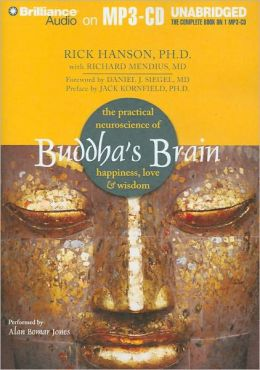
    BOOK REVIEW: “Buddha’s Brain”: by Rick Hanson and Richard Mendius 

    This book has been out there a while, about twenty years, but not only did I just now discover it, but I suspect that many people who’d like to ingest this kind of knowledge and information are more interested than inspired, because it’s not easy knowledge to ingest, without resorting to woo-woo and juju, which ultimately does not hold up to peer-reviewed scrutiny. Because this is the point where spirituality meets science, and the path is not for the weak hearted. The basic idea is that your mind, and by extension your brain, or vice-versa, in effect control the keys to your happiness, and that is the path of your salvation. To accomplish this Hanson the neuroscientist PhD and Mendius the MD mix and match metaphors and math to navigate this path for you. But where to begin?

    They begin with what could be considered the mantra for this entire book, a quote so powerful that I used it as a standalone quote on my Facebook page: “Neurons that fire together, wire together,” meaning in short, that you can create a neural network that facilitates your happiness with the same ease and simplicity that you can go to a doctor, or a university, or a friend’s house for after-dinner drinks that might lead to the love of your life, and that sort of happiness. But wouldn’t any of those go better and easier with the kind of mental attitude and predisposition that almost guarantees success? You can create that. And, if that goes against the belief in ‘Thoughts without Thinkers,” well, so be it. That was never meant to be a call to inaction, but more like a generality, or a palliative, or a reminder to ‘not think too much.’

    But, there must be a place in our lives for ‘right thoughts’ and ‘right actions’ and this is a good place to begin, i.e. mind training. Unfortunately, our brains and therefore minds have a negativity bias for survival, so this must be at least partially overcome, since it quickly leads to the suffering of separateness and a world of simulation which is very different from the present moment that largely defines sati, mindfulness. Because the second dart is often worse than the first dart, as explained here, i.e. our reactions are worse than the actions which have caused the negative effects that we are trying to mitigate. It’s a vicious circle, the dog chasing its tail when the tail is not the problem; the chasing is the problem. It is here that meditation can come to the rescue to reboot the action-reaction sequence with a solid dose of silence as salve and salvation.

    If happiness is the goal, then we need to ‘accent the positive,’ or ‘Ac-Cent-Tchu-Ate the Positive’, if you prefer, all thanks to Bing and the Andrews Sisters and Johnny Mercer, while avoiding any and all clichés and giving a break to Mr. In Between, haha. Because  as Buddhists we can seriously identify with that, all extremities duly avoided by Buddhist writ long unwritten. But meditation can only create a level playing field, per its role as the zero shunya of shunyata which is so important to the advanced transcendental Buddhism of Mahayana. Once the fires are calmed, then the neuroaxis can begin to do its thing, with the brain stem, limbic system, and pre-frontal cortex, etc. Sounds complicated, but guess what? It doesn’t have to be. It can be as simple as not responding to that first dart, adding your second dart to the karmic mix which, once established, becomes increasingly hard to shake.

    And, if non-response sounds like ‘spiritual bypassing’, then, once again, so be it. That’s the whine of psychiatrists who fear a loss of revenue. Buddhism is a religion of at least partial renunciation. Because there are (at least) two wolves in every heart: Love and hate. Love and hate create us and them. The only cure is empathy, easier said than done, true, but not too hard. Just add kindness, and compassion. The compassion is to cure suffering, and the kindness is to bring happiness. Kindness is pre-frontal. Enlarge your circle. Meditate. Make it frontal. Control your attention; basal ganglia seek attention. It’s the power of meditation; sati leads to wisdom. Rapture and joy bring dopamine. Fast gamma waves bring singleness of mind. Relax the Self: don’t take things personally. Self is a convergence of many neural networks. It’s a process, always changing. Any questions? Don’t think too much. Chill. It’s worth the read. I give it a four.

     
  • Unknown's avatar

    hardie karges 4:56 pm on February 2, 2025 Permalink | Reply
    Tags: , , , , , , , , , , , shunya, , , , ,   

    Buddhism 499: Causes and Conditions… 

    It’s not enough to temporarily alleviate a bad situation, but better to permanently change the causes and conditions that created it. This gives the lie to the dismissive notions that Buddhism is only interested in the ‘present moment’, and that ‘thoughts have no thinkers’, and other casual self-disses that imply that Buddhism is superficial and unconcerned with deeper meanings. The Buddha never said that, and nothing could be further from the truth. Those are popular modern themes, but the historical reality is quite different.

    In fact, Buddhism has been extremely concerned with causes and conditions since day one. And if that’s readily apparent in the earliest Theravada Buddhism, it’s a frank obsession by the time of Vajrayana. Never is there a call to cease suffering without a simultaneous call to end the causes of suffering. I think it’s even fair to say that this was likely something of a revelation in that pre-scientific time. Because in that era prior to the scientific era of experimentation, deep contemplation was the next best thing.

    Even Einstein knew that from his deep thought experiments, and the Socratic dialogs of Plato at or around the same time as the Buddha’s sutras were a dualistic echo of the same approach. It requires deep thinking and difficult training, not just a fly catcher nabbing a thought or two on their way through the garden to the kids’ pool. It’s even very possible that it was Buddhist monks who invented (yes, invented) the zero, something which would not catch on in the West for almost 2000 years. It first existed as a concept in shunya, before making the jump to higher math. How do you transfer the liquids between two full containers? You need an empty container. That’s a zero. Think about it. Then meditate. That’s a zero.

     
  • Unknown's avatar

    hardie karges 3:35 am on January 28, 2024 Permalink | Reply
    Tags: , , , , , , , shunya, , , , , zero point   

    Buddhism and the Power of Silence  

    Words once spoken cannot be taken back. Actions once committed cannot be retracted. Silence is better than violence. This is one of the hidden little gems of Buddhism, the value of silence. And other than the emphasis on meditation, it’s something that doesn’t often get mentioned—until now. Because here and now, in the modern age and the Western world, the noise is almost deafening, and the calls to engage are never-ending, no matter that much of that engagement is cruel and disheartening.  

    As a ‘digital creator’ on Facebook, I get it all the time, as if non-engagement were synonymous to incompetence. But nothing could be further from the truth. Silence is not violence, and BLM (Black Lives Matter) should know this. MLK (Martin Luther King) certainly knew it well, as did Mohandas K. (Mahatrma) Gandhi. Silence is one of the most powerful weapons in the world, in fact, but it is also much more than that. As the operating method of meditation, it can save souls (people) and so, it can also save nations.  

    If silence is the zero point for meditation, then meditation is the zero point for life. In this analogy, silence is like the zero (shunya) for which emptiness (shunyata) is named and can be thought of like the mathematical zero as the point between positive and negative (existence or non-existence?) numbers or the absolute zero temperature beneath which there is no lower, or even the zero-point energy of quantum physics as that point closest to absolute stillness. That’s the goal of meditation, insight optional, and that’s the goal of life, if only for a moment, now and again, always and forever. 

     
  • Unknown's avatar

    hardie karges 5:22 am on August 25, 2023 Permalink | Reply
    Tags: , , , , , , , shunya,   

    Shunyata: Emptiness at the Center of Buddhism  

    Shunyata is famous as the Emptiness factor of Buddhism. But that zero, shunya, also defines a center. And so that same word, or some variation of it, forms the word or concept of centrality in many Southeast Asian languages, where it first arose. Thus, it refines the concept of the Middle Path in the same way that it refines the concept of anatta or ‘non-self.’ Now we can see that not only is there no permanent enduring self to worship or obey throughout eternity, but there is no permanent enduring anything to worship or obey throughout eternity.  

    In the same way we can see that not only is there a Middle Path that defines our passage through life, but there is also a center that we can keep coming back to, if we want, or revolve around, if we must, lest we lose our bearings in the passages of time and space. Because that Middle Path can be meandering, as we’ve already seen, but a center is more fixed, by definition, even if it is following a path in 3-D space. It is still fixed in relation to its surroundings. And so is a center.  

    So, I think that it’s possible to postulate and adhere to a Central Point of Buddhism in the same way that we follow a Middle Path. Nothing has changed except the precision of the definition, as with anatta. Thus, we should always ‘stay centered’ in the same way that we should avoid extremes in following a Middle Path. If this seems trite, trivial, and even somewhat torturous to accept, then I suggest otherwise. Because if that concept of samsara was originally a ‘wandering’ which soon became synonymous with ‘the world,’ then at some point we must settle down and find our center. 

     
  • Unknown's avatar

    hardie karges 10:42 am on April 22, 2023 Permalink | Reply
    Tags: , , , , Mark Epstein, , Roman numerals, shunya, ,   

    Samma Vaca: Right Speech on the Buddhist Middle Path  

    This is something so difficult for so many people that often no speech is better. Because Buddhism didn’t start the old ‘Silence is Golden’ saying, but it probably could have. Because it’s such a valuable tool in the workshop of life that its effect is invaluable. I think that it can easily be seen as the sonic equivalent of Emptiness for Buddhist purposes, that same shunyata Emptiness derived from the Pali/Sanskrit shunya zero (yes, THAT zero), which is not really a number, but a concept, and which largely expanded the original anatman no-self doctrine to everything. 

    But, if easy convenient symbols for that powerful metaphor are hard to find, then silence is one of the easiest, maybe even easier than the eponymous shunya itself, i.e. zero. Because number systems did just fine for many years without the place holder and multiplier that we call ‘zero’ in the English language. And, despite some interpretations that it’s necessary for a decimal system, well, in fact, it is not, and our own (!?) Roman numerals are the proof of that, easily countable up to about 5000, and not so hard to write as V. But you wouldn’t want to see 4999. 

    And, so it is with speech. Sometimes less is more, not just figuratively, but literally, and numerically. Because, if the zero allows easy multiplication, with possibilities of infinity, then silence can do the same. Until I say something, then anything is possible, and the future is wide open. But once I commit to speech, and language, then its reach is definite, certain, limited—and past tense. But what is ‘right speech’? After all, we can’t be silent ALL the time. What everybody wants in life, whether they know it or not, is to feel good.  

    So, in brief, right speech is speech that makes you feel good, though not just you, but all the other people within hearing range, or in the case of written speech, then all potential readers. But that’s easier said than done. Because ours is a world of fierce differences and often acrimonious debate, even when the potential results are more futile than feudal. Still, we persist in advancing our agendas. Silence allows time and space to see the other side. But, if you must speak, then say nice things, constructive and conciliatory. And think good thoughts. That’s two steps of the Buddhist Middle Path right there. You’re halfway home. 

    Author’s note: just after writing this, I discovered a passage in Mark Epstein’s ‘Thoughts Without a Thinker’ that resonates in total agreement, in the section called ‘Holding Emotions’: “The Buddha taught a method of holding thoughts, feelings, and sensations in the balance of meditative equipoise so that they can be seen in a clear light.” Nice, couldn’t have said it better myself. Enjoy. 

     
  • Unknown's avatar

    hardie karges 10:43 am on August 15, 2021 Permalink | Reply
    Tags: , , atta, , , , , , shunya,   

    Buddhism and the Limits of Suffering… 

    Suffering doesn’t have to be painful. It is only painful if you refuse to accept it. Buddhism is famous for its acknowledgement of suffering, of course, to the point that it must deal with charges of pessimism, when nothing could be further from the truth, to be honest. It is simply realistic: you are not immortal, you are not eternal, and you are not the center of the universe. We shouldn’t need to appeal to Science to prove something so obvious and fundamental. You will die. Get over it.

    But these are the kinds of feel-good epithets that get tossed to the hungry lions we are, anxious for abundance and thirsty for fulfillment, of the fluid levels in our bodies and the ego levels in our mind, such that we will entertain fantastic notions in order to satisfy those notions of grandeur and grandiosity. If that is the shorthand definition of optimism—egotism—then maybe pessimism is better. But I won’t cop to that, and don’t think that is necessary.

    (More …)
     
  • Unknown's avatar

    hardie karges 10:44 am on August 8, 2021 Permalink | Reply
    Tags: Alexander the Great, , , , , , Hindi, , , , , , , , , , shaman, shunya, , , , Yaqui   

    Buddhist Metta-tation, Friendship Beyond Thought, Language Optional… 

    The truest love is metta, friendship, without all the burdens of possession. That’s Buddhist love, of course, without all the weeping, wailing, and the gnashing of teeth. The Pali word metta often gets written up as ‘lovingkindness’ by latter-day Buddhists, mostly American, who want the passion that term implies, but the Buddha likely intended nothing of the sort. That’s a Christian term, too, from the Hebrew chesed, with a heavy dose of devotion implied, but the Buddha seemed to intend none of that, and the word’s presence in many other Asian languages of the time reflects none of it, either.

    So ‘lovingkindness’ would seem to come from a totally different line of descent by genome. Culture is not genome, though, of course, though they often parallel one another, and the ‘Judeo-Christian’ tradition seems to reflect that. So, we Westerners tend to be emotion junkies, even when that emotion is not necessarily a pleasant one. We are implored to embrace suffering, by that logic, even though suffering implies pain, and the heavy dose of sadness that often brings. The fact that the Pali word dukkha means ‘suffering’ and the related word dukhee means ‘sadness’ in modern Hindi would seem to reflect that range of intent.

    (More …)
     
  • Unknown's avatar

    hardie karges 5:24 am on October 21, 2018 Permalink | Reply
    Tags: Euclid, Fibonacci, , golden mean, golden ratio, , , shunya, ,   

    Zero, Emptiness and the Golden Mean of Buddhism… 

    img_1935The concept of the Golden Mean always crossed my mind when studying Buddhism, but I never heard anyone reference it re: the Middle Path, i.e. madhyamagga, until recently, and while I’m not sure the reference is entirely correct, I do think the possibilities are exciting. In fact the Golden Ratio (a probably more accurate term) is 1.618, “a special number found by dividing a line into two parts so that the longer part divided by the smaller part is also equal to the whole length divided by the longer part”—Wikipedia

    This is also the foundation of the famous Fibonacci sequence, ubiquitous as a design principle in nature, and known to humans as early as Plato and Euclid, who was first to define it, and celebrated initially because for some reason it just looks good, or somehow feels right, notwithstanding the fact that it is by definition always a bit eccentric, i.e. off-center…

    And in fact the concept of center did not fully even exist at the time, before the invention of zero, so only geometrically as the fixed point of a radius, but not mathematically as a divider and multiplier for ever-increasing levels of exponential counting, literally ‘powers of zero’, or ‘powers of ten’, if you prefer, in addition to forming something of a ‘dead center’ or ‘ground zero’ mathematically, which can be repeated infinitely as decimals for each and every member of the count… (More …)

     
  • Unknown's avatar

    hardie karges 6:04 am on July 15, 2018 Permalink | Reply
    Tags: , , , , , shunya, , , sunya, ,   

    Buddhism, shunyata and the cult of zero… 

    IMG_1559The Buddhist doctrine of shunyata is one of its most famous, and the one that put Mahayana Buddhism on the map, a full step beyond what was envisioned with the original teachings of the Buddha, yet well within that purview. It is usually translated as ’emptiness’ or ‘voidness’, though I prefer ‘zero-ness’, in recognition of the fact that the word ‘shunya’ or ‘sunya’ literally means just that, zero, and in the modern standard language of every Theravada Buddhist country today, still means just that, or a derivation thereof…

    And if that sounds a bit spacey and abstract, it’s probably best thought of as an extended version of the Buddha’s doctrine of anatta or ‘no-self’, or no soul or no ego, i.e. no intrinsic reality to the human personality, which, according to this theory, is merely a collection of (s)kandhas, literally ‘heaps’ of transient characteristics with no permanence… (More …)

     
    • quantumpreceptor's avatar

      quantumpreceptor 6:29 am on July 16, 2018 Permalink | Reply

      Hey great post and expansion of the zero idea. Even for the fact that zero has been named means that it is something.
      Have you heard of sunyata as being explained as empty of? Empty of its own or independent existence?

      QP

      • hardie karges's avatar

        hardie karges 7:15 am on July 16, 2018 Permalink | Reply

        Thanks. Yes, I think that your definition is the most commonly accepted one, and if I didn’t say that, then I meant to. Mostly I just wanted to give some context to the development of the doctrine. It seems that ‘shunya’ was discussed even in the Buddha’s time, becoming ‘shunyata’ later on. The invention of the zero was a really big deal, and it just may have much more to do with the development of Buddhism than is commonly acknowledged, a thesis I intend to investigate further. Thanks for your comment…

        • quantumpreceptor's avatar

          quantumpreceptor 12:23 pm on July 17, 2018 Permalink

          Yes, Hardie, that’s a really interesting idea to develop that further, I can’t wait.

          As for being a discussed​​, I would even say that it was a hot topic. In Tibetan, we have three words rangtong, shentong, and detong. The tong comes from tongpanyi which is Tibetan for shunyata. Rangtong is empty of self-nature​. Many see only rangtong as nihilistic nits nature. Shentong is described as emptiness with something on top. The idea here was that because it could be experienced that the experience was part of reality. This was debated as being materialistic.

          Detong is also very interesting. De comes from Dewa and means great bliss. So detong is seen as the great joy that arises from emptiness. This happens when mind recognizes its own radiant space.

          You may look at these three terms as competing ideas and to some extent be correct. However, you may also see them as a natural progression as one leading to the next as if they were steps along the way. I cannot wait to find out more about your zero theory.

          QP

    • Dave Kingsbury's avatar

      Dave Kingsbury 4:52 pm on July 16, 2018 Permalink | Reply

      Some great practical suggestions that could give town planners something to think about. If they aren’t an endangered species! Seriously, they worry about what to do with empty shops … community hubs? You bring this abstract subject to life by relating it to modern discoveries and issues eg. “It should be noted that this is not much different from the logical conclusions to be drawn from a thorough consideration of the implications of the reality depicted by quantum mechanics: things are not real, not really”

      • hardie karges's avatar

        hardie karges 6:13 pm on July 16, 2018 Permalink | Reply

        I’ve always loved Mexican cities, with the central park and lots of community space. I always assumed it was a Spanish thing, but it may actually be pre-Columbian. And what with ‘high streets’ now under the assault of online shopping, it’s probably time to reassess the role of cities…

        • Dave Kingsbury's avatar

          Dave Kingsbury 11:50 am on July 17, 2018 Permalink

          I’d love to think we had matured enough to take considered stock of the past and come up with a better future, though I fear we might be too locked in our mad consumer present …

c
Compose new post
j
Next post/Next comment
k
Previous post/Previous comment
r
Reply
e
Edit
o
Show/Hide comments
t
Go to top
l
Go to login
h
Show/Hide help
shift + esc
Cancel