Tagged: religion Toggle Comment Threads | Keyboard Shortcuts

  • Unknown's avatar

    hardie karges 4:55 am on February 23, 2025 Permalink | Reply
    Tags: , , , , , , , , , , , religion, ,   

    Buddhism 102: Craving is the Curse… 

    Don’t test positive for COVET disease, because jealousy is a hard habit to break, as many a fine pop song has elucidated quite well. But it rings true, especially in the Buddhist attitude toward the world, fully established in Noble Truth number two as the cause of suffering. That’s craving, of course, also known in its manifestations as jealousy, which is only slightly different, or even lust, with its own category of trsna or tanha, Sanskrit or Pali, a thirst gone too far, beyond the simple satisfactions of life, and into unrequited desire. And then there’s greed, one of the three poisons, all closely related on the scale of Dependent Origination.

     But such is the nature of desire, or craving, that it can never be satisfied, by the very nature of its existence, the unsatisfactory nature, i.e. suffering. The best that we can do is ameliorate it, that is, acknowledge its presence, and its call, and give it something, but don’t give it all, of your time or your money, just enough to keep it at bay, far far away, out of your life and out of your mind. Because that is the greatest curse of all, to let nefarious emotions and influences occupy all of your precious thoughts.

    This is why thinking sometimes gets a bad rap and a bad rep, simply because, if left to fester uncontrolled, thoughts can run wild and waste all your time, leading to what we often call ‘monkey mind’, in reference to the constant chatter and mindlessness that defiles us and denies the reason we’re here. And so, we seek more mindfulness, and a decrease in suffering, caused by craving, firstly, and impermanence, secondly, the phenomena of existence that must be dealt with, but not succumbed to, similar to wild dogs prowling Main Street late at night, howling at the moon for lack of something better to do. But we have something better—meditation. When danger threatens, do nothing—quickly.

     
    • jmoran66's avatar

      jmoran66 5:00 am on February 23, 2025 Permalink | Reply

      “When danger threatens, do nothing—quickly”. That’s a keeper.

    • Hardie Karges's avatar

      Hardie Karges 6:06 am on February 23, 2025 Permalink | Reply

      Haha, thanks

  • Unknown's avatar

    hardie karges 4:56 pm on February 2, 2025 Permalink | Reply
    Tags: , , , , , , , , , religion, , , , , , ,   

    Buddhism 499: Causes and Conditions… 

    It’s not enough to temporarily alleviate a bad situation, but better to permanently change the causes and conditions that created it. This gives the lie to the dismissive notions that Buddhism is only interested in the ‘present moment’, and that ‘thoughts have no thinkers’, and other casual self-disses that imply that Buddhism is superficial and unconcerned with deeper meanings. The Buddha never said that, and nothing could be further from the truth. Those are popular modern themes, but the historical reality is quite different.

    In fact, Buddhism has been extremely concerned with causes and conditions since day one. And if that’s readily apparent in the earliest Theravada Buddhism, it’s a frank obsession by the time of Vajrayana. Never is there a call to cease suffering without a simultaneous call to end the causes of suffering. I think it’s even fair to say that this was likely something of a revelation in that pre-scientific time. Because in that era prior to the scientific era of experimentation, deep contemplation was the next best thing.

    Even Einstein knew that from his deep thought experiments, and the Socratic dialogs of Plato at or around the same time as the Buddha’s sutras were a dualistic echo of the same approach. It requires deep thinking and difficult training, not just a fly catcher nabbing a thought or two on their way through the garden to the kids’ pool. It’s even very possible that it was Buddhist monks who invented (yes, invented) the zero, something which would not catch on in the West for almost 2000 years. It first existed as a concept in shunya, before making the jump to higher math. How do you transfer the liquids between two full containers? You need an empty container. That’s a zero. Think about it. Then meditate. That’s a zero.

     
  • Unknown's avatar

    hardie karges 4:46 am on January 26, 2025 Permalink | Reply
    Tags: , , , , , , , , , , , , , religion,   

    Buddhism 202: True Love Can Save the Planet 

    The truest love is metta, friendship, without the burden of possession. That’s a hard sell to a teenager with a bone he’s trying to drive home, but it’s true nevertheless, for long-term or short, which is the proof of its purity. Powerful passions may produce plentiful babies, but without lovingkindness, most of those efforts will be largely lost before the high school graduation exercises, and that’s what’s important. Because we’re no longer the young planet that we once were, raw and untamed and unpopulated.

    Now the danger is over-population and the possibility that we might become victims of our own successes, as Global Warming would seem to suggest. So, a different attitude than constant growth is recommended for long-term survival. This means a more thoughtful and less cavalier attitude to our relationship with others, gentler and kinder, less aggressive and careless. If that overlooks the reality that sometimes Buddhism can be too passive, then so be it. The alternative is worse—uncontrolled aggression.

    That’s the reason that I became a Buddhist, to save myself, then save the world. That’s my motto and mantra that also sums up the transition from early self-centered Theravada Buddhism to later society-centered Mahayana Buddhism, not that such a generality explains much about either of them. But the motto and mantra still work, for me, at least. Be kind, first and foremost, and the world will become a kinder place in return. That’s karma.

     
  • Unknown's avatar

    hardie karges 5:03 am on January 5, 2025 Permalink | Reply
    Tags: , , , , , , , , religion, Robert Wright, The Matrix, ,   

    Book Review: ‘Why Buddhism is True’ by Robert Wright… 

    Okay, I owe this review to Robert Wright as payback, because, while others at my Buddhist college were ‘oohing’ and ‘aahing’ back in 2017 over the release of his book ‘Why Buddhism is True’, I was extremely skeptical—and quite vocal about it. Why? Well, first, there’s the title: ‘Why Buddhism is True’. It seemed phony to me, as phony as some rock-and-roll band calling themselves ‘Nirvana’. Don’t push my buttons. Then there’s the Matrix glom-on right in the First Chapter. Or was it the Introduction? Are you serious? That’s certain proof of amateur hour for me. Last, but not least, there’s professional jealousy. Wright is first and foremost a journalist. So, what makes him the best person to write this book?

    Because, even back then, I knew that that’s the $64k question that any self-respecting literary agent would ask you before rejecting you, without telling you about the ‘journalist’s exemption’. Now I know, older but wiser (and with an MA in Buddhist Studies plus a recently published novel based on the travels of Buddhist pilgrim Fa Hien, hint hint). But his book is pretty darn good. So, I owe Mr. Wright a heartfelt apology. And that’s not a quick and easy decision, because he’s pressing his luck by reducing Buddhism to meditation, when many, if not most, of the world’s Buddhists, meditate very irregularly—IF EVER!

    But he pretty much left the Matrix references behind (‘Dharma film’, indeed!), and moved right on to other topics, some of which still stretched credulity, but served as some kind of Buddha’s Greatest Hits collection, if nothing else, so that’s probably a plus for the lightly initiated. After all, Buddhism has come a long way from its early Theravada discipline, Mahayana metaphysics of Emptiness, and Vajrayana mysticism. Now there are Vipassana, koans, and ‘crazy wisdom’, instead. Wright even devotes an entire chapter to ‘How Thoughts Think Themselves,’ one of my pet peeves in the modern Buddhist canon. But Wright handles it with journalistic equanimity, making clear that there are ways of justifying that attitude, without necessarily seeing all thoughts as falling into that category.

    But my favorite part of the book is the attention given to the possibilities of a simulated reality for us here in this life in this world, as alluded to in ‘Chapter 11: The Upside of Emptiness’, in which he argues that it is a psychological necessity to project ‘essence’ for long-term survival and human evolution. And while I would prefer to draw parallels between our neural simulations and the digital simulations of Virtual Reality, the bottom line is the same: it’s better than ‘illusion’ and nihilism is prohibited. Nirvana is similarly and summarily dismissed as the overriding raison-d’etre of Buddhism, while mentioning the unmentionable: we’re talkin’ ‘bout death here, y’all.

    Then there’s the title, which I assumed was editorial overreach on the part of Simon & Schuster, in the vein of the previously mentioned ‘Thoughts w/o Thinkers’, ‘Hardcore Zen’, ‘Universe in a Single Atom’, and other such pseudo-Buddho titular nonsense, but no: this is Wright’s chosen title, which he is prepared to defend as indicating its psychological appropriateness, something like samma ditthi, right view; nothing like absolute truth, so that’s cool. Wright is casual too, sometimes even funny, witness the title to Chapter 13: ‘Like Wow, Everything is One (at Most)’, haha. I like that. Bottom line: sometimes a well-traveled journalist is preferable to a star-spangled Rinpoche, especially when that guru is telling you to vote for the orange guy with the big bulge and the bankroll. I like honest brokers. Wright is worth the read. R.I.P. Kurt. The last Matrix movie sucked.

     
  • Unknown's avatar

    hardie karges 4:32 am on December 8, 2024 Permalink | Reply
    Tags: , , , , , , , , , , religion, ,   

    Buddhism Basics: Metta and Karuna, Kindness and Compassion… 

    Kindness and compassion, metta and karuna, are not the path of weakness. They are the path of true strength, which may or may not coincide with the popular images of ‘big men’ and ‘strong men’ flexing muscles and making waves, but that is not the paradigm of the Buddhist monk in partial renunciation from the world. That is the paradigm of the world that the Buddhist must renounce, at least partially, the world of hatred, fear, and anger, often masquerading as bravado, strength, and victory.

    Ironically, many Buddhists may defer to such popular images of strength and victory while forgoing it themselves. Because they know that such phenomena are the manifestations of the world, samsara, over which they have little of no control. We can only control ourselves. But, if we can stay on the good side of those circumstantial strong men that the world spits out like so many celebrities for sale, then so much the better. That’s ‘skillful means.’ It doesn’t imply superior dharma or any kind of enlightenment on the part of the big man, just survival instincts on the part of the average bloke.

    But Buddhism is a path of kindness and compassion. That much is certain. The only question is how best to manifest that in our own private lives. As always, the Middle Path seems to offer the best clue. Don’t be too passive or too aggressive. There is a sweet spot right there in the middle somewhere, defined by an almost equal distance from the extremes that we must avoid. And if it seems like this is a path for losers and nondescript middlemen, then nothing could be farther from the truth. Living right is its own reward.

     
  • Unknown's avatar

    hardie karges 12:17 am on December 3, 2024 Permalink | Reply
    Tags: , , , , , , , , literature, , religion,   

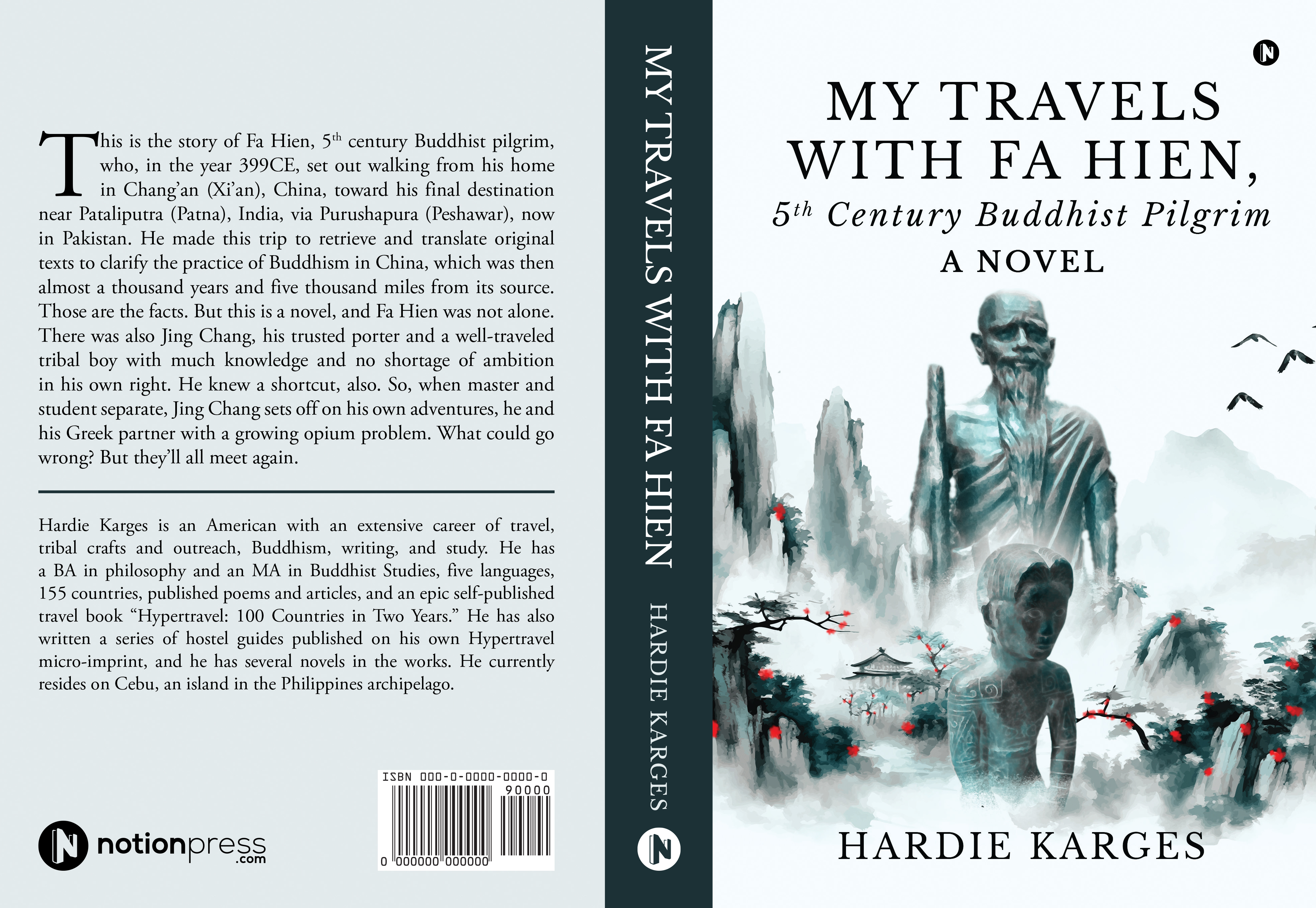
    My Travels with Fa Hien, 5th century Buddhist Pilgrim: Kindle E-book now available 

    Coming soon to an Amazon near you!

    I am happy to announce that the book “My Travels with Fa Hien, 5th Century Buddhist Pilgrim”, is now available in Kindle E-book at Amazon US (others soon) as well as physical copies there and at Notion Press, Flipkart, and bookstores in India. This is the true story of the 5th century Buddhist pilgrim on a 5000 mile trip from central China to eastern India via what is now Pakistan and the mountains and valleys that lie between. In the course of his travels, not only does Fa Hien complete his mission to find the true origins of Buddhism, while translating its sacred texts, but his crew manage to have adventures of their own in the process. This occurs while Rome falls and Europe enters its Dark Age on the other side of the world. It’s a travel book; it’s a dharma book; and it’s a history book, all in one. This is my tribute to Buddhism, Asia, and multiculturalism at its finest. A portion of all sales will go to charities in India. For more information and samples, please join my Fa Hien Facebook group. Enjoy.

    My involvement with this project began with the completion of an MA in Buddhist Studies, at the age of 65, after a long history of travel that covered some 155 countries, during which I studied language and cultures, while buying folk art. Much of that occurred at or after the age of 55 as documented in my own travel epic “Hypertravel: 100 Countries in Two Years,” published in 2012. After that I spent several years compiling travel guides to world hostels, again published on my own micro-imprint. As my interest in Buddhism grew, I attended retreats and spent time in temples and monasteries in Thailand and Myanmar, before finally entering International Buddhist College in south Thailand as an MA candidate in 2017. I completed my MA in 2019, while studying on campus and online, with much travel in Asia.

    Then came the pandemic. After a growing interest in the story of Fa Hien I finally started writing the manuscript in late 2020 in Guatemala and finished the first draft in early 2022 in Lumbini, Nepal, the birthplace of the Buddha himself. After many rewrites and a 2023 sabbatical waiting for further inspiration, I finally finished the book with several new chapters in 2024. Upon careful consideration I decided to publish the book in India, which is the setting for much, if not most, of the book. Unlike the West, also, Fa Hien is known widely there, even if he never gained the hero status that his imitator Xuanzang did in China with the classic epic ‘Journey to the West’. I’d like to change all that and give credit where credit is due, for the sake of Buddhism and travel. A portion of all sales will go to charities in India. For more information and samples, please join my Fa Hien Facebook group. Enjoy.

     
  • Unknown's avatar

    hardie karges 4:40 am on November 24, 2024 Permalink | Reply
    Tags: ashrama, , , , , , , , , religion, , sannyasin, , ,   

    Buddhism 399: Homelessness and the Joy of Giving… 

    Give more than you take. That will be more than enough, and the world will be a better place. That is the essence of almost all religions, Buddhism included, regardless of whether you consider Buddhism first and foremost a philosophy, as I tend to think. But philosophies don’t usually include a call to action, whereas religions usually do. Buddhism doesn’t do that, though, not specifically, but it is implicit in the practice, the original practice. That’s why you’ll see orange or yellow-robed shaved-head monks walking through the markets at daybreak in almost every Theravada country in SE Asia, requesting alms for subsistence, usually food. This giving is usually known as dana.

    This harkens back to an even earlier practice in India wherein long-haired rishis and sannyasins wearing similar saffron clothing but usually without a group of like-minds, would make similar rounds, a practice which continues to this day. The difference is not only that the former are Buddhist and the latter Hindu, but the former have rules and regular routes, and are often registered for this activity, whereas the latter are more likely free and on their own, often in the last phases of life according to the four Hindu ashramas of student, householder, forest dweller, and renunciant—nice.

    But the important thing is the giving. So, instead of seeing a renunciant as a societal parasite reduced to begging, we should see them as symbols of purity, offering laypersons the opportunity to experience the same bliss of renunciation that they not only symbolize but incarnate. It’s only ironic that they themselves often consider themselves—and call themselves—homeless, no pun intended. Because that is the little joke they play on all of us, that the poorest people of the West are linguistically identified with the holiest of the East. I only wish that Western practitioners would follow the same precepts. The food is usually pretty good, at least in Thailand.

     
  • Unknown's avatar

    hardie karges 3:59 am on November 17, 2024 Permalink | Reply
    Tags: , , , , , , religion   

    Buddhism on the Half Shell: Dharma without Dogma 

    Beware stir-fried spirituality, vague ideas tossed in a pan and stirred ‘til piping hot. Buddhism is an open doctrine, true, but it needs a compass. And the Eightfold Path is that compass, of course, the prime phenomena of our lives listed and pointed in the direction of ‘rightness’, i.e. the correct and appropriate versions of the main foundations of our lives: thought, intent, speech, action, livelihood, effort, mindfulness, and concentration. If non-duality can fit into that simple list, then fine; it is welcome. If not, then reshuffle your deck to find your place in lives where things actually exist and thoughts actually occur.

    For better or worse, Buddhism must live with the titles of its popular books, regardless of whether those actually describe the philosophy accurately or not. So, we must spend time explaining why ‘Buddhism is True’, and why there are a ‘Buddha and the Badass’ and how we can have a ‘Universe in a Single Atom’, whether any of that has anything to do with Buddhism or not. For the most part, those titles are just the consumeristic fantasies of book publishers, and the ideas inside their covers have little or nothing in common with them.

    But that’s a compromise we make. The real problem occurs when the ideas themselves get breaded and fried in almost total opposition to the original concept. So New Age Buddhists remind you to love yourself without bothering to explain, or even acknowledge, that we have no intrinsic Self, or even selves. Then they’ll tell you that our thoughts are not our own, while giving no clue as to where they actually come from, apparently just floating around, soul-like looking for a body to inhabit. But these are only minor inconveniences. The dharma can easily transcend most of that. I persevere.

     
  • Unknown's avatar

    hardie karges 4:36 am on October 27, 2024 Permalink | Reply
    Tags: , asceticism, , , , , , , , , , , , , Padmasambhava, , religion, , Upanishads, ,   

    Buddhism is the Middle Path between Jainism and Brahmanism… 

    Brahmanism is what we now call ‘Hinduism’, but that term didn’t really exist way back when, only recently applied by the Brits to the plethora of sects and devotions which now constitute Hinduism. But it was in the midst of the Upanishad era at the time of the Buddha, which would redefine the previously Indra-based fire rituals which had reigned during the Vedic times. And with the advent of the new Upanishadic orientation, the resulting resemblance to Buddhism was profound—but still distinct.

    And so was Jainism distinct from both of them, at the same time that it shares much with them. But remember, that the ‘Hinduism’ that the Jain reacted to in the 6th century BCE is not the same as modern Hinduism, either, and that is partly because of this same three-way dialogue. Jainism was largely a reaction against the Brahmanists’ fire sacrifices, they being extreme nonviolent vegetarians. But many modern Hindus are also vegetarians, with Buddhists characteristically somewhere ‘in between.’

    That’s the Middle Path, specifically between the extreme asceticism of the Jains and the lavish rituals of the ‘Hindus’, but also between the many gods of Hinduism and the total lack of them in Jainism. Technically Buddhists don’t really have them, either, but, you know… Later versions of Buddhism were not so strict about that, such as the Tibetan version of Vajrayana, which came direct from India sometime after the 5th century and attested by Padmasambhava in the 8th century.

    But both Jains and Hindus were crazy about souls, Jains finding them everywhere and Hindus finding them cosmic, Atman, preferably in union with the cosmic dharma principle Brahman. But Buddhism found little of value in any of that, and so chose non-self anatta. So, they all evolved into different sects with different orientations, and we generally all get along nicely. The main difference is that Hinduism tilted toward a nationalism which international Buddhism could never assimilate. And Jains, ‘winners’ in Sanskrit, were ultimately the losers.

     
  • Unknown's avatar

    hardie karges 5:00 am on October 20, 2024 Permalink | Reply
    Tags: , , , , evangelical, , , , , , , , religion, ,   

    Buddhism at the Checkout Lane: the Best Rebirth is Spiritual 

    Spiritual rebirth begins within. It should never end. Samsara is something different. Samsara literally means ‘the world,’ always did, though perhaps etymologically from a distant past word connoting ‘wandering,’ but who knows? Etymology is always a best guess. As far as we know, at the time of the Buddha the word meant ‘the world,’ as it does to this day in modern Nepali, the modern language closest to its Sanskrit roots. Hindi probably got tired of the debate, so adopted the Arabic word dunia for most ordinary usage.

    But Buddhists turned the world cyclical, and so that circularity came to represent samsara more than the other aspects of the world itself. And that circularity specifically refers to the concept of rebirth, heavily borrowed from the Hindu concept of reincarnation, but without the literal transfer of the physical body from one generation to the subsequent one. In fact, Buddhism goes to great lengths to explain away the conundrum of <“What is reborn?”> at the same time that they go to equally great lengths to explain exactly what is the nature of this self that we’re denying. It’s a mess.

    Bottom line: the Christians—the evangelical Christians, of all sects—may have beat us to the punch on this issue. Because their insistence on being born again in the spirit is not only in the Bible, in multiple quotations, you may hear it loud and long at any tent revival in the lower US south from participants both black and white, in their exaltation at surviving a ‘Long Dark Night of the Soul’ as originally described by the 16th century Spaniard St. John of the Cross (not Eckhart Tolle).

    There is scarce reference to rebirth in any Buddhist text, though the Brahmanist Hindus and especially Jains would likely have many if only they had bothered to write it down. But that’s another story. The important thing is that spiritual rebirth is a very beautiful thing and idea, whereas physical reincarnation or even sorta kinda almost maybe rebirth of consciousness in a random body is a leap of logic, not to mention dubious science. And to those who say you can’t just pick and choose this and that, from assorted religions, I respectfully respond, “Why not?” They all did. Embrace it.

     
c
Compose new post
j
Next post/Next comment
k
Previous post/Previous comment
r
Reply
e
Edit
o
Show/Hide comments
t
Go to top
l
Go to login
h
Show/Hide help
shift + esc
Cancel