
Tagged: mindfulness Toggle Comment Threads | Keyboard Shortcuts

  • Unknown's avatar

    hardie karges 7:37 am on December 15, 2024 Permalink | Reply
    Tags: , Buddhist precepts, , , , mindfulness, , , , ,   

    Buddhism in the Balance: Giving is primary… 
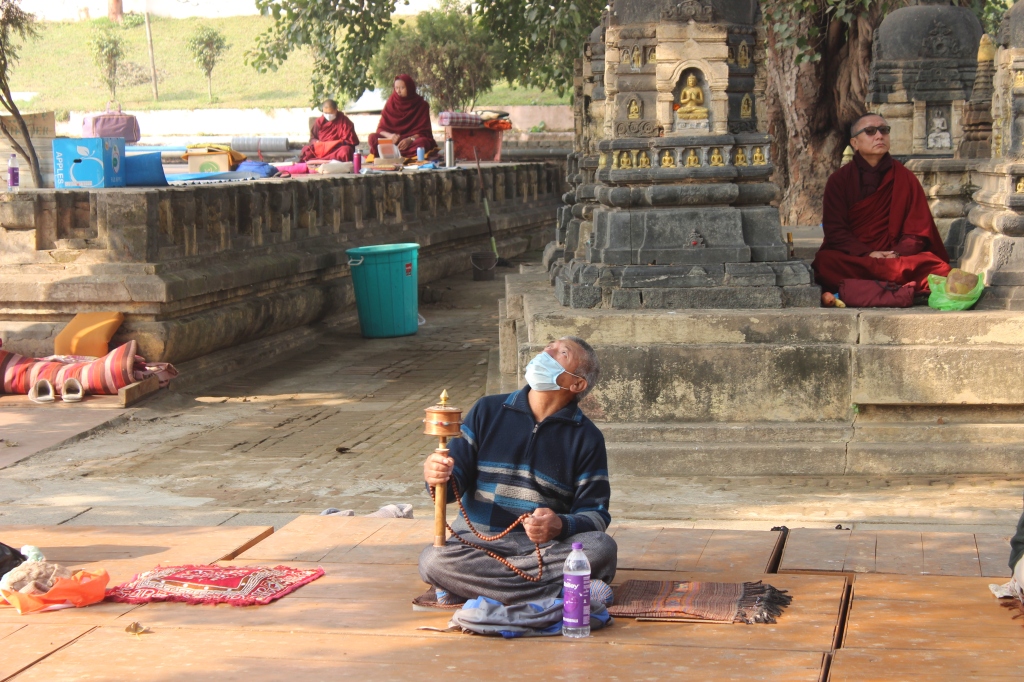
    We own nothing but the experiences of a few hours days weeks months and years upon this planet. We can spend them in mindless consumption or quiet contemplation. The choice is yours. Because, bottom line: you don’t have to do anything, but keep your body alive. But, beyond maintaining the body in an active state, there is no specific call to action. In fact, it’s much more important what you don’t do than what you actually get around to doing in your precious time in this life on this earth.

    Don’t lie, don’t cheat, don’t kill, don’t steal; these are the commandments of Christianity and the precepts of Buddhism, as well, which seems obvious, until you imagine what must have come before. It wasn’t always pretty. I think that is what is obvious. Neither set of rules and regs says anything about doing this or doing that, though, until you get into the higher levels of commitment, and for Buddhism, that’s right thoughts, right words, right actions, etc., simple. That’s not rocket science. And the main blessed action is to give.

    Because giving serves two purposes, both of equal value. On the one hand, you are helping others. On the other hand, you are reminding yourself that your needs are few and possessions are often unnecessary. In fact, we often become possessed by our very possessions, which seems counter-intuitive, but accurate. Therefore, possessions are really no better than mindless consumption, short-term satisfaction or longer-term, but the result is often the same: we become addicted to the rush, whether the rush of sensation or the rush of satisfaction, for something which often offers no deep level of satisfaction at all. Quiet contemplation is often better.

     
  • Unknown's avatar

    hardie karges 4:32 am on December 8, 2024 Permalink | Reply
    Tags: , , , , , , , , mindfulness, , , ,   

    Buddhism Basics: Metta and Karuna, Kindness and Compassion… 

    Kindness and compassion, metta and karuna, are not the path of weakness. They are the path of true strength, which may or may not coincide with the popular images of ‘big men’ and ‘strong men’ flexing muscles and making waves, but that is not the paradigm of the Buddhist monk in partial renunciation from the world. That is the paradigm of the world that the Buddhist must renounce, at least partially, the world of hatred, fear, and anger, often masquerading as bravado, strength, and victory.

    Ironically, many Buddhists may defer to such popular images of strength and victory while forgoing it themselves. Because they know that such phenomena are the manifestations of the world, samsara, over which they have little of no control. We can only control ourselves. But, if we can stay on the good side of those circumstantial strong men that the world spits out like so many celebrities for sale, then so much the better. That’s ‘skillful means.’ It doesn’t imply superior dharma or any kind of enlightenment on the part of the big man, just survival instincts on the part of the average bloke.

    But Buddhism is a path of kindness and compassion. That much is certain. The only question is how best to manifest that in our own private lives. As always, the Middle Path seems to offer the best clue. Don’t be too passive or too aggressive. There is a sweet spot right there in the middle somewhere, defined by an almost equal distance from the extremes that we must avoid. And if it seems like this is a path for losers and nondescript middlemen, then nothing could be farther from the truth. Living right is its own reward.

     
  • Unknown's avatar

    hardie karges 4:40 am on December 1, 2024 Permalink | Reply
    Tags: , , , , , , , mindfulness, neuron, , , , ,   

    Buddhism 202: Thoughts and Thinkers 

    Buddhism in Bhutan

    Samma sankappa, one of the Buddhist Four Noble Truths, is Right Thought = Good Thought, not No Thought. For no thought, maybe samma samadhi is better, Right (Good) Meditation. It’s very popular for New Age-y Buddhists to talk about ‘thoughts without thinkers and/or ‘thoughts that think themselves’, as if they were both particle and wave out there floating around looking for a pickup gig, but that implies that thoughts are bad, and the Buddha never said anything like that.

    I think that the confusion comes with the role of language in thought, and its somewhat checkered past. Because no one would dare say anything bad about sati, i.e. consciousness, mindfulness, or awareness. That’s sacrosanct in Buddhism. And it’s a form of thought, also, but without language. Dogs do it; cats do it. All animals do, to a greater or lesser degree. But: like Boolean logic, we invented language, and now that we have it, it’s hard to go back, at least not full time. And there’s no real reason to.

    Because thought can be a good thing, and the linguistic variety is likely the most powerful type, BUT: it can also be destructive, both to society and to the personality, aka ‘self’. On the metaphysical plane, not only is it not ‘non-dual’, with its definitive subjects and objects, but it’s also argumentative and unsettling, arguably war’s greatest weapon. And while I don’t advocate a return to the ‘non-dual’ lives of bonobos and chimps, I do strongly advocate daily meditation. Because, no matter how powerful linguistic thought can be, its non-linguistic cousin meditation can be much more peaceful. That’s samadhi.

    But this can be a contentious subject for debate, because, on the one hand, thoughts DO just pop up sometimes unannounced and often unwanted. And we DON’T always have total recall, much less immediate recall. But that doesn’t mean that we are passive listeners and watchers of thoughts as they pass in and out of our brains or minds, for lack of better words to portray a very abstract subject. Remember the old saying: ‘Practice makes perfect’? Well, neuroscientists have one, also: ‘Neurons that fire together, wire together.’ That means that we establish neural pathways that can be considered our own, in that they are distinct from that of others. So, yes, to a certain extent, thoughts have thinkers, and thinkers have thoughts. We’re the living proof.

     
  • Unknown's avatar

    hardie karges 4:40 am on November 24, 2024 Permalink | Reply
    Tags: ashrama, , , , , , , , mindfulness, , , sannyasin, , ,   

    Buddhism 399: Homelessness and the Joy of Giving… 

    Give more than you take. That will be more than enough, and the world will be a better place. That is the essence of almost all religions, Buddhism included, regardless of whether you consider Buddhism first and foremost a philosophy, as I tend to think. But philosophies don’t usually include a call to action, whereas religions usually do. Buddhism doesn’t do that, though, not specifically, but it is implicit in the practice, the original practice. That’s why you’ll see orange or yellow-robed shaved-head monks walking through the markets at daybreak in almost every Theravada country in SE Asia, requesting alms for subsistence, usually food. This giving is usually known as dana.

    This harkens back to an even earlier practice in India wherein long-haired rishis and sannyasins wearing similar saffron clothing but usually without a group of like-minds, would make similar rounds, a practice which continues to this day. The difference is not only that the former are Buddhist and the latter Hindu, but the former have rules and regular routes, and are often registered for this activity, whereas the latter are more likely free and on their own, often in the last phases of life according to the four Hindu ashramas of student, householder, forest dweller, and renunciant—nice.

    But the important thing is the giving. So, instead of seeing a renunciant as a societal parasite reduced to begging, we should see them as symbols of purity, offering laypersons the opportunity to experience the same bliss of renunciation that they not only symbolize but incarnate. It’s only ironic that they themselves often consider themselves—and call themselves—homeless, no pun intended. Because that is the little joke they play on all of us, that the poorest people of the West are linguistically identified with the holiest of the East. I only wish that Western practitioners would follow the same precepts. The food is usually pretty good, at least in Thailand.

     
  • Unknown's avatar

    hardie karges 3:40 am on October 13, 2024 Permalink | Reply
    Tags: , , , , , , mindfulness, , ,   

    Buddhism 101: Pain is Our Birthright… 

    Pain is our connection to the realm of sentient being. We are all equal in this regard. But we have a path, thankfully. This refers to the First Noble Truth, of course, something like ‘There is suffering.’ Period. Full stop. That’s the foundational thesis of Buddhism, which all further dissertations struggle to assimilate, what with its apparent pessimism, which only gets worse (before it gets better). ‘Birth is suffering, aging is suffering, sickness is suffering, dissociation from the loved is suffering, not to get what one wants is suffering.’ Yeow. Yes, life’s a real sh*t-show at times. What to do?

    Oh, sure, the PhD’s try to explain it all away by saying that ‘suffering’ can mean ‘dissatisfaction’, ‘stress’, or maybe even ‘bummer’, but the result is the same: it’s not a good look, not when everybody else is bragging about their seven flavors of bliss and their multiple stairways to heaven. But that’s what the Buddha said, and that’s what he meant. But I think that he also meant that’s our connection to the world and each other. Otherwise, how would we even really know that we’re really alive? Pleasure is fleeting.

    But pain is real. And a large part of it is caused by the simple fact of our oh-so-human cravings. Bingo. There’s a path for that, and it will keep us humble in its universality. Because isn’t the underlying cause of all craving, desire, lust, and greed, our selfish assertion that we are something special and deserving of whatever we can get? Haha. Gotcha. Because we are but a bundle of causes and conditions that predictably lead to the defilements which define us: hatred, greed, anger, and those oh-so-pesky cravings. The path outta there is as simple as the decade-old Franz Ferdinand song which seconded that emotion: “Right Thoughts, Right Words, Right Action.” Simple, no? It works. Try it.

     
    • jmoran66's avatar

      jmoran66 4:25 am on October 13, 2024 Permalink | Reply

      I think you, as they say, nailed it here. There’s nothing to add.

    • hardie karges's avatar

      hardie karges 4:59 pm on October 13, 2024 Permalink | Reply

      Thank you for your comments.

  • Unknown's avatar

    hardie karges 4:25 am on October 6, 2024 Permalink | Reply
    Tags: , , , mindfulness, , , , , , theft   

    Buddhism in the Bardo Realms: You Are Never Alone 

    Buddhism in Bhutan

    The existential conundrum of our lives is that we are never alone, nor can we be, nor would we likely ever want to be, even if we could. Think of it this way: Suppose you want to enjoy yourself by yourself or just take a little swim. So, you walk down to the beach, find a nice little spot, and proceed to disrobe and jump right in. There’s only one problem: when you come back, you don’t know if your stuff will still be there or not—bummer. This is what many a happy tourist deals with every day.

    Oh, sure, there are ways to mitigate the circumstances. You can go with a friend, but that friend really can’t jump right in, now, either, can they? No, they can’t, because then any potential plunderer has just doubled his payoff. Even if you have a designated watcher for a larger group, that designee still doesn’t get to have his fun (and you still must trust him not to run). So, maybe hire a professional designee? Ditto. Or you could lock it in a box, if it’s a public space with such amenities, but that would probably preclude a dip in the buff, boo hoo. And even then, would you just wrap the key around your little finger?

    Or, you could just leave the key in your pocketed swim suit, but then, why not just leave your stuff in your room, and saunter to the beach semi-nude and flip-flop friendly, because, after all, nobody will steal a pair of flip-flops, or a towel, now, will they? Or would you even care if they did? And your room is safe, right? But what about the maid? Or you could just drive, and lock everything in the trunk, if you’re American, or the boot, if you’re a Brit, but by this time you’re making quite a big show of it, so maybe just call the whole thing off?

    This is the existential conundrum: that our fates are so intertwined, that it doesn’t leave a lot of time, or space, for accidents or circumstance. So, what is the solution? In a more peaceful time, in a more peaceful world, I have it on good authority that people left their houses unlocked with no ill repercussions, and that is the way that it should be. But that was in a world less crowded than today. And many people take it as their supreme inalienable right to reproduce without limit. So, now we live in a world of eight billion with no end in sight. And there’s no place to hide. So, we must learn to live in peace. And Buddhism is nothing, if not a religion of peace.

     
  • Unknown's avatar

    hardie karges 4:03 am on May 26, 2024 Permalink | Reply
    Tags: , dissatisfaction, , Existentialism, , , , , , , , mindfulness, , , , , , , , , ,   

    Buddhism 499: Sometimes Some Things Are Lost in Translation  

    Beware re-translations. The Buddha spoke a Sanskrit-related language. Sanskrit never went extinct. ‘Dukkha’ still means ‘suffering’, sorry. Many Western Buddhists try to manipulate the message, however slightly, to make it more appealing to Western tastes, but that says as much about Western tastes as it does about Buddhism. The issue in question, of course, is the First Noble Truth, which states something as innocuous—and obvious—as the fact that suffering exists, nothing more, nothing less, UNLESS: you want to make that jagged little pill a little easier for someone from Hoboken to swallow. 

    Because if the principle of suffering is important enough to list it first and foremost as the foundational principle of your new religion, then that’s easily hyperbolized into such platitudes as ‘Life is Suffering’, ‘All Life is Suffering’, and so on, which is understandable, but somewhat depressing for many Western tastes accustomed to fast food and Ferris Wheels (for those of us raised on Existentialism, it’s not such a problem). But the easiest way to mitigate that circumstance is to soften the edges of that term ‘suffering’ to make it sound more like ‘dissatisfaction’, ‘stress’ (ahem), ‘spot of bother’ (maybe ?), or my favorite: ‘bummer’, haha. 

    Okay, so I’m joking a little bit, but the modern notion of ‘stress’ was surely unknown in 5th C. BCE India, so that’s a bit of a joke, also. But the effort at mitigation is certainly allowable under the Buddha’s own notion of ‘skillful means’, so it’s just a question of what’s appropriate. Bottom line: dukkha means ‘suffering’ as surely today as it did 2500 years ago, as a quick trip to Google Translate will quickly prove (yes, they have Sanskrit). The problem is that many Westerners see life as something ‘fun fun fun’ and so actually want rebirth or reincarnation (if not eternal life), while many traditional Easterners downplay any attachment to this cosmic play of samsara, while seeking release in Nirvana. 

    What to do? Nothing, really, because Buddhism should not be concerned with gaining adherents or scoring points, but merely offering some solace and refuge for those who need such. The world is what it is, and you’re probably going to die, regardless of any and all medical advances (though Virtual Reality is a remote possibility). Therefore, even the best scientific advances can only be limited in scope, and satisfaction with those limits is much better than trashing ourselves and/or the planet in frustration. As always, the middle path offers a practical solution: enjoy life, but don’t get too attached to the wheel. Accept some limits without total submission to them. Persevere. The middle path is long and winding.

     
  • Unknown's avatar

    hardie karges 4:18 am on May 19, 2024 Permalink | Reply
    Tags: , , , harmony, , , mindfulness, , , , ,   

    Buddhism 103: Sometimes the Symptoms are the Disease…   

    Sometimes the symptoms are the disease. Suffering is like that. Buddhism is the medicine. There is no cure. That implies negation. But there is cessation. And that implies a diminution, by degrees, with the possibility, and expectation, of a complete removal of the causes of all suffering and the subsequent re-establishment of complete health, harmony, and happiness. And, if that sounds somewhat simplistic, then so be it, because such is human health. Diseases are not always the result of deep causes and conditions.  

    Sometimes diseases are ephemeral, and the slightest change of equilibrium can sink or float the entire boat. That’s why the super-young and super-old are most vulnerable. We’ve either lost that protective shield of healthy disposition, or we haven’t even developed it yet. But the simple disease of unnamed random suffering is even trickier to avoid and evade. Because it is purely psychological, with few or none of the biological connections to disease which are typically the case.  

    And that is where Buddhism can help the most, those cases in which biology has little or nothing to do with the suffering. Because suffering can be caused by anything—finances, relationships, bad attitudes, or work. And the solution to those kinds of problems fall into one of two categories, external or internal. You can either change your circumstances or you can change your connection to those circumstances. For example, you can change your work, or you can learn to like it. And many things work that way, a simple attitude adjustment. Add some meditation for extra benefit. It’s that special sauce. It works. Try it.  

     
  • Unknown's avatar

    hardie karges 4:15 am on May 5, 2024 Permalink | Reply
    Tags: , , , how-to-meditate, , mental-health, mindfulness, , samma ditthi, ,   

    Buddhism for Beginners: Some Things are Best left Unspoken   

    If you examine thoughts before giving voice to them, then they will likely come out better. Maybe that’s obvious, but, as with anything, thinking something is easy, saying it is harder, while acting on it is another thing altogether, usually nothing if not a challenge. But what could be easier than looking before you leap? It goes deeper than that, though. After all, the best laid plans of mice and men often go awry. So, this is a meditative experience. And much of what meditation requires is simple observation, intransitive, i.e. awareness. 

    There are only a few differences in types of meditations, and if you’re expecting fireworks and rainbows, then you’re probably going to be disappointed. Much of the difference can be something as apparently insignificant as object-oriented meditation, transitive, or meditation that is not object-oriented, such as meditation on the breath. In either case, though, you are not really thinking, at least not actively thinking. You are simply observing thoughts as they pass by and pass through, maybe swatting them like flies if they are pesky little critters begging for food, but no more than that. Leave them alone and they will go away—eventually. 

    But that’s neither here nor there. That’s nowhere. That’s everywhere. On a more practical level, to think before you talk is simply a matter of common sense, the difference between a child crying for his mother and his mother explaining how it’s done. If you place no limits or controls on your thoughts, then people will likely be hurt in the process, simply because words are often so callous and careless. Now, I’m not one of those who believe that ‘thoughts have no thinker,’ and that’s important. The Buddha never said that. Some thoughts are random, true, but not all. Choose the good ones carefully, and let the others fall away. That’s key to right understanding, samma ditthi. That’s key to speech, sama vaca.

     
  • Unknown's avatar

    hardie karges 3:45 am on April 14, 2024 Permalink | Reply
    Tags: , , , , , , , Heart Sutra, , , , mindfulness,   

    Buddhism 101: the Middle Path is Easy  

    Muslims don’t always seem happy. Christians sometimes seem too happy. Buddhists seem just about right, more or less, give or take, on average, all things considered. That’s the middle path, that sweet spot somewhere between extremes, of luxury and lack, surrender or attack, white and black, better multicolor than random shades of gray. And that’s foundational to Buddhism, that lack of hard doctrine, much less dogma, in favor of an all-encompassing dharma based on principles on moderation, mediation, and avoidance of extremes and attachments. 

    “My religion is kindness,” the Dalai Lama himself once famously said, and that about wraps it up, on the foundational level, when combined with meditation as the finest form of practice. Sure, there’s the ontological primacy of emptiness, still, but that makes little or no difference in the average person’s life, it itself subject to shifting connotations and lack of definition, resonant mostly as the dueling protagonist in the Heart Sutra refrain, “Form is Emptiness, Emptiness is Form,” fully transcendent but ultimately inconclusive. 

    Buddhism is first and still foremost discipline, dignity, and detachment, far from the madding crowds and seething temptations. Control your mind to control your circumstances, especially when the likelihood of changing those circumstances is minimal. Choose your battles carefully. Save yourself, then save the world. That’s the best that we can do. Do it now. 

     
c
Compose new post
j
Next post/Next comment
k
Previous post/Previous comment
r
Reply
e
Edit
o
Show/Hide comments
t
Go to top
l
Go to login
h
Show/Hide help
shift + esc
Cancel