Tagged: India Toggle Comment Threads | Keyboard Shortcuts

  • Unknown's avatar

    hardie karges 12:17 am on December 3, 2024 Permalink | Reply
    Tags: , , , , , , India, , literature, , ,   

    My Travels with Fa Hien, 5th century Buddhist Pilgrim: Kindle E-book now available 
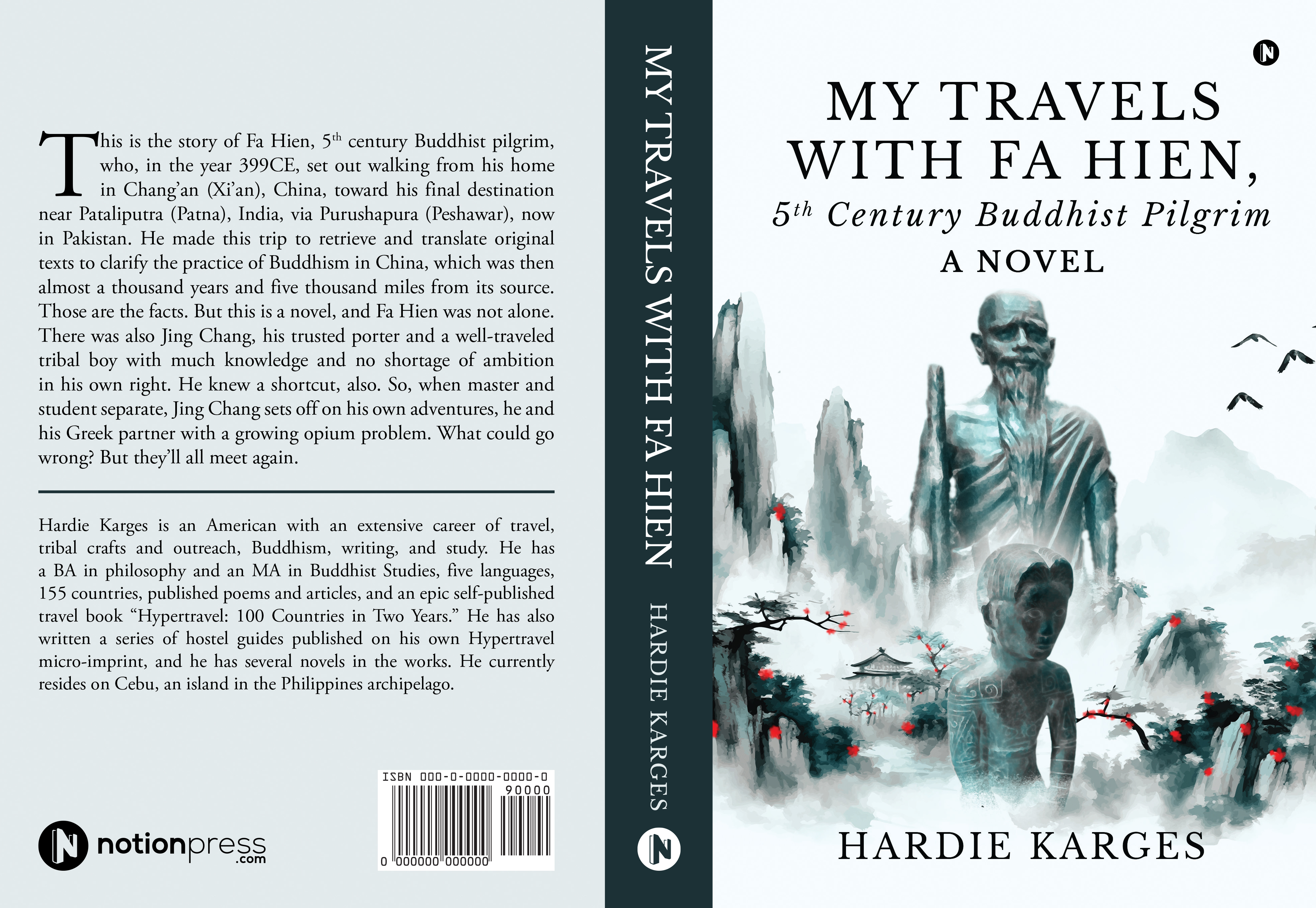
    Coming soon to an Amazon near you!

    I am happy to announce that the book “My Travels with Fa Hien, 5th Century Buddhist Pilgrim”, is now available in Kindle E-book at Amazon US (others soon) as well as physical copies there and at Notion Press, Flipkart, and bookstores in India. This is the true story of the 5th century Buddhist pilgrim on a 5000 mile trip from central China to eastern India via what is now Pakistan and the mountains and valleys that lie between. In the course of his travels, not only does Fa Hien complete his mission to find the true origins of Buddhism, while translating its sacred texts, but his crew manage to have adventures of their own in the process. This occurs while Rome falls and Europe enters its Dark Age on the other side of the world. It’s a travel book; it’s a dharma book; and it’s a history book, all in one. This is my tribute to Buddhism, Asia, and multiculturalism at its finest. A portion of all sales will go to charities in India. For more information and samples, please join my Fa Hien Facebook group. Enjoy.

    My involvement with this project began with the completion of an MA in Buddhist Studies, at the age of 65, after a long history of travel that covered some 155 countries, during which I studied language and cultures, while buying folk art. Much of that occurred at or after the age of 55 as documented in my own travel epic “Hypertravel: 100 Countries in Two Years,” published in 2012. After that I spent several years compiling travel guides to world hostels, again published on my own micro-imprint. As my interest in Buddhism grew, I attended retreats and spent time in temples and monasteries in Thailand and Myanmar, before finally entering International Buddhist College in south Thailand as an MA candidate in 2017. I completed my MA in 2019, while studying on campus and online, with much travel in Asia.

    Then came the pandemic. After a growing interest in the story of Fa Hien I finally started writing the manuscript in late 2020 in Guatemala and finished the first draft in early 2022 in Lumbini, Nepal, the birthplace of the Buddha himself. After many rewrites and a 2023 sabbatical waiting for further inspiration, I finally finished the book with several new chapters in 2024. Upon careful consideration I decided to publish the book in India, which is the setting for much, if not most, of the book. Unlike the West, also, Fa Hien is known widely there, even if he never gained the hero status that his imitator Xuanzang did in China with the classic epic ‘Journey to the West’. I’d like to change all that and give credit where credit is due, for the sake of Buddhism and travel. A portion of all sales will go to charities in India. For more information and samples, please join my Fa Hien Facebook group. Enjoy.

     
  • Unknown's avatar

    hardie karges 4:40 am on November 24, 2024 Permalink | Reply
    Tags: ashrama, , , , , , India, , , , , sannyasin, , ,   

    Buddhism 399: Homelessness and the Joy of Giving… 

    Give more than you take. That will be more than enough, and the world will be a better place. That is the essence of almost all religions, Buddhism included, regardless of whether you consider Buddhism first and foremost a philosophy, as I tend to think. But philosophies don’t usually include a call to action, whereas religions usually do. Buddhism doesn’t do that, though, not specifically, but it is implicit in the practice, the original practice. That’s why you’ll see orange or yellow-robed shaved-head monks walking through the markets at daybreak in almost every Theravada country in SE Asia, requesting alms for subsistence, usually food. This giving is usually known as dana.

    This harkens back to an even earlier practice in India wherein long-haired rishis and sannyasins wearing similar saffron clothing but usually without a group of like-minds, would make similar rounds, a practice which continues to this day. The difference is not only that the former are Buddhist and the latter Hindu, but the former have rules and regular routes, and are often registered for this activity, whereas the latter are more likely free and on their own, often in the last phases of life according to the four Hindu ashramas of student, householder, forest dweller, and renunciant—nice.

    But the important thing is the giving. So, instead of seeing a renunciant as a societal parasite reduced to begging, we should see them as symbols of purity, offering laypersons the opportunity to experience the same bliss of renunciation that they not only symbolize but incarnate. It’s only ironic that they themselves often consider themselves—and call themselves—homeless, no pun intended. Because that is the little joke they play on all of us, that the poorest people of the West are linguistically identified with the holiest of the East. I only wish that Western practitioners would follow the same precepts. The food is usually pretty good, at least in Thailand.

     
  • Unknown's avatar

    hardie karges 4:36 am on October 27, 2024 Permalink | Reply
    Tags: , asceticism, , , , , , , , India, , , , , Padmasambhava, , , , Upanishads, ,   

    Buddhism is the Middle Path between Jainism and Brahmanism… 

    Brahmanism is what we now call ‘Hinduism’, but that term didn’t really exist way back when, only recently applied by the Brits to the plethora of sects and devotions which now constitute Hinduism. But it was in the midst of the Upanishad era at the time of the Buddha, which would redefine the previously Indra-based fire rituals which had reigned during the Vedic times. And with the advent of the new Upanishadic orientation, the resulting resemblance to Buddhism was profound—but still distinct.

    And so was Jainism distinct from both of them, at the same time that it shares much with them. But remember, that the ‘Hinduism’ that the Jain reacted to in the 6th century BCE is not the same as modern Hinduism, either, and that is partly because of this same three-way dialogue. Jainism was largely a reaction against the Brahmanists’ fire sacrifices, they being extreme nonviolent vegetarians. But many modern Hindus are also vegetarians, with Buddhists characteristically somewhere ‘in between.’

    That’s the Middle Path, specifically between the extreme asceticism of the Jains and the lavish rituals of the ‘Hindus’, but also between the many gods of Hinduism and the total lack of them in Jainism. Technically Buddhists don’t really have them, either, but, you know… Later versions of Buddhism were not so strict about that, such as the Tibetan version of Vajrayana, which came direct from India sometime after the 5th century and attested by Padmasambhava in the 8th century.

    But both Jains and Hindus were crazy about souls, Jains finding them everywhere and Hindus finding them cosmic, Atman, preferably in union with the cosmic dharma principle Brahman. But Buddhism found little of value in any of that, and so chose non-self anatta. So, they all evolved into different sects with different orientations, and we generally all get along nicely. The main difference is that Hinduism tilted toward a nationalism which international Buddhism could never assimilate. And Jains, ‘winners’ in Sanskrit, were ultimately the losers.

     
  • Unknown's avatar

    hardie karges 4:03 am on May 26, 2024 Permalink | Reply
    Tags: , dissatisfaction, , Existentialism, , , , India, , , , , , , , , , , , , ,   

    Buddhism 499: Sometimes Some Things Are Lost in Translation  

    Beware re-translations. The Buddha spoke a Sanskrit-related language. Sanskrit never went extinct. ‘Dukkha’ still means ‘suffering’, sorry. Many Western Buddhists try to manipulate the message, however slightly, to make it more appealing to Western tastes, but that says as much about Western tastes as it does about Buddhism. The issue in question, of course, is the First Noble Truth, which states something as innocuous—and obvious—as the fact that suffering exists, nothing more, nothing less, UNLESS: you want to make that jagged little pill a little easier for someone from Hoboken to swallow. 

    Because if the principle of suffering is important enough to list it first and foremost as the foundational principle of your new religion, then that’s easily hyperbolized into such platitudes as ‘Life is Suffering’, ‘All Life is Suffering’, and so on, which is understandable, but somewhat depressing for many Western tastes accustomed to fast food and Ferris Wheels (for those of us raised on Existentialism, it’s not such a problem). But the easiest way to mitigate that circumstance is to soften the edges of that term ‘suffering’ to make it sound more like ‘dissatisfaction’, ‘stress’ (ahem), ‘spot of bother’ (maybe ?), or my favorite: ‘bummer’, haha. 

    Okay, so I’m joking a little bit, but the modern notion of ‘stress’ was surely unknown in 5th C. BCE India, so that’s a bit of a joke, also. But the effort at mitigation is certainly allowable under the Buddha’s own notion of ‘skillful means’, so it’s just a question of what’s appropriate. Bottom line: dukkha means ‘suffering’ as surely today as it did 2500 years ago, as a quick trip to Google Translate will quickly prove (yes, they have Sanskrit). The problem is that many Westerners see life as something ‘fun fun fun’ and so actually want rebirth or reincarnation (if not eternal life), while many traditional Easterners downplay any attachment to this cosmic play of samsara, while seeking release in Nirvana. 

    What to do? Nothing, really, because Buddhism should not be concerned with gaining adherents or scoring points, but merely offering some solace and refuge for those who need such. The world is what it is, and you’re probably going to die, regardless of any and all medical advances (though Virtual Reality is a remote possibility). Therefore, even the best scientific advances can only be limited in scope, and satisfaction with those limits is much better than trashing ourselves and/or the planet in frustration. As always, the middle path offers a practical solution: enjoy life, but don’t get too attached to the wheel. Accept some limits without total submission to them. Persevere. The middle path is long and winding.

     
  • Unknown's avatar

    hardie karges 4:59 am on April 21, 2024 Permalink | Reply
    Tags: , , , , , India, , , ,   

    Buddhism 202: Nature is the Law of Life  

    Nature is a law, not a mountain. Rivers and oceans have no more independent existence than you or I. But this is a bone of contention among religions, now, isn’t it, and possibly the main point of division between competing philosophies? Because, if an eternal soul divides Hinduism from Buddhism in India, then the same issue is what divides almost all Western religions from their secular counterparts. After all, isn’t that why most Asians become Christians? Eternal life is Christianity’s main selling point internationally.

    But Nature tends to get a pass from such easy distinctions. Mountains are sacred and rivers aren’t bad. Beaches draw the riffraff, but sublime locations can still be had, if one cares to take a walk and distance oneself from the madding and maddening crowds. And isn’t that what makes a place spiritual, anyway, the silence and the solitude and the serenity implicit in such sublime locations? Bring in the tourist hordes, and the nicest places can quickly go downhill fast, training wheels optional. 

    But that’s neither here nor there from the standpoint of the law that is dharma. The only important thing from the standpoint of dharma is the fact that these phenomena occur in regular and predictable ways, subject to certain causes and conditions. Thus, nature is not random, not entirely, anyway, and not within the time scales utilized by human perception. The implicit beauty is just eye candy for hungry hearts. More important are the principles that govern such relationships. In Thai nature is ธรรมชาติ, dhammashart, the law of life… 

     
  • Unknown's avatar

    hardie karges 5:15 am on February 4, 2024 Permalink | Reply
    Tags: , , , , , , , India, , , , , , , , , ,   

    Buddhism: Meditation, not Mysticism…  

    Buddhism was never intended to be mystical. Buddha was very rational in his take on life and suffering. Any mysticism came later, mostly in the Vajrayana Buddhism of Tibet that came directly from India, not China, and which had taken firm hold in that country by the Eight Century CE. And while that ‘school’ of Buddhism is often included in the Mahayana tradition which traveled through, and was greatly influenced, by China, such is not the case with Vajrayana, which derives from a later, maybe the last, Indian Buddhist tradition, before it succumbed to the coup de grace by the invasive Mughals, after centuries of losing ground, and followers, to the Brahmanist Hindus. 

    About the only thing that all the Mahayana schools have in common, in fact, is that they are not of the original Theravada tradition, which originated in India and found fertile ground in southeast Asia, mostly. And if the Vajrayana tradition is famous for its multiple levels of heaven and hell, its Tantric yab-yum, mudras and mantras, then Theravada (aka Hinayana), is best known for its lack of all that, and concentration on meditation, especially, to the extent that it’s sometimes known by that most famous meditation technique Vipassana. Meanwhile the Mahayana Buddhism of China is probably best defined by its transcendent Buddha and the vast Emptiness of reality, both more recent developments.

    Many famous Chinese monks, Fa Xian and Xuanzang foremost among them, even made long arduous trips to India just to get it right, like Charlemagne realizing his 8th century French language wasn’t proper Latin. And mostly I believe that meant learning meditation, and some other disciplines, which Theravada monks usually excel at, and Chinese monks often suck at—to this day. In fact, I didn’t really even know what meditation was until I attended some Theravada-based meditation retreats in Southeast Asia, intended for Asians, not Westerners. When you see a layman sitting silent unflinching for two or three hours lost in no-thought: that’s meditation. The monks are even better at it. Now I get it. Get it. 

     
  • Unknown's avatar

    hardie karges 3:12 am on November 20, 2023 Permalink | Reply
    Tags: Alexander, , , , , Gymnosophists, , India, , , , Pythagoras,   

    Buddhism and Christianity in the Future of the World…  

    Christianity was perhaps better to develop a raw wild unruly world. But Buddhism is better to sustain it. All of which avoids the issue of whether we will survive or not. But, isn’t it better to have developed the world and lost, than never to have developed it at all? Hmmm, I’m not sure, because it seems that we could have developed mentally, and consciously, without ever filling the landfills with so much kitchen appliance junk that our lives are full of, whether we ever perfect the perfect counter-top blender or not. Remember them? 

    But, one thing is for sure: if our civilization collapses, future archeologists will certainly have fun trying to figure it all out, assuming that the historical narrative is fundamental to that civilization, so, it, too, will also likely be lost. Only time will tell, because war is so fundamental to civilization, that to lay down arms, in an effort to reconcile our differences, would be seen as treason to many a competing contender to world dominance. Such is our world and our lives.  

    With the recognition that northern India and modern Europe are genetically related, it must have been interesting to sit around gatherings on the northern steppes when they all spoke a common language, but with apparently different opinions. Because northern Indian philosophy has offered a distinct alternative to the European analytical quest since time immemorial, and that is the milieu from which Buddhism arises, debates with the Brahminists and the Jains.  

    But the Platonists and Pythagoreans had their own issues, never the twain to meet, until Alexander sought the Gymnosophists there in India and the East and West renewed their long conversation left behind on the northern steppes. Now here we sit, trying to make sense of it all, human diversity trying to respond to natural laws, which can only be surmised and rarely proven in the first place or the second instance, and so the only satisfaction lies in trying—or not, if you’re a renunciant.  

     
  • Unknown's avatar

    hardie karges 8:30 am on August 29, 2021 Permalink | Reply
    Tags: , , , , , , , India, logos, Persia,   

    Was Heraclitus the Original Buddhist? 

    Was Heraclitus the Original Buddhist? If not, he certainly missed a good opportunity, because it was he who once said: “No man ever steps in the same river twice, for it’s not the same river, and he’s not the same man.” And a clearer and more succinct articulation of the Buddhist principles of anatta and anicca have never been spoken, the former best defined as ‘non-self’ or ‘no self,’ particularly in the sense of a permanent eternal soul like that of the contemporaneous Brahmanic religion, or Hinduism, as we now know it. But of course Heraclitus was not a Buddhist, per se, but a philosopher of change, and maybe best known for his other famous quote: “The only thing permanent is change.”

    And so he tackles two major Buddhist themes—self and change—with no knowledge of the Buddha himself, apparently, though the possibilities are there. I’ve written often about the genetic and cultural connections between the Greek and Indian philosophers, so I won’t do that now, but it’s interesting that not only do they share significant genetic ancestry, but are contemporaneous in the case of Heraclitus, who lived almost exactly the same time as the Buddha. Add to that the fact that he and the other Ionian philosophers were technically part of the Persian Empire, which spanned the entirety of the 2000mi/3000km between the Greek and Indian mainlands, so it’s tempting to speculate.

    Maybe they had Twitter pigeons? Ha! But the main difference is that the Buddha saw change as a cause of suffering, second only to craving, and Heraclitus did not. For him it was simply a fact of life, like fire, for him the basic ‘stuff’ of existence, as with the Vedic ‘acharyas’ and ‘pandits.’ ‘Basic stuff’ was the obsession of all pre-Socratic philosophers, many of them Ionian, the original word that meant ‘Greek’ in most Asian languages. His logos was also very dharma-like, and Buddhist dharma, in particular, is not fixed, but flexible enough to adapt to a variety of circumstances over time and over space.

    Whether the Buddha intended it that way or not is debatable, but if he considers change a source of suffering, then it is doubtful. That’s just the way it is, and thus proof of the reality, if not the suffering. The suffering is yours—or not. I remember crying when my family moved from the city to the countryside when I was eight years old. Now I seek out new countries all the time, 155 and counting. So, it is not a source of suffering for me, obviously. Thus, the Buddha may have made the mistake of over-generalizing. He was only human, after all. The transcendent Buddha came later. That’s Mahayana: Zen and all that jazz. Craving is still the main cause of suffering, that and attachment to self, as ego. That’s the other aspect of self to be avoided, however impermanent, always doomed to fail.

     
  • Unknown's avatar

    hardie karges 10:44 am on August 8, 2021 Permalink | Reply
    Tags: Alexander the Great, , , , , , Hindi, India, , , , , , , , , shaman, , , , , Yaqui   

    Buddhist Metta-tation, Friendship Beyond Thought, Language Optional… 

    The truest love is metta, friendship, without all the burdens of possession. That’s Buddhist love, of course, without all the weeping, wailing, and the gnashing of teeth. The Pali word metta often gets written up as ‘lovingkindness’ by latter-day Buddhists, mostly American, who want the passion that term implies, but the Buddha likely intended nothing of the sort. That’s a Christian term, too, from the Hebrew chesed, with a heavy dose of devotion implied, but the Buddha seemed to intend none of that, and the word’s presence in many other Asian languages of the time reflects none of it, either.

    So ‘lovingkindness’ would seem to come from a totally different line of descent by genome. Culture is not genome, though, of course, though they often parallel one another, and the ‘Judeo-Christian’ tradition seems to reflect that. So, we Westerners tend to be emotion junkies, even when that emotion is not necessarily a pleasant one. We are implored to embrace suffering, by that logic, even though suffering implies pain, and the heavy dose of sadness that often brings. The fact that the Pali word dukkha means ‘suffering’ and the related word dukhee means ‘sadness’ in modern Hindi would seem to reflect that range of intent.

    (More …)
     
  • Unknown's avatar

    hardie karges 11:49 am on October 4, 2020 Permalink | Reply
    Tags: , , , , , , India   

    Buddhism and Christianity Occupy Different Realms of the World and Mind.. 

    The best religions unite us. The worst religions divide us. Most do nothing at all—except give a momentary feeling of satisfaction, at a job well done, vindication for following a path, any path, and somehow defining one’s life in the process, even if the changes are subtle.

    We can snicker now at the circumstances surrounding the split between the universal Catholic church of Rome, as it splintered into a thousand Protestant denominations—names—as if, ‘What’s the big deal?’ But at the time it was a very big deal, even if the results and ramifications would not be known for a century or two, just like Athens and Rome before it, and those are the lessons, contained in the names, as each country tries to personify itself in the religion of its choice.

    But one of my favorite themes is that at its origins and Sunday best, a religion should try to change you into something better, so not necessarily what you want to be, but what you should be, as determined by the high priests of your subconscious. But I’m not sure that works. Has Christianity made Europe and America less violent and aggressive? Good question. Has Buddhism made Asia less possessive and grasping? I’m not sure.

    What I am pretty sure of, though, is that it makes us feel better, if only for a day, week, month, or year, and serves as a constant reminder of what we should be doing, even if we fall so unfailingly flat so often. But if our feelings of guilt once pushed us toward religions that chastised us for our failings, now we tend to gravitate toward those that make us feel good in spite of them, best not to even mention them, lest someone should feel a twinge of regret for not doing better.

    So at the same time that we now feel less guilty, our societies and families continue in a downward spiral, those who can’t be bothered to improve themselves, at the cost of a moment’s self-sacrifice. And that is a shame, because instant gratification is a cheap trick at best, and a descent into the abyss at worst. And as it is with Christianity, so it is with Buddhism, and other Eastern religions.

    Buddhism often gets written up as the export version of Hinduism, and if I can’t really agree with that, there is certainly some circumstantial evidence to support it. What is acknowledged less often is the contribution of the resident Jains, who, at the time of the Buddha, were the inspiration of much of the religious seeking, defining and refining that was going on in India at the time of the Buddha, around the mid-millennium before the time of Christ.

    And the same splintering occurred with Buddhism, Hinduism only spared the process, because it was never a doctrine in the first place, and maybe that’s why it was never suitable for export. Ask an Indian. Given sufficient time and circumstances, I think that all religions, despite best original intentions, will devolve into devotion, pure and simple.

    Is that what it takes to unite us? If so, then I suppose the only question is: to what are we devoted? Take your pick. When the world is too cold, warm it with your heart. When the world is too cruel, make it kinder. When you are weary, sleep…

     
c
Compose new post
j
Next post/Next comment
k
Previous post/Previous comment
r
Reply
e
Edit
o
Show/Hide comments
t
Go to top
l
Go to login
h
Show/Hide help
shift + esc
Cancel
