Tagged: Hardie Karges Toggle Comment Threads | Keyboard Shortcuts

  • Unknown's avatar

    hardie karges 2:32 am on June 15, 2025 Permalink | Reply
    Tags: Bing Crosby, Buddha's Brain, , dopamine, Hardie Karges, , limbic system, , , neurons, pre-frontal cortex, Richard Mendius, Rick Hanson, ,   

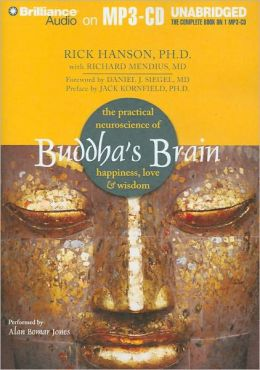
    BOOK REVIEW: “Buddha’s Brain”: by Rick Hanson and Richard Mendius 

    This book has been out there a while, about twenty years, but not only did I just now discover it, but I suspect that many people who’d like to ingest this kind of knowledge and information are more interested than inspired, because it’s not easy knowledge to ingest, without resorting to woo-woo and juju, which ultimately does not hold up to peer-reviewed scrutiny. Because this is the point where spirituality meets science, and the path is not for the weak hearted. The basic idea is that your mind, and by extension your brain, or vice-versa, in effect control the keys to your happiness, and that is the path of your salvation. To accomplish this Hanson the neuroscientist PhD and Mendius the MD mix and match metaphors and math to navigate this path for you. But where to begin?

    They begin with what could be considered the mantra for this entire book, a quote so powerful that I used it as a standalone quote on my Facebook page: “Neurons that fire together, wire together,” meaning in short, that you can create a neural network that facilitates your happiness with the same ease and simplicity that you can go to a doctor, or a university, or a friend’s house for after-dinner drinks that might lead to the love of your life, and that sort of happiness. But wouldn’t any of those go better and easier with the kind of mental attitude and predisposition that almost guarantees success? You can create that. And, if that goes against the belief in ‘Thoughts without Thinkers,” well, so be it. That was never meant to be a call to inaction, but more like a generality, or a palliative, or a reminder to ‘not think too much.’

    But, there must be a place in our lives for ‘right thoughts’ and ‘right actions’ and this is a good place to begin, i.e. mind training. Unfortunately, our brains and therefore minds have a negativity bias for survival, so this must be at least partially overcome, since it quickly leads to the suffering of separateness and a world of simulation which is very different from the present moment that largely defines sati, mindfulness. Because the second dart is often worse than the first dart, as explained here, i.e. our reactions are worse than the actions which have caused the negative effects that we are trying to mitigate. It’s a vicious circle, the dog chasing its tail when the tail is not the problem; the chasing is the problem. It is here that meditation can come to the rescue to reboot the action-reaction sequence with a solid dose of silence as salve and salvation.

    If happiness is the goal, then we need to ‘accent the positive,’ or ‘Ac-Cent-Tchu-Ate the Positive’, if you prefer, all thanks to Bing and the Andrews Sisters and Johnny Mercer, while avoiding any and all clichés and giving a break to Mr. In Between, haha. Because  as Buddhists we can seriously identify with that, all extremities duly avoided by Buddhist writ long unwritten. But meditation can only create a level playing field, per its role as the zero shunya of shunyata which is so important to the advanced transcendental Buddhism of Mahayana. Once the fires are calmed, then the neuroaxis can begin to do its thing, with the brain stem, limbic system, and pre-frontal cortex, etc. Sounds complicated, but guess what? It doesn’t have to be. It can be as simple as not responding to that first dart, adding your second dart to the karmic mix which, once established, becomes increasingly hard to shake.

    And, if non-response sounds like ‘spiritual bypassing’, then, once again, so be it. That’s the whine of psychiatrists who fear a loss of revenue. Buddhism is a religion of at least partial renunciation. Because there are (at least) two wolves in every heart: Love and hate. Love and hate create us and them. The only cure is empathy, easier said than done, true, but not too hard. Just add kindness, and compassion. The compassion is to cure suffering, and the kindness is to bring happiness. Kindness is pre-frontal. Enlarge your circle. Meditate. Make it frontal. Control your attention; basal ganglia seek attention. It’s the power of meditation; sati leads to wisdom. Rapture and joy bring dopamine. Fast gamma waves bring singleness of mind. Relax the Self: don’t take things personally. Self is a convergence of many neural networks. It’s a process, always changing. Any questions? Don’t think too much. Chill. It’s worth the read. I give it a four.

     
  • Unknown's avatar

    hardie karges 3:12 am on June 8, 2025 Permalink | Reply
    Tags: Bharata, , , Hardie Karges, , , , , , ,   

    Buddhism: Dharma is a law of Nature… 

    Dharma is a law of Nature, not a law of men. That much must be acknowledged, even if the details are a little bit sketchy. After all, it would be much too easy just to call it the ‘law of the Buddha’, since it precedes that event by a thousand years or so, even if the details are still no less sketchy. But the Vedic Brahmanists used the word profusely, as if the meaning were obvious, and so we could probably surmise that the term meant something like Socrates’s ‘good life’ or just ‘living right.’

    Project that concept into the future Sanatana Dharma and you’ve got the phrase that traditional natives from India, Bharat(a), use to call the vast field of knowledge and belief that we call Hinduism. But I think that Buddhism refined the concept, even without limiting it, not really, as something analogous to the Middle Way, a path between luxury and lack. Add to that the early Buddhist association of dharma with jati, life, to refer to nature, dharmajati, and the symbiosis is complete.

    Dharma is irrevocably connected to nature, without much concern for who gets the credit. And that is the Holy Grail for modern creator-less religion, of course, something nature-based and at the same time rational and open to science. Bingo. That’s Buddhism without the superstition, meditation-based, Vipassana, discipline without all the deities. Now reference the Thai Forest Tradition, or any other forest tradition, and the circle is complete, also. Nature is our temple, and dharma is our practice.  

     
  • Unknown's avatar

    hardie karges 9:16 pm on June 1, 2025 Permalink | Reply
    Tags: , , Hardie Karges, , ,   

    Buddhism: Compassion is Key… 

    Even the wicked deserve compassion, because it’s never too late for them to change their wicked ways. As a matter of fact, it’s mandatory, because otherwise, if we accept that there are certain ‘kinds’ of people, then we are denying free will to those who need it most, the habitually wicked and morally compromised. And, if forgiveness is too Christian for you, then just call it compassion, and don’t worry about who did what way back when and then started it again just when you almost forgot it.

    The important thing is to mitigate the suffering and promote reconciliation, even if that means foregoing some choice words and fierce jabs in the heat of battle with no breaks to be had, just compassion. Because language is not always a solution and often is the problem itself. That’s no surprise, since, in the history of the world, it’s obvious that homo sapiens only came to reign supreme with the advent of language and the advantages that brought to the battlefield—and the bedroom.

    So, if the bottom line of any Buddhist equation is self-control, then so be it. Because it requires no self, and not much control, really, just wise decisions and the ability to pull punches and hold your temper. It’s hard these days, true, what with politics flying and tempers flaring all for the cost of a taco, but even more necessary because of its prevalence. What happens to us when we’re angry and hateful all the time? That’s no way to live and an even worse way to die. Control yourself to control the situation. Forego the heat of battle to gain the coolness and calmness of forbearance.

     
  • Unknown's avatar

    hardie karges 2:39 am on May 25, 2025 Permalink | Reply
    Tags: , , , Hardie Karges, , , ,   

    Buddhism 599: Change (Impermanence) is Not so Bad, After All… 

    Nature is the greatest and wisest teacher, unfailing in her knowledge and unerring in her accuracy. In Thai the word for Nature is dharmajati, pronounced something like thammashart, so literally the ‘law of life’, unless you have a better definition of dharma¸ then feel free to use it. The point is, that for all its diversity and beauty and apparent randomness, Nature (with capital N now; see what I did there?) is not only a law, but it’s permanent. This is something that the Buddha warned against constantly, the impermanence of existence, so not something to take lightly.

    That’s because the laws of men are temporary and changing, but the laws of nature are immortal. Now, I probably wouldn’t go as far as the Buddha himself in claiming that change is a cause of suffering, maybe second only to craving and clinging, but still, permanence is a wonder to behold. And if change is only painful when you refuse to accept it, then it can be something truly special when you initiate it yourself. I’m not sure if the Buddha ever experienced that, but I think that it holds true, and I swear by it myself.

    So, if there’s any one thing that I would improve on with Buddhism, it would be the negative connotation of change (and the status of women). Change can be something good, if it follows the Eightfold Path, and so something to seek, not necessarily something to avoid. In the ancient world, I can certainly understand how that could have been an issue, but in our modern world, I think that the greater sin is to avoid change altogether. As always the trick is to follow the Eightfold Middle Path and pursue Right Change, not the bad stuff. Avoid that.

     
  • Unknown's avatar

    hardie karges 2:31 am on May 18, 2025 Permalink | Reply
    Tags: , commandments, Hardie Karges, , , ,   

    Buddhism 401: Language Falls Flat 

    Politics is rarely polite. Civilization is often uncivilized. And language is hardly equipped to explain why. So just be nice. Stricter commandments may be easy to come by and easy to plaster on walls and gates, but the cost of strict enforcement is rarely worth the time it takes. So, why make things complicated when a simple rule of thumb will do? After all, aren’t the Buddhist precepts and the Christian commandments similar enough that they hardly bear endless repeating?

    The main difference is literary, the contrasting roles of commandment and prohibition, and active voice versus passive voice, differences more of style than substance, the Western preference for direct action versus the Eastern predilection for unspecified involvement. After all, sometimes there is little action available except for jumping up and down, which rarely solves many problems and often creates new ones. In any case language is rarely equipped to help much.

    In fact, meditation is the crowning achievement of Buddhism, by almost any measure. Some ‘schools’ emphasize it more than others, true, but all respect and encourage it, and Theravada has largely redefined itself as Vipassana, one of the more ubiquitous and modern forms of meditation, though I personally make not so much difference between them, except in the case of silent versus ‘guided’ meditations. Either way, language rarely explains much, but if it can ‘guide’ or show the way, then that is the proper role for it.

     
  • Unknown's avatar

    hardie karges 4:25 am on May 11, 2025 Permalink | Reply
    Tags: , , , Hardie Karges, , , , , ,   

    Buddhism in a Time of Troubles 

    In times of chaos, we need calm minds. In times of crisis and cruelty we need strong hearts. Welcome to the USA, c. 2025. It is a time of peace. It is a time of war. There’s no real way to know what future historians will think about this era, but it probably won’t be good. Goodness is as goodness does, and cruelty just doesn’t count for much, unless you’re engaged in some frightfully fanciful fantasy. But Buddhism is just the opposite of that, and that comes after many a long involved historical dialectic, the likes of which continue to this day.

    But cruelty was never the kicker. Kindness is. The Dalai Lama said it, and I’d second it in a second. In Buddhism you don’t really have to do much of anything, as long as you’re nice about it. In fact, Buddhism is defined more or less by what you’re NOT to do, e.g. the precepts, not to be confused with the commandments, more like the prohibitions. Then there’s Emptiness, ‘shunyata‘, which veritably defines Buddhism by its lack of requirements, meditation being the prime example.

    So, the trick is not to be consumed by the swirl of politics and policies, even when the angst is almost overwhelming. After all, sometimes the worst situations eventually yield the best results. The important thing is to hold fast to certain principles, no matter how difficult that can sometimes be. Then there are ‘skillful means.’ That means that sometimes difficult goals can be accomplished in unfamiliar and unexpected ways. Be creative. The world is waiting patiently.

     
  • Unknown's avatar

    hardie karges 4:38 am on May 4, 2025 Permalink | Reply
    Tags: advaita, , , , Hardie Karges, , , , ,   

    Buddhism on the Installment Plan: Samma Advaita? Coming Soon… 

    There should be no quarrel between science and religion, or philosophy and physics, because truth is an evolving body of knowledge. But there is, and it can occupy a lot of space in that wide hopefully open field called consciousness. And if ‘dualism’ is looking for some extra work on tricky subjects, then the opposites of mind and body, or matter, is not a bad place to start. Because that is the core dichotomy which underlies them all, usually, to the point that a convenient synthesis is really not possible.

    If there were an easy synthesis to override the apparent duality, then it would be a simple dialectic. That’s easy with adjectives, but not so easy with nouns. So, the better alternative is often to define the space, so that each can exist in its own sphere of influence. Physics by definition deals with a material conception of reality, and so philosophy should respect that field of knowledge, since nothing can be proven beyond a shadow of a doubt.

    Thus, there is no true metaphysical certainty, because it presupposes an inquiry which is logically misplaced. Philosophy is better off with ethics and logic and anything ese for which certainties are possible. Likewise with science and religion. Science is a method of proof. Religion is not, and more often than not is defined by acts of devotion. That’s not Science, so it’s best to ask questions pertinent to each of the two disciplines. Right non-duality to go with right views and right action? We’re working on it…

     
  • Unknown's avatar

    hardie karges 4:33 am on April 27, 2025 Permalink | Reply
    Tags: , Hardie Karges, , , , , ,   

    Buddhism Meditation and Emptiness 

     Meditation is the art of open heart and open mind, closed mouth, eyes optional. To me it’s almost amazing how many Theravada Buddhists don’t meditate at all, but I suppose that speaks to the time and the place as much as anything, as well as the ultimate goals and prime motives. Because a Thai citizen or resident doesn’t really need a motive to be Buddhist, except to be good and be social and contribute to the overall well being of the populace. If you’re already Buddhist, then you don’t really need a reason to be Buddhist.

    But a Westerner needs a reason to be Buddhist, and so for many of us that’s long been a choice of Zen or Vajrayana (Tibetan), two of the more exotic versions of the field, and so an attraction to those for whom an attraction is helpful. The only problem is that the Buddha himself might not recognize either of them as representative of his teachings. For us street-corner philosophers, that’s plenty of motivation by itself, the simplicity and veracity of the original message. So, now that Theravada is re-branding itself as Vipassana, pure and simple, that accomplishes a necessary goal, to get Buddhism back to its root without worrying about word games and past lives.

    Because Theravada Buddhists were always the best meditators, even if many never did it. And meditation can accomplish with practice what precepts and concepts can only suggest with words. You can talk about shunyata—emptiness—all day and not know much more than what you started with. Or you can sit silent unflinching for an hour while concentrating on breath and know quite a great deal, without uttering a word. It’s an acquired taste.

     
  • Unknown's avatar

    hardie karges 4:35 am on April 20, 2025 Permalink | Reply
    Tags: , Hardie Karges, , , , , , , , ,   

    Buddhism and Mindfulness, Language and Life… 

    ‘Mindfulness’ is a tricky term, full of modern marketing. I prefer ‘consciousness,’ the original meaning to the same word in Pali, sati. Now that may seem like a minor quibble, but I prefer to keep superstitions and general ‘woowoo’ and ‘joojoo’ to a minimum for easier acceptance. Because I don’t want Buddhism to be something magical and mystical, even if that brings in some fervent fanatics full of vim and vigor. But it rules out science and that is the problem for me. Religion and science should be perfectly compatible, and that is best accomplished by staying off each other’s turf.

    Maybe it’s an impossible task, I suppose, but it’s still worth trying, I think. Because already a certain stratum of words has been ‘Buddhafied’ and elevated to a meaning that doesn’t conform to that of the ordinary world and its ordinary usage of the word. I’m not worried about the extra work of cataloging two meanings in my mind, but I’m concerned that we’re losing something by avoiding that original meaning. So, when samsara comes to mean ‘endless cycle of rebirths’, rather than its original meaning as simply ‘the world’ (e.g. in modern Nepali), well, something has changed, and not always for the better. You can check to see if that original meaning still works in every case, and it does AFAIK, but with a difference—authenticity.

    Only rarely does a word totally change meaning within the historical period, like the English word ‘passion’, for instance, once suffering, now a kind of special love, for us silly westerners, of course. In modern standard Thai, the word that now means ‘mindfulness’ is sati, from the Pali, but there it simply means consciousness. When I was lying on the side of the road after a motorcycle accident near Wiang Papao, no one was asking if I was mindful. They were asking if I was conscious. There’s a difference. Original early Buddhism was very down to earth. Transcendence came later. For me mindfulness is the opposite of mindlessness, pure if not simple.

     
  • Unknown's avatar

    hardie karges 4:06 am on April 13, 2025 Permalink | Reply
    Tags: , , Hardie Karges, , , , superstition   

    Buddhism 101: You shouldn’t take more than you give… 

    Give more than you take, and the world will become a better place. It’s almost hard to believe that something so hard could really be so easy, but I tend to think that it’s true, and that’s how I try to live my life. Because, for one thing, it places high value on the concept of giving, regardless of the amount, and I think that’s important. But how much to give? That’s often a tricky question. So, it’s very easy just to simplify the equation. Just give more than you take.

    So, not only is that a net positive increase for the world, but it speaks to karma, also, and that’s one of the toughest concepts to tackle. But it shouldn’t be. Do good things. Karma means action, and samma kammanta means right actions. Nothing is more right and good than giving. That’s called dana. But how much is enough? Give more than you take. That’s plenty. And that’s good karma, so you will be rewarded, somehow some way, somewhere. That’s as far as my superstitions go.

     
c
Compose new post
j
Next post/Next comment
k
Previous post/Previous comment
r
Reply
e
Edit
o
Show/Hide comments
t
Go to top
l
Go to login
h
Show/Hide help
shift + esc
Cancel