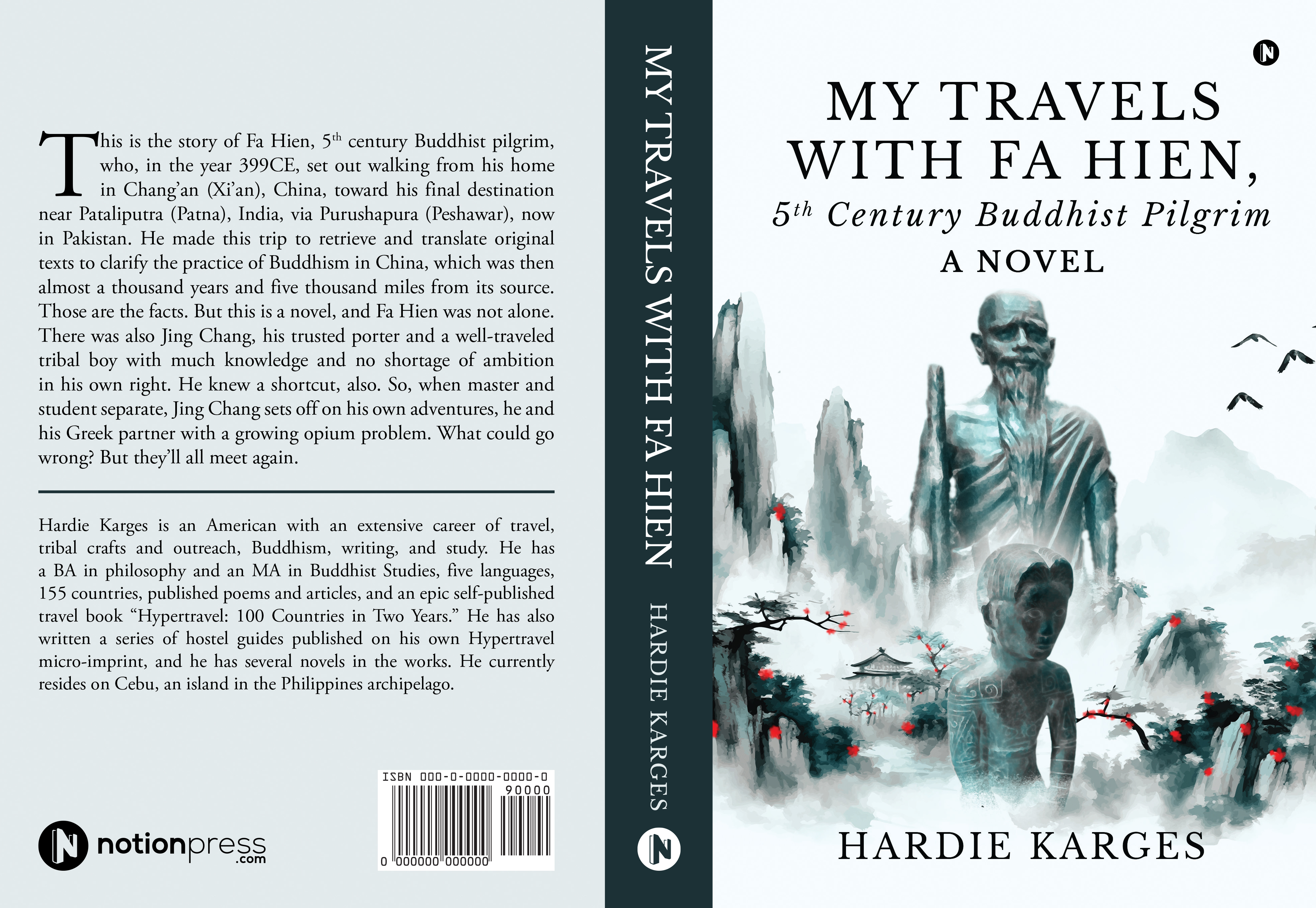
Tagged: Hardie Karges Toggle Comment Threads | Keyboard Shortcuts

  • Unknown's avatar

    hardie karges 3:02 am on August 24, 2025 Permalink | Reply
    Tags: , , , Hardie Karges, , , , , , , , ,   

    Buddhist Middle Path: Hold Your Applause 

    All you need is kindness. Compassion is good, too. These are the Buddhist foundational concepts known in the Pali language as metta and karuna, often combined in modern standard Thai language as mettakaruna. I guess that’s similar to the Christian compound word ‘lovingkindness’, but without all the gratuitous emotion, please. That’s more Christian than Buddhism has ever aspired to, and largely by design.

    Christians need to hug and kiss, often, while Buddhists could usually care less. Christians are emotion junkies, while Buddhists are cool as cukes, usually, salad dressing optional. So, Christians deliberately took that word from the Hebrew Chesed and translated it to lovingkindness to make a point. Then, when Buddhism came to the West, many practitioners figure what’s good for the goose… you know. But, by then, Buddhism has changed its character, and not necessarily for the better.

    But that’s one way to fight the charge of pessimism and nihilism: slather the special sauce, and Bam! Thailand becomes like the Philippines, all of a sudden, fiery and passionate. I suppose there’s no real harm, but it’s really not what Buddhism is in its essence–just the opposite. Emotions go up and down as if by design, while the Buddhist path steers towards the middle always. That’s not a hard rigid path, but it’s not seeking peak emotion, either. That’s American Photography Course 101, always seeking ‘peak emotion’. Good luck with that. I’ll follow the Middle Path.

     
  • Unknown's avatar

    hardie karges 2:49 am on August 17, 2025 Permalink | Reply
    Tags: , , , Hardie Karges, , , , , ,   

    Buddhist Skillful Means in the Material World… 

    Buddhism is a social paradigm, too, and a vision of a better world. How is that possible, you ask? How could it not be possible, if everyone could tame the violence that resides there in their minds, implicit in the language we use as operating systems? Because, if craving is the main cause of individual suffering in this world, then violence is the main cause of mutual suffering, and the means of spreading it is by means of language.

    And there is much of the problem right there, because violence is inherent to any form of language and maybe especially to the Indo-European base languages of Sanskrit, Persian, Latin, and German that characterized the early colonial world. So, meditation is the solution to that problem, certainly. The reason language was invented, after all, was for strategic advantage in the battlefield, so we’re lucky that it’s developed other uses and applications in the meantime.

    But Buddhism is nothing if not a philosophy of peace, and that is written into its precepts of kindness and conciliation, if not submission. Because our kindness should not be mistaken for weakness, remember, and that goes double for Buddhism. Skillful means are required to maneuver crooked paths. So, sometimes we have to do things that normally would be unacceptable, with the understanding that it is a measure of the moment, that there is no other option. Death is not an option, forbidden by precept. Everything else is on the table, with the understanding that it is temporary, as is everything.

     
  • Unknown's avatar

    hardie karges 2:47 am on August 10, 2025 Permalink | Reply
    Tags: , , , Hardie Karges, , , ,   

    Buddhism to Order: Save Yourself, then Save the World… 

    Extinguish the fires inside, then extinguish the fires outside. Or, as I sometimes like to say it: save yourself, then save the world. And this is the basic difference between Theravada and Mahayana Buddhism, and much the very reason why Mahayanist (Large Vehicle) Buddhists like to call Theravadins ‘Hinayanists’ (Small Vehicle) Buddhists, as if there were something ‘lesser’ about training your mind rather than wasting much time and energy trying to train the world top act better.

    But I don’t see it that way. I just see it as dealing with first things first. If you are truly capable of training yourself to a high state of Buddhahood, then you have nothing to lose by turning your attentions to the problems of the world as a Bodhisattva for hire—cheap, haha. But most people will never reach that level of Enlightenment. And anyone who claims that they have attained that level is probably mistaken—by definition. A truly enlightened person, or Bodhisattva, would never make such claims, for fear of diminishing the others with their own paths.

    That doesn’t mean that you should surrender all politics to the shenanigans of autocrats and scammers. Just don’t pretend that that’s the final destination for all mankind. The path never ends. Even when politics are at their smoothest and best, there are still probably thousands of sleights and injustices to rectify and make whole. To fight for what’s right is the hardest thing in the world, since fighting itself is so wrong. But when our survival is at stake, then that is what we must do sometimes.

     
  • Unknown's avatar

    hardie karges 2:41 am on August 3, 2025 Permalink | Reply
    Tags: , Cessation of Suffering, Christian Science, GNH, GNP, Hardie Karges, , , , , ,   

    Buddhism and the Cessation of Suffering… 

    Wealth has nothing to do with the money in your pocket or your bank account. It has to do with the quality of your thought. That’s why Buddhism is at least semi-renunciative, because there are more important things in life than money. And if that’s what the Bhutanese government official meant when he said something to the effect that Bhutan has no GNP Gross National Product, instead they have GNH Gross National Happiness, then I think that’s what he meant, not that Bhutan is the happiness country in the world, something which would be extremely hard to prove, anyway.

    But, it’s been said a thousand times before, and it’ll be said a thousand times more, that there’s more to life than money, and nothing could be truer. Because, if it’s all about money, then how much is enough? At that point, you’ve defined life as something quantitative, and not qualitative, and that’s never good, the artificial thirst and hunger that inhabit the material body in the material world. In Buddhism, this lust is usually associated with thirst, so trsna or tanha in Sanskrit and Pali.

    In that sense, it’s natural, so nothing to be ashamed of, but still it’s definitely something to mitigate the extremes of, in order to mitigate the suffering. And I think that’s largely implicit in Buddhism by the use of the term ‘cessation of suffering’ and not ‘cure’. Because I don’t really think that anybody is really looking for a miracle cure with traditional Buddhism the way they might be with Christian Science or even Vajrayana Buddhism, but that’s exactly what the Buddha had in mind, I feel sure. Keep the parties to a minimum and keep the suffering to a minimum for a good and happy life. That’s the middle path.

     
  • Unknown's avatar

    hardie karges 4:31 am on July 27, 2025 Permalink | Reply
    Tags: , , , Hardie Karges, , , , , , ,   

    Buddhism on the Installment Plan (with Quick Easy Payments) 

    If Science conquers Death, then Buddhism may be out of work, but I doubt it. Because, for all the rap about Buddhism being pessimistic, the truth is that it’s not; it’s realistic. Now, that may contrast sharply with the goo-goo eyed optimism of Sunday School Christianity (any denomination) and their doctrines of eternal life and passionate love, but it’s only being realistic—and rational. You’re going to die. Get over it. For an adult, that’s the starting point of any life equation. You’ve got x amount of years to produce y amount of children and z amount of money, so you better get started, because time’s wasting.

    Or not. Buddhism always allows for negation in any of its tetralemma style catuhskoti logic, so, if that’s negative, by definition, then so be it. Negation is often the only certainty, just as Emptiness is often the only Eternity. And that is why Buddhism is so often defined by its meditation, which is essentially doing nothing—creatively, watching thoughts come and go while breath counts the time and plays rhythm. But it’s only a partial renunciation, unlike the Jains’ total immersion, from which they seldom emerge. That’s the Middle Path, neither total leisure nor lack, buffet nor snack.

    Buddhism is so ‘right’ simply because it’s so simple. Avoid extremes and be nice; seek friends. Because that’s the heart of Buddhist ‘love’, metta, friendship. Ex-Christians try to soup it up by invoking ‘lovingkindness’, with Mary and babe at the breast, but really, it’s just friendship, non-possessive and cool, not hot, male or female, jewelry or not. Feel free to try it at home. It’s non-toxic. Or form a group. Some call it sangha. Others call it family. And don’t forget to wash your karma.

     
  • Unknown's avatar

    hardie karges 4:48 am on July 21, 2025 Permalink | Reply
    Tags: , , Hardie Karges, , , , , wokeness   

    Buddhist Enlightenment and the Means to an End 

    Buddhism in Bhutan

    True enlightenment is like ripples on still water, radiating outward, never making waves, never causing pain. In other words, Enlightenment is hard to describe. If you think you have it, then you probably really don’t. And if you think you deserve it, then you probably really shouldn’t. But there is something there to be accomplished, without really trying, the placement of self between renunciation and monkey mind, a state of being awake and aware.

    So, why are we so obsessed with it? We Buddhists, that is, some of us, at least. Why does a Buddhist, who technically doesn’t even believe in a self, want to claim to be enlightened? That would seem to be a selfish desire, akin to wearing a gold chain around ones neck, like a cheap date hanging out much too late. But Buddhists aren’t perfect, especially the not-yet-ordained masses who think that ‘being Buddhist’ and talking all ‘spiritually’ somehow conveys a certain status akin to ‘wokeness’, which is what the word really means, after all, i.e. ‘awakened’?

    Maybe there’s a law akin to the Middle Path that states that everything is the opposite of what is claimed? That is, those who claim to be enlightened are the least enlightened, and those who make no such claims are likely the most enlightened? I doubt that the rule would hold in every case, but it might work in a bunch of them. Because the most enlightened being might not speak a word, in fact, and so long as he similarly does not lift a finger to inflict pain to even a cockroach, he is accomplishing much of what the Buddha would recommend. Maybe there should be a principle of strategic inaction, if not complete renunciation. There is. I think it’s called ‘skillful means’.

     
  • Unknown's avatar

    hardie karges 4:40 am on July 13, 2025 Permalink | Reply
    Tags: , Hardie Karges, letting go, , ,   

    Buddhism and the Conundrum of Forgiveness 

    People make mistakes. Life is too short to hold grudges. Forgiveness is necessary. And this may be one area where Westerners score higher on the Richter scale of righteousness than Asians, but that isn’t necessarily the fault of Buddhism. I think forgiveness is certainly encouraged by Buddhism, but other forces are at play, also. Still, forgiveness is one of the foundations of Christianity, and that is to its credit. Because forgiveness is one of the hardest things in life, and it can only be perfected with practice.

    The hard part is sometimes admitting fault, but that is not always necessary, nor is it completely discernible as to who the offending party is. So, then the hard part is simply letting go of those selfish considerations to concentrate on starting anew. Most Buddhists embrace the idea of living in the present moment, so this semi-necessary re-start should be second nature. If we truly live in the present moment, then we’ll never become bogged down in reconciling the past nor plotting the future.

    But that’s easier said than done, and though I’m not the ‘present moment’s biggest loudspeaker, I’m certainly a loyal fan from the bleacher seats. For one thing, the Buddha never said much about the Present Moment, to my knowledge, and for another, it doesn’t mesh well with the concept of karma. The future can be a beautiful sea of possibilities, too, hardly the drudgery that is often characteristic of the past. As always, the Middle Path rules. So, the act of forgiveness need not be some ritual of self-mortification when a simple ‘letting go’ will do just fine.

     
  • Unknown's avatar

    hardie karges 3:58 am on July 6, 2025 Permalink | Reply
    Tags: , , Hardie Karges, , , ,   

    Buddhism and the Principle of Relativity 

    Buddhism is not about glorifying the Buddha. It is about humbling yourself. Because if you think that you are the master of this world, then you have more problems than anyone can help you with, Buddha included. But this is intrinsic to all the world’s religions, isn’t it? Surrender to that which is greater and better than you? Yes, of course. The problem is to separate that from the petty dictators who would derail that religious instinct for their own nefarious purposes in order to accumulate wealth and power.

    The Buddha is a symbol and the exemplar, and, in many ways, the ‘way shower’ that Jesus was. And even though he was certainly quite special, he was hardly unique. Many are the prophets who simply said what was obvious to them, yet hidden to many others, because their eyes were not open to something so sublime. Middle Path? Duh. I could’ve told you that, but it was all about the content in the context of a historical situation that typically finds itself stalled at a series of crossroads.

    And so it was in the time of the Buddha in the place of the Buddha, where ‘Hindu’ Brahmanists were dualling (!) with the resident Jains over many of the same questions that obsessed the Buddha, no wonder. So, the Brahmanists were awash in rituals, while the Jains were awash while nude in spring rains, so the Buddha steps in and says let’s split the difference: enough ritual to remember while we’re here, but let’s wear some clothes while we’re at it, so that our donors giving dana are not scared of us by sight. Done. A practice was established of partial renunciation and partial reconciliation, and the rest is history.

     
  • Unknown's avatar

    hardie karges 4:34 am on June 29, 2025 Permalink | Reply
    Tags: , Denisovan, Floresiensis, Hardie Karges, , , , , , , , , ,   

    Buddhism, Meditation, and the Zero… 

    We are all conditioned by language. So, try to watch your tongue. That is not a Zen koan, but it could be, since they speak to the same issue. Language is not always a solution.  Often it is the problem. And that places it largely outside the Western world’s system of knowledge and transactional engagement. Because, when Mark Z says that he wants to see engagement on Facebook posts, he’s not talking about flirtation and sweet talk (though that’s okay, too, I’m sure). He’s talking about verbal exchange, to the point of sparring and verbal disembowelment.

    That’s why many people love Facebook. And it’s why just as many hate it and go on to other social media. Because language is the world’s preeminent weapon, likely the reason why homo sapiens, aka homo vehemens, was able to defeat the Neanderthals and Denisovans and Floresiensis so handily and bodily. They had a not-so-secret weapon. The rest is history. The talkers got the spoils of war, and the others got shallow graves. And so, it is today. High-tech is our language.

    Enter Buddhism and the meditation that defines it. Like the zero, shunya, that gave its name to Emptiness, shunyata, we need that empty space to make sense of things. We need that empty space to return to our natural pre-linguistic awareness, sati, which predates the ‘monkey mind’ that language sometimes produces, and which must be held in check by concentration and attention. The world outside is limited, changing, and full of stuff. The world inside is infinite, eternal and empty. We only need that emptiness to hold it all in perfect place notation. That’s what zero is for. That’s what meditation is for.

     
  • Unknown's avatar

    hardie karges 5:11 am on June 21, 2025 Permalink | Reply
    Tags: , , , Hardie Karges, , kuti, , ,   

    Buddhism on the Installment Plan: the Gift is in the Giving… 

    Don’t worry about what you can get from this life and this world. Give all that you can give, before it is too late. Too many people see this life and this world as transactional, i.e. what do I get? But, if you’re Buddhist, then that is the wrong question to ask, and anything obtained in that way is fraught with great risk. Because giving is the path of righteousness and the foundation of karmic justice, that somehow some way you will be rewarded for your generosity, details to be left to future generations to determine, whether that is truly necessary or not.

    It’s not. The only thing that is important is the act of giving itself, regardless of whether the outcome bears fruit or not. Because if everyone gives from the bottom of their hearts, then the outcomes can only be good. This is not the jungle, and the laws of the jungle no longer apply. This is the law of the dharma, and the dharma dictates dana, giving, Possessions are loaded with contradictions, anyway, after all, and the rewards are subject to interpretation. If you can’t take them with you, then why bother with them?

    The devil is in the details, of course, as always, and it’s no different here. Because the act of possession is the great conundrum of modern existence: the more we get and spend and squirrel away, the more miserable we are somehow some way. The math just doesn’t add up and it likely never will. It’s the modern curse, the high price of buying a house, but I often wonder if that’s not a curse but a blessing. It does signify the end of freedom, after all. So, there’s that. It also opens up the possibilities of other lifestyles that just might offer substantial benefits. A kuti in a Thai Forest Temple cost me nothing—nice.

     
c
Compose new post
j
Next post/Next comment
k
Previous post/Previous comment
r
Reply
e
Edit
o
Show/Hide comments
t
Go to top
l
Go to login
h
Show/Hide help
shift + esc
Cancel