Tagged: Hardie Karges Toggle Comment Threads | Keyboard Shortcuts

  • Unknown's avatar

    hardie karges 8:00 am on March 17, 2024 Permalink | Reply
    Tags: , , , , , , Hardie Karges, , , , , turn the other cheek   

    Buddhism in a Christian World, Fighting Aggression with Non-Aggression… 

    The great Buddhist dilemma, or tetralemma, is how to deal with aggression. Do you turn the other cheek? But no Christian really did that, did they? Still, the goal is the goal, the difficulty of accomplishing it notwithstanding. And surely some Christians did just that, though Buddhists are probably better at it, given their cultural conditioning, just as some Buddhists are aggressive bullies, in some emulation of the Alpha Male Syndrome, if nothing else. Boys will be boys, and many of those are aggressive by nature. 

    But is there a better way? Aren’t we guilty of another form of spiritual bypassing, if we avoid difficult social and political situations by simply retreating into our spiritual comfort zones and letting the world degenerate into madness? After all, is that any different from using our spirituality to avoid confronting our own emotions and unresolved existential crises? In fact it might be worse, much worse. So, yes, there is an opportunity here for someone to learn a lesson if only he or she wants to put the time and effort into it. 

    But we can’t lose ourselves in the affairs of others. We can only teach what we ourselves know above and beyond question and learn from everything else. The important thing is not to react, or at least not overreact. We are all baited everyday with statements designed to inflame or instill anger when we ourselves intended no such thing at all initially and desire no such thing as result. But such is the nature of aggressive modern culture. And we are in it, regardless of whether we are truly of it or not. If turning the other cheek is to invite further abuse, then nothing has been accomplished. To simply walk away and limit future involvement with the aggressor might be a better solution. 

     
  • Unknown's avatar

    hardie karges 6:19 am on March 10, 2024 Permalink | Reply
    Tags: , , , , , , Hardie Karges, , , , , , , , ,   

    Buddhism at the X-roads: More Dharma, Less Drama 

    To live from sensation to sensation is to live like an animal. To follow dharma is to live like a human. Because, despite the attraction of the so-called ‘present moment,’ which may or may not be real, the Buddha prized reason and rationality above almost all else, easily verified by his insistence on recognition of the causes and conditions underlying all actions and motivations. He may or may not have said something supporting the ‘present moment,’ but I’m not sure what or when that would have been. 

    Bottom line: reason(s) and rationality are to be prized above almost all else in Buddhism, the one possible exception being the need for, and insistence upon, meditation. And, for me, this is where that ’present moment’ comes into play, it being almost the perfect metaphor for that suspension of belief and disbelief which is meditation, all thought suspended in favor of pure awareness, of breath, if nothing else, anapanasati, the original meditation of which all others have subsequently derived.  

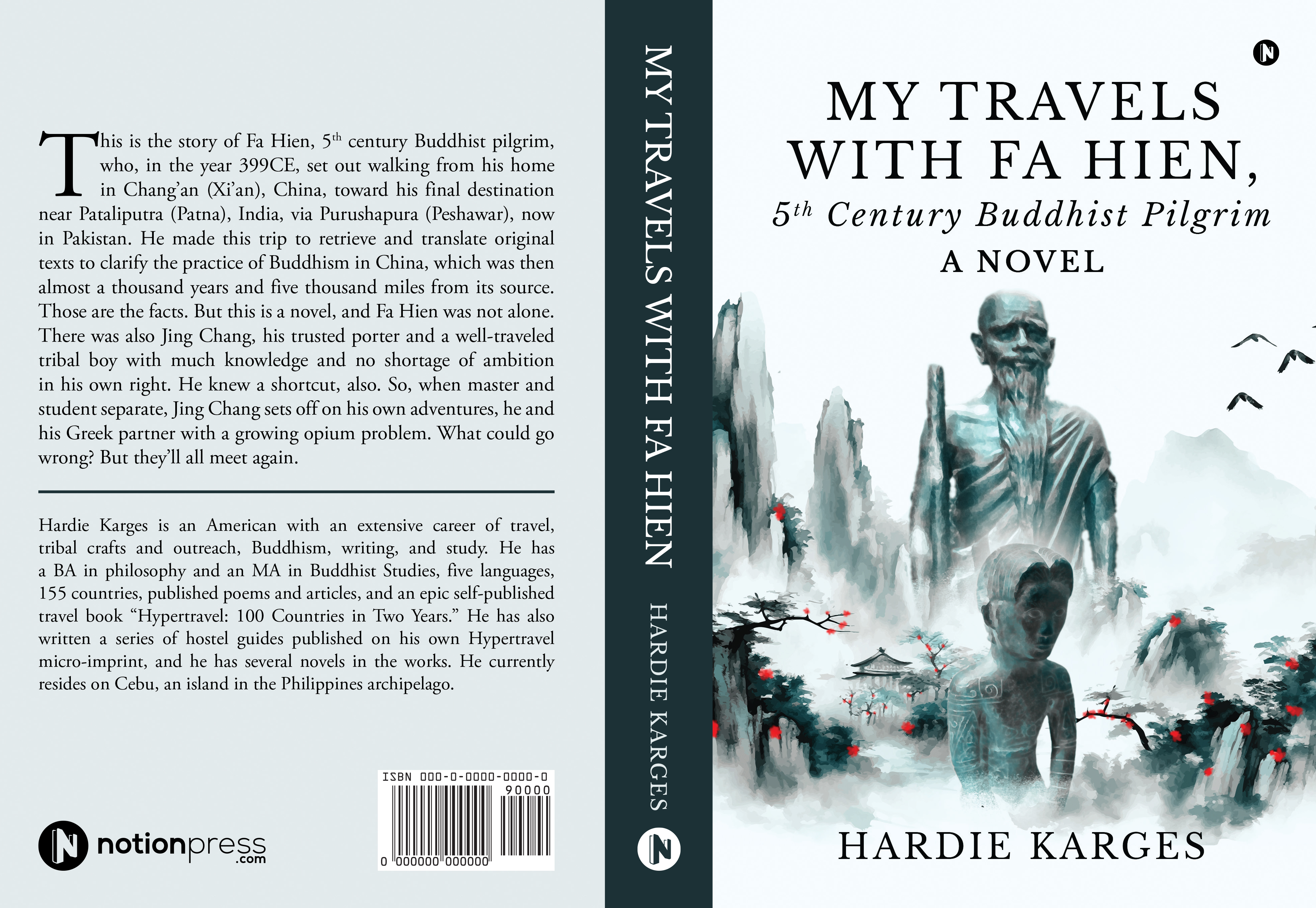
    Meditation is so fundamental to Theravada Buddhism that it has recently almost become re-branded as Vipassana, or ‘insight meditation,’ all the other disciplines involved in the practice of Buddhism notwithstanding. And this is likely what the Chinese Buddhist pilgrims Fa Xian (Hien) and Xuanzang found above all else, silent meditation, since almost nothing else was written, and was almost too heavy to carry once they had it transcribed from the original Pali or Sanskrit into Chinese.  

    But how do you transcribe meditation into any language for inclusion in a book which someone may or not read at some point in history? Meditation was largely independent of written vinaya (discipline), and that is what had sustained Buddhism for around 1000 years by that time. And that’s what sustains it today, all the opinions and debate on Facebook and elsewhere notwithstanding. Original Buddhism required only silence, and concentration, no apps or other accessories necessary. 

     
  • Unknown's avatar

    hardie karges 8:42 am on March 3, 2024 Permalink | Reply
    Tags: , , , Hardie Karges, , , , , ,   

    Buddhism 301: Emptiness Is Also Silent, and Infinite…  

    Silence is normal. All noise should be treated as an alien force, approached with caution and handled with great care. But, we live in a world of mechanical waves, so we assume that the world should be full of it, percussion and repercussions. But that doesn’t necessarily mean that our worlds should be so full, since our worlds are plural, and everyone must make that choice individually. And this is another case of the glass half-full or half-empty, since it’s likely neither. But which is better?  

    Maybe there was a time in the history of the world when to merely ‘break the silence’ was somehow enlightening, revolutionary, and revealing, worth something in and of itself, but those days are likely long gone as the world rapidly fills up with stuff if not substance, and the resulting benefit is as illusory as it is elusive. What to do, then? Embrace the silence, for all it’s worth, as that should be plenty, for it is itself the raw material of meditation. 

    And, if simple awareness is the stuff of consciousness, then meditation may not be consciousness ‘on steroids,’ God forbid, but hopefully consciousness refined, purified, and made more intense in the process and more sacred in turn. For, what is more sacred than pure consciousness? This is a question that science cannot answer, and likely never will, but if there is something sacred in this life and in this world, then that must be it.  

    Buddhist ‘Emptiness,’ shunyata, based on the numerical concept of zero, is hard to define, and even harder to embody, but if that space is empty, then it must also be silent, and that makes a life more refined and much finer. But which came first, the concept or the number? It doesn’t really matter, now, does it? Embrace it, for to be empty, and silent, does not mean to be lacking. It means to be infinite, as only emptiness can. Stuff is limited. Find a place for it, then forget about it, if you can, for a while, at least.

     
  • Unknown's avatar

    hardie karges 3:59 am on February 18, 2024 Permalink | Reply
    Tags: atoms, , , , , , Hardie Karges, , , , ,   

    Buddhism is not Opposed to Science…  

    You shouldn’t have to choose between Buddhism and Science. You don’t. Describing the physical nature of reality is not the proper role of Buddhism. The Buddha did not have Samma Paramanu (right atoms) at the top of his list of the Eightfold Path. He had Right View, Right Intention, Right Speech, Right Action, etc., all ‘things’ within the realm of human endeavor. The debate over rebirth notwithstanding, the nature of reality should be off-limits. The nature of human understanding is primary. 

    When I was a child and my mother would ask what I learned in Sunday School, I was famous for replying ‘magic,’ haha, beginners’ luck on my part, that I was prescient enough to see that most religions require a double dose of faith, whether that is pure superstition or not. And most Christian religions are proud of that fact, as if too strong of a reliance on science leaves no room for faith, which is at the heart of most Christianity. With Buddhism it seems optional. Because, while I don’t need the concept of rebirth for Buddhism to make sense to me, I make no issue of it with others, 

    Even science requires some faith, but that’s not the same as belief. After all, how many of us can understand the math that underlies quantum physics? Not me. But I can appreciate the fact that a physicist can, and they agree that the science has been proven empirically countless times. Buddhism requires no such empirical truth. The truth is in your heart and mind, which are one and the same. The foundational truths of Buddhism and Christianity are almost the same.  

    Change passive voice to active, change positive suggestions to negative prohibitions and the five Buddhist Precepts are almost identical to the second half of the Ten Commandments: no killing, no stealing, no lying, no hanky panky, and no drink—simple, except for the drink, which Christianity allows. The first five of the ten commandments more resemble Islam. But the point is that Science is not prescribed nor prohibited by any of this. Science is a method, not a religion, and it’s always tentative, never dogmatic. At its best, Buddhism is the same, and never at odds. 

     
  • Unknown's avatar

    hardie karges 5:27 am on February 11, 2024 Permalink | Reply
    Tags: bonobos, , , , , Hardie Karges, ,   

    Buddhism 499: Conciliation is always better than confrontation…  

    There is always an alternative to war and conflict. Conciliation starts at home. Such is the way of the world. If we can’t maintain the peace within our families, then how can we ever hope to keep the peace among such large, scattered and diverse groups as exist in the world these days, with eight billion souls and counting? Score one for samsara, the world in all its gory details: hate, greed, fear, and anger, watch your step and be on a constant lookout for danger.  

    But it doesn’t have to be that way. Except for chimpanzees—but not bonobos—no other species besides glorious homo sapiens feels the need to kill for any other reason than to acquire food. We do it because we’re wired that way, I guess, DNA and all that rap, A, C, G, T nucleotides, with sometimes Y and W (just kidding), as if all our thoughts and emotions were pre-programmed at the factory, just like the determinists claim, and all our actions doomed to repetition and suffering.  

    Enter religion, and now we have reason and inspiration to up our game. For now, we have expanded our family to include all like-minded souls, regardless of race, gender, or geography, the only problem being, of course, that that is still not enough. For one thing, different religions don’t always agree with their own governments, much less with each other. Still there is hope, and the rule of thumb to ‘leave well enough alone’ is not a bad guide for the guileless. Sometimes you don’t have to do anything. You have to do nothing—quickly. And like so, determination can defeat determinism, and peace can prevail.

     
  • Unknown's avatar

    hardie karges 5:15 am on February 4, 2024 Permalink | Reply
    Tags: , , , , , Hardie Karges, , , , , , , , , , , ,   

    Buddhism: Meditation, not Mysticism…  

    Buddhism was never intended to be mystical. Buddha was very rational in his take on life and suffering. Any mysticism came later, mostly in the Vajrayana Buddhism of Tibet that came directly from India, not China, and which had taken firm hold in that country by the Eight Century CE. And while that ‘school’ of Buddhism is often included in the Mahayana tradition which traveled through, and was greatly influenced, by China, such is not the case with Vajrayana, which derives from a later, maybe the last, Indian Buddhist tradition, before it succumbed to the coup de grace by the invasive Mughals, after centuries of losing ground, and followers, to the Brahmanist Hindus. 

    About the only thing that all the Mahayana schools have in common, in fact, is that they are not of the original Theravada tradition, which originated in India and found fertile ground in southeast Asia, mostly. And if the Vajrayana tradition is famous for its multiple levels of heaven and hell, its Tantric yab-yum, mudras and mantras, then Theravada (aka Hinayana), is best known for its lack of all that, and concentration on meditation, especially, to the extent that it’s sometimes known by that most famous meditation technique Vipassana. Meanwhile the Mahayana Buddhism of China is probably best defined by its transcendent Buddha and the vast Emptiness of reality, both more recent developments.

    Many famous Chinese monks, Fa Xian and Xuanzang foremost among them, even made long arduous trips to India just to get it right, like Charlemagne realizing his 8th century French language wasn’t proper Latin. And mostly I believe that meant learning meditation, and some other disciplines, which Theravada monks usually excel at, and Chinese monks often suck at—to this day. In fact, I didn’t really even know what meditation was until I attended some Theravada-based meditation retreats in Southeast Asia, intended for Asians, not Westerners. When you see a layman sitting silent unflinching for two or three hours lost in no-thought: that’s meditation. The monks are even better at it. Now I get it. Get it. 

     
  • Unknown's avatar

    hardie karges 3:35 am on January 28, 2024 Permalink | Reply
    Tags: , , Hardie Karges, , , , , , , , , , zero point   

    Buddhism and the Power of Silence  

    Words once spoken cannot be taken back. Actions once committed cannot be retracted. Silence is better than violence. This is one of the hidden little gems of Buddhism, the value of silence. And other than the emphasis on meditation, it’s something that doesn’t often get mentioned—until now. Because here and now, in the modern age and the Western world, the noise is almost deafening, and the calls to engage are never-ending, no matter that much of that engagement is cruel and disheartening.  

    As a ‘digital creator’ on Facebook, I get it all the time, as if non-engagement were synonymous to incompetence. But nothing could be further from the truth. Silence is not violence, and BLM (Black Lives Matter) should know this. MLK (Martin Luther King) certainly knew it well, as did Mohandas K. (Mahatrma) Gandhi. Silence is one of the most powerful weapons in the world, in fact, but it is also much more than that. As the operating method of meditation, it can save souls (people) and so, it can also save nations.  

    If silence is the zero point for meditation, then meditation is the zero point for life. In this analogy, silence is like the zero (shunya) for which emptiness (shunyata) is named and can be thought of like the mathematical zero as the point between positive and negative (existence or non-existence?) numbers or the absolute zero temperature beneath which there is no lower, or even the zero-point energy of quantum physics as that point closest to absolute stillness. That’s the goal of meditation, insight optional, and that’s the goal of life, if only for a moment, now and again, always and forever. 

     
  • Unknown's avatar

    hardie karges 4:06 am on January 20, 2024 Permalink | Reply
    Tags: Branhmanism, , Divine Feminine, , Hardie Karges, , , , , , , , ,   

    Buddhism and the Divine Feminine  

    Is a creator God a product of patriarchy? Probably. Buddhism doesn’t need it, regardless. Buddhism embodies the Divine Feminine, whether it knows it or not. This goes way back, of course, even before the Abrahamic religions, at least as far back as the Sanskrit-era Dyaus Pitr (think Deus Pater) ‘Sky Father’ of the proto-Hindu Rigveda, and probably before that. But Sky Father was always with Earth Mother Prithvi Mata, and that pretty much defines the Hindu/Buddhist dichotomy that dominated the philosophical debates of 500 BCE India, Hinduism the more male-dominant principle, Buddhist the more female-dominant. 

    And this is important, even if it is seldom stated, or even acknowledged, given the lesser status of Buddhist nuns, in comparison to their male counterparts. But it’s there, and it’s true, from what I can see, and that is good. It means that Buddhism is non-agressive, and that is purpose-built, in stark opposition to the early Brahmanistic war god Indra, which Buddhism refuses to acknowledge as its heritage. It also means that Buddhism is more concerned with down-to-earth issues of kindness, and craving, than abstract considerations of dualism vs. non-dualism. 

    Thus, Buddhism embodies many of the qualities often associated with the ‘divine feminine,’ such as ‘intuition, nurturing, creativity, empathy, and wisdom’ (www.anahana.com). So, it should be unnecessary to say that Buddhism is not a conquering religion, unless you count the hearts and minds conquered, not bodies inscribed with epithets and enlisted in future wars with imaginary enemies. Buddhism is better than that. Conquer yourself and you will have conquered the world, your world… 

     
  • Unknown's avatar

    hardie karges 3:25 am on January 14, 2024 Permalink | Reply
    Tags: , , , , Hardie Karges, , , ,   

    Buddhism 102: the Cessation of Craving  

    If you indulge cravings, then there’s no end to them, just mindless consumption. It’s better to cut them off at the source, your mind. This lies at the heart of Buddhism and is enshrined in the Second of Four Noble Truths as the primary cause of suffering. There are other causes, too, and so other forms of suffering, but this is the main one, and the one for which Buddhism is famous. After all, what is more insufferable than craving and its deleterious effects? 

    Well, that is a debatable point, but most importantly, craving is the one cause of suffering that we are most able to do something about, in order to effect a positive change in that status. Old age and many forms of sickness leave us at their not-so-tender mercies to live or die, but craving is just a clownish monster, mocking our every move, and our every intent to free ourselves from its hideous grip, adding insult to injury, when what we really need is encouragement to succeed.  

    Because craving is akin to addiction, and this is one of the most hideous of worldly phenomena that we must deal with in the course of our short lives, the inability to free ourselves from the grips of habits and substances which are harmful to us, even when we are fully mindful of that fact. But the craving is mindless, not mindful. And so that is where we must nip it in the bud, at the point where the mind has made an unconscious allowance that facilitates this perversion of intent. 

    It is of no importance that the mind may have no more intrinsic importance than the craving, either, or ourselves, for that matter. What is important is that we cease the defilement at the source, rather than make excuses for our failings. And the source is will or lack thereof. If you are willing to allow cravings to control you, then they will do so, without fail. Only if you are willing to exert some discipline can you truly defeat the monsters that inhabit the subconscious realm of craving. Only then are you truly a disciple of the Buddha.  

     
  • Unknown's avatar

    hardie karges 3:10 am on January 6, 2024 Permalink | Reply
    Tags: , Hardie Karges, , , , , ,   

    Buddhism 102: Kindness is Contagious  

    Disease is not the only thing that is contagious. So is kindness, and compassion, and the smile of a stranger. That is how karma works. What goes around comes around. And if that sounds all New-Agey and superstitious, I suspect that it could be proven, if we only knew how to properly frame the questions, to probe the parameters of truth, in an open field without any markers nor metrics. After all, just how do you measure kindness and compassion, anyway? I mean: you can’t just walk into the supermarket and order a quart or a liter or it, now, can you? I wish, haha… 

    But what you can do is ‘pay it forward’, i.e. not just return every kindness with a kindness as an equal and equitable ‘payback’, but initiate such actions without any promise of a return on that investment. Because, if you’re expecting a return, then it’s not an act of kindness at all, but an act of business, interest on principal, compounded annually, if not quarterly. But true kindness is entirely selfless, by its very nature, and so avoids the back-slapping and hand-clapping which is the minimum that most people expect as reward for their generosity. 

    Why have most nations adopted some form of religion at some point in their history, anyway? To enlarge the circle of friends, of course, and hopefully improve people’s lives in the process. Because, without it, the only people you can trust are your immediate family, and beyond that, maybe even your so-called ‘race’. Religion is a way to transcend racism, and what is religion if not a circle of kindness? The challenge is to include everyone in that circle. Because then karma is not only a likely story, but a living breathing reality… and the meek will inherit the earth.  

     
c
Compose new post
j
Next post/Next comment
k
Previous post/Previous comment
r
Reply
e
Edit
o
Show/Hide comments
t
Go to top
l
Go to login
h
Show/Hide help
shift + esc
Cancel