Tagged: Buddhism Toggle Comment Threads | Keyboard Shortcuts

  • Unknown's avatar

    hardie karges 11:44 am on July 17, 2022 Permalink | Reply
    Tags: , Buddhism, , , , , , , id, , , , , ,   

    Buddhism 101: Anger is a Warning Sign of Impending Danger… 

    Anger is like a lying dog, that, when provoked, rises up in consciousness, and strikes the nearest hand that most recently fed it. Because it’s blind, and usually vicious, hatefulness optional, and it infects everything it touches, anger does. But it’s not always so easy to recognize, because it comes in many forms, most often in concert with hatred, true, but equally conversant with deception and denigration and the other delusions of sense perception, always a prime source of suffering, no matter the particular place and time in question…

    And then there is the other ‘poison’ of Buddhism, besides hatred and delusion, which is greed, or sensual desire, with which anger is also often associated. But sometimes the symptom is worse than the disease, and this could often be one of those cases, in which the anger is worse than the moha, raga, or dvesha itself. These are also variously known as the Three Unwholesome Roots and the Three Kileshas, which are also available in a convenient Five-Pack for serious abusers, but who’s counting?

    Still, it all counts as demerit in a lifestyle that prides itself on making merit, and doing good, and so worth making a sea change in order to avoid the choppy waves, right? But that gets into issues of global warming and rising sea levels, when simply wearing a life jacket and learning how to swim might accomplish much the same thing in a much shorter amount of time. Why get a brain operation if a pill can cure the headache? That’s what I want to know.

    Hatred, delusion, and greedy attachments can take a lifetime to cease, overcome, or even diminish, much less cure, though, so in the meantime please do us all a favor and control your anger, okay? It becomes you. And there are many American Buddhist ‘teachers’ who might disagree with that, but they may not be so smart, after all, since they often look to Freud and Jung, rather than Buddha, for inspiration, as if the notion of superego were somehow scientific and Freud’s ego were what the Buddha was really talking about in denouncing the Brahmanistic cosmic atta/atman. It wasn’t. So, let go of all anger, the sooner the better. It sucks.

     
  • Unknown's avatar

    hardie karges 1:42 pm on July 10, 2022 Permalink | Reply
    Tags: , , Buddhism, , , , , , , , , , , ,   

    Buddhism in the Bardo: the Language of Dialectic and the Silence of Meditation… 

    Language cannot solve the problems that language creates. Only silence can do that. This is one of those inherent little foundations of Buddhism, also, like non-aggression and the limits to fulfillment, that often get lost in the shuffle of rebirth, karma, and the endless choices of past lives. But that is the essence of philosophy, and religion, to find some reason to live, without expending too much time and energy in the process, and so often that involves divine intervention—or magic…

    And that’s where Buddhism tried to be different, at least in the beginning, though the pressure to spice things up is almost irresistible, and so Buddhism was not so much different. Like Christianity a few hundred years later, it started with basic precepts, or commandments, and proceeded from that humble starting point. And to be honest, the starting points of Buddhism and Christianity were not so much different in their original conceptions.

    Don’t kill, don’t steal, don’t lie, don’t cheat: the basic precepts were very similar in the Abrahamic religions of the Mideast and the Dharmic religions of India. They weren’t that far apart, really, geographically or conceptually, so that may be more than a coincidence. Considering the Aryan migration eastward, also, now proven genetically, the ‘meeting of East and West’ may not have been much more than a meeting at the most convenient location, rather than some journey that required Marco Polos, Fa Hians, and Ibn Battutahs to accomplish, though they did that, too…  

    But Buddhism went through much more of a dialectical process of thesis, antithesis, and synthesis, over the course of its 2500 years, something implied if not intended, in its mantra of the Middle Path between extremes, so that the three major schools of Theravada, Mahayana, and Vajrayana can be seen in precisely that light, something like discipline and devotion having babies, and calling it Dharma. But at the core of them all was always meditation, and that was silent. Christianity still hasn’t learned that trick. Maybe one day they will.

     
  • Unknown's avatar

    hardie karges 11:36 am on June 26, 2022 Permalink | Reply
    Tags: , Buddhism, , non-aggression   

    Buddhism and Peak Emotion: Chill, dude… 

    If suffering is the reality that Buddhism acknowledges, then non-aggression is the response to that reality, and most difficult. But that is what we must do. And that is the essence of Buddhism, non-aggression by design and intent. The irony, of course, is that that doesn’t require one to DO much of anything at all. Of much greater importance is what you NOT do…

    Do NOT take the bait when somebody on Facebook forces you into denying something that you never really asserted—or at least never intended to assert—in the first place. Do NOT respond for the fifth time to some debatable thesis to which you’ve already responded—identically—four times previously (actual numbers may vary). Do NOT get angry about something that makes no difference to anyone in the first place.

    Given that anger, or maybe at least a certain form of it, may indeed be necessary when someone’s life or livelihood is in actual danger, ferchissakes don’t waste the precious emotion over the price of rice in China, or the price of gas in Flagstaff. Yes, emotion should be a precious commodity, to be doled out judiciously and with mindfulness aforethought, not something to be tossed around willy-nilly like so many wedding invitations from a bride or groom who really only want the registry gifts.

    But this is the hardest thing for a Western Buddhist to learn, that emotion is something to be avoided, and not encouraged. Defendants in western courts, after all, are expected to ‘show remorse’ and not just prove intent. So, it’s not a bad little trick to learn, TBH, because it might save you some time or some bucks, should you ever need to make amends for your wrongdoings.

    But it will score you few or no points in Buddhism, where actions (karma) speak louder than words—or tears. So, the Japanese PM gets little recognition for multiple apologies for Japanese behavior in WWII, while the German PM wins the prize for Best Actor for dropping on to his knees at Auschwitz and crying profusely. It’s the dangedest thang. But that’s what we’re taught in photography class: go for the peak emotion! And so that’s what we do. And history bears witness to it all…

     
  • Unknown's avatar

    hardie karges 9:11 am on June 19, 2022 Permalink | Reply
    Tags: Buddhism, , , , Siddhartha Gautama,   

    Buddhism in a World of Pain and Suffering… 

    To love the one that loves you is easy. To love the one that hates you is the challenge of enlightenment. Because we don’t really need religion or philosophy when times are good and grocery store shelves are full. We need religion and philosophy when ‘Times are hard…and the jobs are few’ (Townes Van Zandt). And that’s the foundation stone upon which Buddhism was built, as intuited by Siddhartha Gautama even as he sat upon his throne, while being entertained by dancing girls and God-knows-what-else. A quick trip outside the palace walls proved the Buddha’s worst suspicions.

    Because there he quickly found old age, sickness, disease, and death. Thus was born Buddhism, for which the task was to facilitate the mitigation of those most obvious sufferings. And in his humble estimation the most important things to remember were not about what to do, but what NOT to do, specifically craving. So, if we’re willing to live simple lives, content with simple pleasures, and not possessed by our possessions, and not obsessed with cravings, then life can be good. But if we constantly want more, and more, and more, then our lives will likely go downhill fast, accordingly.

    And I had problems with that concept for a long time, not because I was obsessed with material wealth, but because I saw a passivity in many Buddhist countries that didn’t seem healthy to me, and which I assumed could be easily manipulated by the rich and powerful by their own means and to their own ends. But everything is different now. So, if that is sometimes, or even often, the case, the opposite is the worse risk at this point in time of world history. Because we are killing ourselves with excess, and it is not going softly. Buddhism is better than that. We can learn from nature, but first we unlearn the violence.

     
  • Unknown's avatar

    hardie karges 10:52 am on June 12, 2022 Permalink | Reply
    Tags: Buddhism, , , global hunger, , , Law of Excluded Middle, , ,   

    Buddhist Dependent Origination and the Law of Excluded Middle 

    We worry about Global Warming, and even Global Hunger, but what about Global Hatred and Global Anger? Because the seeds of one are in the other, and there really is no solution short of a comprehensive solution. I mean, is there any real likelihood that Global Warming could ever be solved without also solving other global problems at the same time? It’s not likely. Such is the nature of the Buddhist Law of Dependent Origination, that we are caught in a web of causal connections, even if the details are sometimes best left to the imagination.

    Because the Buddha’s world was one based largely on perception, and introspection, in that order, from the simplest to the most complex, and in which rationality was something radical and revolutionary. But that’s exactly what the Buddha attempted, a full two hundred years before Aristotle, albeit with mixed results. Because Aristotelian logic is an ‘either/or’ choice between any proposition and its negation. There is no middle option with the Law of the Excluded Middle. But Buddhism is all about that middle option, that sweet spot between extremes.

    So, Buddhist logic, aka catuhskoti, aka tetralemma, in addition to the proposition and its negation, also allows both—or neither. Given such logical options, pure perception is likely to be the more accurate description of reality. And that’s what Buddha attempts with the twelve nidanas that comprise the Buddhist Law of Dependent Origination. But words can’t accurately describe a law of nature, so the progression from ignorance, formation, consciousness, name and form, etc., may not necessarily make total sense in the particulars what makes perfect sense in general.

    The Buddha’s path of knowledge was deep introspection, which is the best that you can do without science. Einstein was a master of it with his thought experiments. And Plato did much the same with his Socratic dialogs, forerunner to the modern dialectic of Hegel and others. Jesus’s parables and the Buddha’s sutras accomplish much the same thing, but more in the personal and ethical sphere than in scientific breakthroughs. Einstein’s ‘happiest moment’ and ‘biggest blunder’ were special relativity and the Cosmological Constant, respectively. The Buddha’s were the middle path and the underestimation of women. He was only human, after all.

     
  • Unknown's avatar

    hardie karges 10:31 am on June 5, 2022 Permalink | Reply
    Tags: Buddhism, , , , , , , MS_DOS, , , Visual Basic   

    Meditation and Mediation, the Twin Foundations of Buddhism 

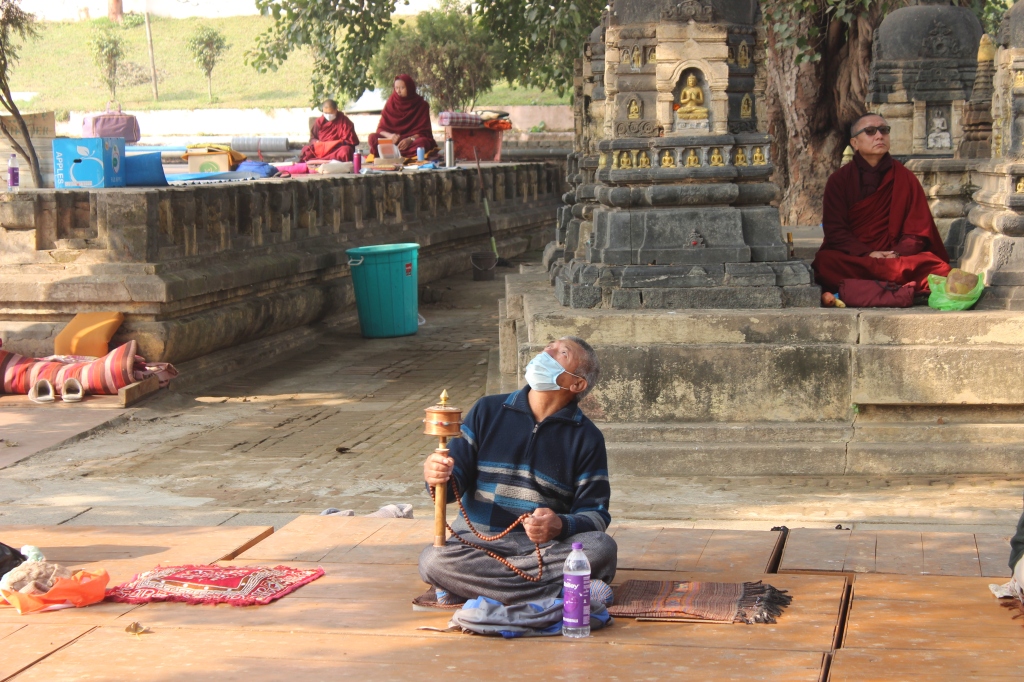
    Buddhism in Bhutan

    If you need a reason to meditate, then maybe that’s not really meditation. Meditation neither gives nor responds to demands. It simply IS. To be honest I probably think of it as a system re-boot more than anything else, that row of zeroes at the end of a really big number, that means that a dot will soon come, and then things will begin all over again on the other side of some line. Meditation is the dot between the two zeroes. The zeroes represent emptiness, of course, aka shunyata…

    There are all different flavors of meditation, supposedly, according to all the books and the writers, but they all tend to get back to basics, concentration on something, or everything, or nothing. But for me they all represent that same re-boot, a return to primordial pre-linguistic thought, if only for a few moments. Because once we think in a language, we never really go back. It’s simply not possible. But a new language could substitute for the old, just like Visual Basic took over where MS-DOS left off.

    Could humans ever function with a non-linguistic operating system? Of course, because we once did. And then the invention of language (or the manifestation of that instinct, for you Chomskyites) was probably the biggest revolution in the history of mankind. Just ask the Neanderthals, if you’re lucky enough to have some of their DNA. They disappeared as a species shortly after the appearance of language in Homo sapiens, hint hint.

    Ironically, they had all the same hardware and software for language themselves. Apparently, they “just didn’t have much to say.” (Spencer Wells). But that’s not our problem. Our problem is that we have too much to say, and not enough time to say it. So, we race to the finish line, shooting our mouths off and writing the Great American novel ad infinitum, whether anyone wants to read it or not. Meditation can help with that. The only app you need is silence. Mediation? That’s the Middle Path between extremes…

     
  • Unknown's avatar

    hardie karges 8:45 am on May 1, 2022 Permalink | Reply
    Tags: Buddhism, , , , , , Mosaic, moses, , , Roman, sanatana   

    Buddhism and the Mosaic of Laws It Competes With… 

    Repay every aggression with kindness, sooner rather than later. Because in this way, not only can society progress and history advance, but wounds can heal, and toxic attitudes can change. This is one of the prime conceptual bases of religion, of course, all the best ones, that you don’t have to respond “eye for an eye, and tooth for a tooth,” lex talionis, Roman if not Christian. Because that predates Jesus Christ and his subsequent Christians, going way back to the early Jews, Moses, and the Mosaic law that sits there like concrete, composed of gravel and mud, shards and pieces, cobbled together in an elaborate composite of moral, civil, and ceremonial considerations not unlike the various bodies of law(s) and customs that have subsequently been handed down from the example of it.

    There’s only one problem: that ain’t religion, not most of it. That’s law and politics and culture and custom, almost everything BUT religion, except the parts of it that can be considered ‘moral law.’ And those are almost indistinguishable from the Buddhist precepts: Thou shalt not kill, thou shalt not steal, etc., and even then, the attitude most truly religious that they can muster is for the Christians to have no other god before God (Allah), and for the Buddhist to not claim any form of enlightenment that they really can’t deliver–boom. It was up to Jesus to bring true religion to the Jews, just like it was up to the Buddha to bring true religion to sanatana dharma (Hinduism).

    The Muslims kept the ‘eye for an eye,’ famously, of course, and in that sense distinguish themselves form Christians. The Jews did likewise for most of history, only shifting to the more liberal Christian orientation recently, c. 1948. The rest is history. But that’s politics. We want religion. And the lex talionis doesn’t preclude that, of course, it only limits its reach, which is not so bad, all things considered. And the main thing to consider is that it is NOT a proclamation of revenge, in fact just the opposite. Because it limits retribution to the original damage, and, in effect, prohibits the punitive damages that could be considered as revenge, i.e. more than simple punishment, and far more than actual damages. But true religion always tries to heal the transgressor with love and kindness, not revenge or even justice. Religion transcends justice. It should be better than that.

    Note: the word ‘dharma’ has often been translated as ‘law’…

     
  • Unknown's avatar

    hardie karges 7:05 am on April 17, 2022 Permalink | Reply
    Tags: Buddhism, , , , , , , , ,   

    Buddhist Metta in the Age of Social Media… 

    Metta is simple and one of the cornerstones of Buddhism: friendship, simple friendship. Or call it ‘loving-kindness’ if that reconciles you with the Hebrew chesed of your Judeo-Christian tradition. Just note that it is not the passion that is usually associated with Christian ‘loving-kindness,’ not even the passionate embrace of a mother and her child. There’s nothing necessarily wrong with that, but it’s not necessary. What’s necessary is that the child not experience fear and anger and other defilements and afflictions.

    But we Westerners, particularly Americans, are raised on a diet of emotional cocktails, roller-coasters and built-in toasters, speeding up and then putting on brakes, heating up and then cooling our feet, such that life is nothing but one vast mood swing, which we must then ‘shrink’ by repeated visits to the therapist of our choice. To be a ‘bad-ass’ is a compliment in the US of A, and it shows in our interactions with the world. We fight our enemies to the death on battlefields, while never questioning the enemy within.

    This is one reason why it’s so difficult for Americans to be good Buddhists. Because we look for enlightenment in dialogue and debate, rather than the silence that brilliantly illustrates Emptiness, if not strictly define it. Because we look for our meditation in the words of some endless rap from some best-selling app from the online app-store of one of the world’s richest men, rather than that same silence which the Buddha himself used, as do thousands of monks to this day.

    And whether those monks win or lose the debates that some “spiritual bad-asses” (actual quote) find so rewarding and illuminating is not important. What’s important is quieting the mind (i.e. consciousness) by the necessary hours of silent and still sitting that make life itself the only reward necessary for a rewarding existence. All the cars and bars and Hollywood stars on assorted sh*t-stained sidewalks are but illustrations in a magazine that most people can’t sit still long enough to actually read.

    Compared to these challenges, metta is a literal piece of cake, to be shared with friends on any given day, and maybe even twice on Sunday, or Christmas, or Easter. The world is our sangha, our community, and strangers are as much a part of that as family, friends, neighbors, and co-workers. In fact, that can be its greatest reward, communion with strangers as if they were lifelong friends. You can’t know that pleasure until you test those waters. The first rule of friendship is to be friendly, simple. Smile. Happy Easter. Happy Buddhist New Year.

     
  • Unknown's avatar

    hardie karges 6:54 am on April 10, 2022 Permalink | Reply
    Tags: Buddhism, , , Dawn of Everything, , , judgment, , , , ,   

    Buddhism 101: The Difference Between Cravings and Needs–and Karma… 

    Be careful with judgments. The craving for food of a wealthy person is different from the craving for food of a poor person. If that means that there are good cravings and bad cravings, then we are simply getting bogged down in words, because the craving to be avoided is for something beyond what is necessary. Thus, the craving for food of a starving person is not a craving in the sense that Buddhism abhors. That is a need, not a craving. The craving that Buddhism abhors is the incessant call for more, more, and more far beyond what is needed to sustain the life of someone and his significant others.

    This is implicit, of course, in the Middle Path between luxury and lack, which is at the heart of original Buddhism, before the re-birthers decided that it was always all about that: rebirth, past lives, and the generation-jumping karma of retribution. And that original impetus is definitely what we need now, in our economic stage of advanced capitalism, to be reminded that craving is at the heart of our problem. There is even some scientific evidence coming out now in the best-selling book ‘The Dawn of Everything’ that gluttony and craving are at the heart of certain violent and slave-trading cultures.

    Suddenly it all starts to make sense, doesn’t it? The lifestyles that reward gluttony and craving demand violence and other defilements to sustain them. The one feeds the other in a never-ending cycle of degradation, and our lives suffer as a result. Life is not so difficult, after all, certainly not as difficult as the ‘multiple feedback loops of karma’ invoked by some high priests of reincarnation might make you think. Just be kind, and gentle, and respectful to the rights and dignity of others. The rites and rituals can come and go, but what you don’t do is sometimes more important than what you do.

     
  • Unknown's avatar

    hardie karges 4:50 am on March 27, 2022 Permalink | Reply
    Tags: Buddhism, , , , , ,   

    Buddhism: Life in the Slow Lane… 

    It’s okay to enjoy life, even love it, and still be a good Buddhist, as long as you don’t pretend to possess or attach, crave or covet. Because, even if Buddhism is a religion of renunciation, at its origins, and at the core of its being, it is still pragmatic and rational in its acknowledgement that the average life, for the average householder, must be properly maintained and nourished if any of us are to even have anything to renounce. Renunciation, after all, is not poverty. It is a conscious rejection of the supercilious aspects of human existence that lend it its falseness, and which tend to reduce us to its servants, not its masters.

    Because the master of human existence is the one who can take it or leave it, in its fullness or its emptiness, each of which is valid and credible, neither of which is complete in and of itself, and both of which can serve as valuable paradigms toward fulfillment in the right place and in the right time, the details of which are to be established later. Because Buddhism is nothing if not a fertile middle ground for resettlement, after all the thrusts and forays of penetration and conquest have run their course. Those are but illusions, after all, while the real stuff of life is to be found not in articles of consumption, but in the abstract concepts that occupy thought, feeling, and action. There is nothing mystical about Buddhism in its essence. The Middle Path is all about rationality, ratios, and rations…

     
c
Compose new post
j
Next post/Next comment
k
Previous post/Previous comment
r
Reply
e
Edit
o
Show/Hide comments
t
Go to top
l
Go to login
h
Show/Hide help
shift + esc
Cancel