Tagged: Buddha Toggle Comment Threads | Keyboard Shortcuts

  • Unknown's avatar

    hardie karges 4:46 am on January 26, 2025 Permalink | Reply
    Tags: , Buddha, , , , , , , , , , , , ,   

    Buddhism 202: True Love Can Save the Planet 

    The truest love is metta, friendship, without the burden of possession. That’s a hard sell to a teenager with a bone he’s trying to drive home, but it’s true nevertheless, for long-term or short, which is the proof of its purity. Powerful passions may produce plentiful babies, but without lovingkindness, most of those efforts will be largely lost before the high school graduation exercises, and that’s what’s important. Because we’re no longer the young planet that we once were, raw and untamed and unpopulated.

    Now the danger is over-population and the possibility that we might become victims of our own successes, as Global Warming would seem to suggest. So, a different attitude than constant growth is recommended for long-term survival. This means a more thoughtful and less cavalier attitude to our relationship with others, gentler and kinder, less aggressive and careless. If that overlooks the reality that sometimes Buddhism can be too passive, then so be it. The alternative is worse—uncontrolled aggression.

    That’s the reason that I became a Buddhist, to save myself, then save the world. That’s my motto and mantra that also sums up the transition from early self-centered Theravada Buddhism to later society-centered Mahayana Buddhism, not that such a generality explains much about either of them. But the motto and mantra still work, for me, at least. Be kind, first and foremost, and the world will become a kinder place in return. That’s karma.

     
  • Unknown's avatar

    hardie karges 3:35 am on January 19, 2025 Permalink | Reply
    Tags: , , Buddha, , , , , , , , , ,   

    Buddhist Meditation for Beginners: Silence, Blessed Silence… 

    When you can sit still for one hour without saying a word or moving a muscle, then you are a meditator. And I don’t really even care what ‘kind’ of meditation you do, I only grudgingly allowing that there are different kinds, I from the old ‘anapanasati’ school, long before Theravada was rechristened ‘Vipassana’ and long before Vajrayana became ‘crazy wisdom’ while the Buddha rolled over in his ashes and checked his phone to see what year it is. “Yep,” he supposedly said, “pretty much right on schedule.” Haha.

    I only draw a line between silent meditation, true meditation, and ‘guided meditation,’ which I consider to be something else entirely. And I don’t mean to imply that that’s bad, because it’s not. It’s just more like a ‘dharma talk’ than mediation IMHO. So, there’s certainly nothing wrong with that, since the definition of such is so broad and inclusive that it can be almost anything, so long as it revolves around the Buddha and Buddhism. But meditation is something different, and if you’re not doing it silently, then you’re missing out on something good—and important. And that’s silence.

    Because silence, I think, is the shunya, zero, that qualifies for the important category of ‘emptiness’ so revered in later Buddhism, and I like it. It’s possible that Buddhist monks even invented the numerical zero, but this is not the place for that discussion. But, if ‘American Buddhism is Buddha-flavored Christianity,’ as someone once said (me), then this is the litmus test.

    Because psychological therapy is famously ‘talk therapy’ and this is something so different that those practitioners can, and do, make a case of ‘spiritual bypassing’ while they claim that ‘thoughts have no thinkers’, thus having some cake while eating it, too. Cool, since it’s an open doctrine, subject to interpretation. But don’t miss the forest for the trees. Good thoughts are essential to good and proper Buddhism, but silent meditation is, also. It’s not a case of one or the other. Talking can sometimes soothe the overwrought mind, but sometimes silence can do it better. And that largely defines Buddhism.

     
  • Unknown's avatar

    hardie karges 5:03 am on January 5, 2025 Permalink | Reply
    Tags: Buddha, , , , , , , , , Robert Wright, The Matrix, ,   

    Book Review: ‘Why Buddhism is True’ by Robert Wright… 

    Okay, I owe this review to Robert Wright as payback, because, while others at my Buddhist college were ‘oohing’ and ‘aahing’ back in 2017 over the release of his book ‘Why Buddhism is True’, I was extremely skeptical—and quite vocal about it. Why? Well, first, there’s the title: ‘Why Buddhism is True’. It seemed phony to me, as phony as some rock-and-roll band calling themselves ‘Nirvana’. Don’t push my buttons. Then there’s the Matrix glom-on right in the First Chapter. Or was it the Introduction? Are you serious? That’s certain proof of amateur hour for me. Last, but not least, there’s professional jealousy. Wright is first and foremost a journalist. So, what makes him the best person to write this book?

    Because, even back then, I knew that that’s the $64k question that any self-respecting literary agent would ask you before rejecting you, without telling you about the ‘journalist’s exemption’. Now I know, older but wiser (and with an MA in Buddhist Studies plus a recently published novel based on the travels of Buddhist pilgrim Fa Hien, hint hint). But his book is pretty darn good. So, I owe Mr. Wright a heartfelt apology. And that’s not a quick and easy decision, because he’s pressing his luck by reducing Buddhism to meditation, when many, if not most, of the world’s Buddhists, meditate very irregularly—IF EVER!

    But he pretty much left the Matrix references behind (‘Dharma film’, indeed!), and moved right on to other topics, some of which still stretched credulity, but served as some kind of Buddha’s Greatest Hits collection, if nothing else, so that’s probably a plus for the lightly initiated. After all, Buddhism has come a long way from its early Theravada discipline, Mahayana metaphysics of Emptiness, and Vajrayana mysticism. Now there are Vipassana, koans, and ‘crazy wisdom’, instead. Wright even devotes an entire chapter to ‘How Thoughts Think Themselves,’ one of my pet peeves in the modern Buddhist canon. But Wright handles it with journalistic equanimity, making clear that there are ways of justifying that attitude, without necessarily seeing all thoughts as falling into that category.

    But my favorite part of the book is the attention given to the possibilities of a simulated reality for us here in this life in this world, as alluded to in ‘Chapter 11: The Upside of Emptiness’, in which he argues that it is a psychological necessity to project ‘essence’ for long-term survival and human evolution. And while I would prefer to draw parallels between our neural simulations and the digital simulations of Virtual Reality, the bottom line is the same: it’s better than ‘illusion’ and nihilism is prohibited. Nirvana is similarly and summarily dismissed as the overriding raison-d’etre of Buddhism, while mentioning the unmentionable: we’re talkin’ ‘bout death here, y’all.

    Then there’s the title, which I assumed was editorial overreach on the part of Simon & Schuster, in the vein of the previously mentioned ‘Thoughts w/o Thinkers’, ‘Hardcore Zen’, ‘Universe in a Single Atom’, and other such pseudo-Buddho titular nonsense, but no: this is Wright’s chosen title, which he is prepared to defend as indicating its psychological appropriateness, something like samma ditthi, right view; nothing like absolute truth, so that’s cool. Wright is casual too, sometimes even funny, witness the title to Chapter 13: ‘Like Wow, Everything is One (at Most)’, haha. I like that. Bottom line: sometimes a well-traveled journalist is preferable to a star-spangled Rinpoche, especially when that guru is telling you to vote for the orange guy with the big bulge and the bankroll. I like honest brokers. Wright is worth the read. R.I.P. Kurt. The last Matrix movie sucked.
     
  • Unknown's avatar

    hardie karges 12:17 am on December 3, 2024 Permalink | Reply
    Tags: , Buddha, , , , , , , literature, , ,   

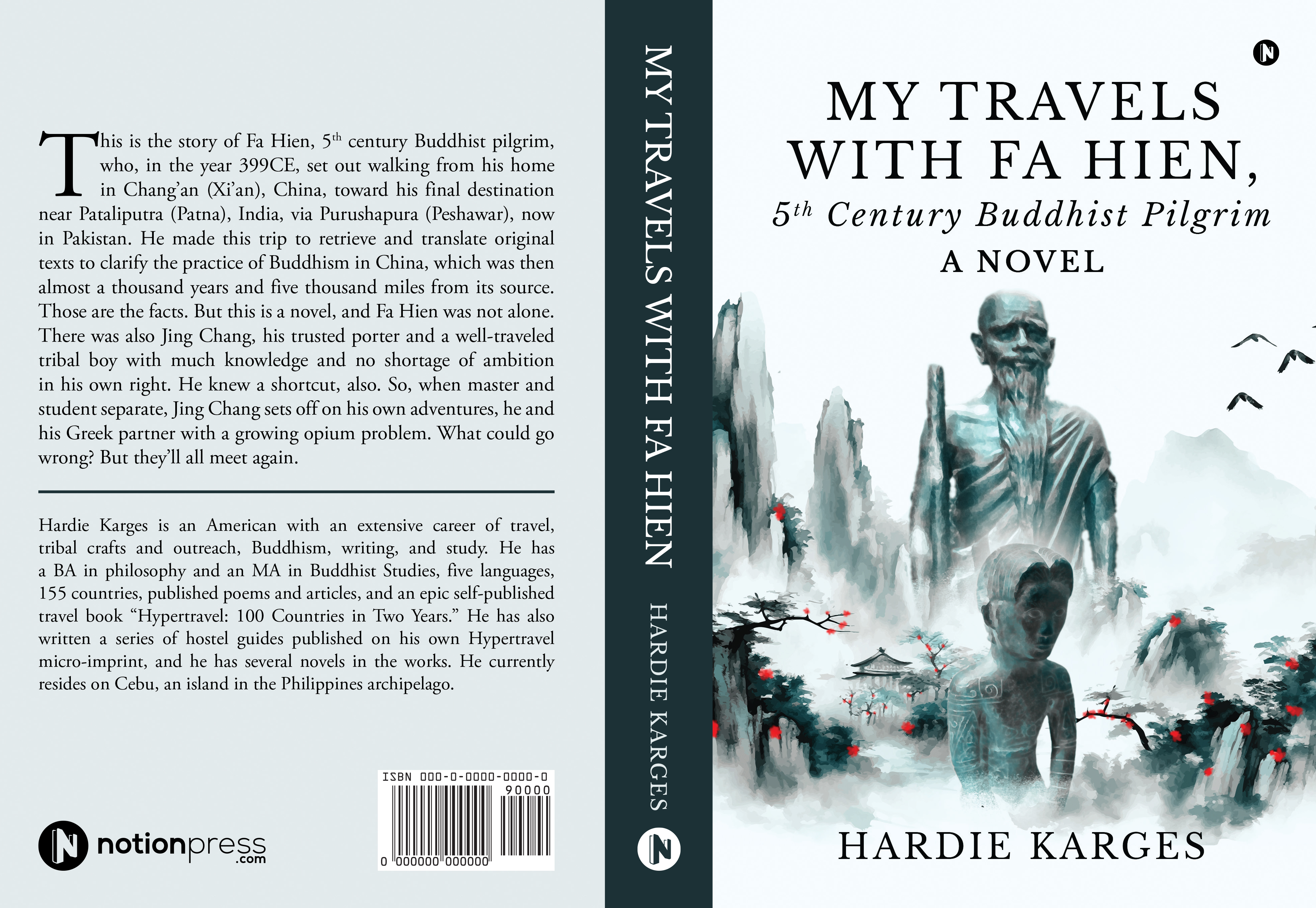
    My Travels with Fa Hien, 5th century Buddhist Pilgrim: Kindle E-book now available 

    Coming soon to an Amazon near you!

    I am happy to announce that the book “My Travels with Fa Hien, 5th Century Buddhist Pilgrim”, is now available in Kindle E-book at Amazon US (others soon) as well as physical copies there and at Notion Press, Flipkart, and bookstores in India. This is the true story of the 5th century Buddhist pilgrim on a 5000 mile trip from central China to eastern India via what is now Pakistan and the mountains and valleys that lie between. In the course of his travels, not only does Fa Hien complete his mission to find the true origins of Buddhism, while translating its sacred texts, but his crew manage to have adventures of their own in the process. This occurs while Rome falls and Europe enters its Dark Age on the other side of the world. It’s a travel book; it’s a dharma book; and it’s a history book, all in one. This is my tribute to Buddhism, Asia, and multiculturalism at its finest. A portion of all sales will go to charities in India. For more information and samples, please join my Fa Hien Facebook group. Enjoy.

    My involvement with this project began with the completion of an MA in Buddhist Studies, at the age of 65, after a long history of travel that covered some 155 countries, during which I studied language and cultures, while buying folk art. Much of that occurred at or after the age of 55 as documented in my own travel epic “Hypertravel: 100 Countries in Two Years,” published in 2012. After that I spent several years compiling travel guides to world hostels, again published on my own micro-imprint. As my interest in Buddhism grew, I attended retreats and spent time in temples and monasteries in Thailand and Myanmar, before finally entering International Buddhist College in south Thailand as an MA candidate in 2017. I completed my MA in 2019, while studying on campus and online, with much travel in Asia.

    Then came the pandemic. After a growing interest in the story of Fa Hien I finally started writing the manuscript in late 2020 in Guatemala and finished the first draft in early 2022 in Lumbini, Nepal, the birthplace of the Buddha himself. After many rewrites and a 2023 sabbatical waiting for further inspiration, I finally finished the book with several new chapters in 2024. Upon careful consideration I decided to publish the book in India, which is the setting for much, if not most, of the book. Unlike the West, also, Fa Hien is known widely there, even if he never gained the hero status that his imitator Xuanzang did in China with the classic epic ‘Journey to the West’. I’d like to change all that and give credit where credit is due, for the sake of Buddhism and travel. A portion of all sales will go to charities in India. For more information and samples, please join my Fa Hien Facebook group. Enjoy.

     
  • Unknown's avatar

    hardie karges 3:59 am on November 17, 2024 Permalink | Reply
    Tags: Buddha, , , , , ,   

    Buddhism on the Half Shell: Dharma without Dogma 

    Beware stir-fried spirituality, vague ideas tossed in a pan and stirred ‘til piping hot. Buddhism is an open doctrine, true, but it needs a compass. And the Eightfold Path is that compass, of course, the prime phenomena of our lives listed and pointed in the direction of ‘rightness’, i.e. the correct and appropriate versions of the main foundations of our lives: thought, intent, speech, action, livelihood, effort, mindfulness, and concentration. If non-duality can fit into that simple list, then fine; it is welcome. If not, then reshuffle your deck to find your place in lives where things actually exist and thoughts actually occur.

    For better or worse, Buddhism must live with the titles of its popular books, regardless of whether those actually describe the philosophy accurately or not. So, we must spend time explaining why ‘Buddhism is True’, and why there are a ‘Buddha and the Badass’ and how we can have a ‘Universe in a Single Atom’, whether any of that has anything to do with Buddhism or not. For the most part, those titles are just the consumeristic fantasies of book publishers, and the ideas inside their covers have little or nothing in common with them.

    But that’s a compromise we make. The real problem occurs when the ideas themselves get breaded and fried in almost total opposition to the original concept. So New Age Buddhists remind you to love yourself without bothering to explain, or even acknowledge, that we have no intrinsic Self, or even selves. Then they’ll tell you that our thoughts are not our own, while giving no clue as to where they actually come from, apparently just floating around, soul-like looking for a body to inhabit. But these are only minor inconveniences. The dharma can easily transcend most of that. I persevere.

     
  • Unknown's avatar

    hardie karges 4:11 am on July 6, 2024 Permalink | Reply
    Tags: , Buddha, , , , , , , , retribution, , ,   

    Buddhism 499: Revenge is not Sweet…   

    Retribution is not necessary. Equanimity is a path for all situations and all times. This is central to Buddhism, if not foundational. Because the foundations are mostly personal, but it’s implicit that once you’ve attained some level of release from your own suffering that you will contribute to do the same for the world. And while this may be more pronounced in the Mahayana tradition of Bodhisattvas, it also applies to all the rest, in substance, if not style. 

    That’s explicit in the tradition of dana, which Theravada Buddhism relies on for its everyday existence, since monks are forbidden to work, at least not in any official capacity. That’s for ‘householders.’ Monks are homeless, by design, making a mockery of the disdain in which we in the west typically hold them, our India relations elevating the concept to a high plain of spirituality as rishis or even maharishis in the Hindu tradition, or arahant in the Buddhist Theravadin tradition. 

    Even more important is ahimsa, non-violence, which holds true for all the India-based spiritual traditions. And while I’m sure their armies have had their own mistakes and misgivings over the years, at least give them the credit for not glorifying it or reveling in it. Because that’s what revenge and retribution imply, whether stated or not. Retribution is a function of karma, which you’ve brought on yourself, so no violence against others is either implied or intended. Stay cool. Don’t react, unless someone’s life is at stake. And, even then, don’t be proud of it. Be forgiving… 

     
    • jmoran66's avatar

      jmoran66 7:14 pm on July 6, 2024 Permalink | Reply

      That’s the roots of jai yen here in Thailand, I would think.

      • hardie karges's avatar

        hardie karges 12:01 am on July 7, 2024 Permalink | Reply

        Cool heart, yes…

  • Unknown's avatar

    hardie karges 3:41 pm on June 30, 2024 Permalink | Reply
    Tags: , Buddha, , , , , , , , , , , , , ,   

    Buddhist Love is not like Falling in Love, Sorry…     

    No, Buddhist love is nothing like the weeping and wailing and gnashing of teeth that often accompanies Christian ceremonies, whether birth or death or the multicolor gray area in between, mostly sex. Buddhist love, metta, is just a whole lot like friendship, and there’s nothing wrong with that. So, Platonic love, then maybe? I think Plato would be cool with that, maybe too cool. And that’s what falls short for a lot of people, for whom devotion is the primary practice of their religion. 

    It just doesn’t have the feeling of total surrender required for the religious experience in many people’s minds. But that’s Buddhism: cool, baby, cool. The devotional aspects were the last major additions to the three major canons of Buddhism, and long after the original discipline orientation of Theravada and the transcendental orientation of Mahayana. So, it’s no coincidence that the Tibetans got their Vajrayana straight from the source of India, which is primarily devotional to this day, whether of Shiva or Vishnu, no matter the object. Devotion is the important thing for the devotee. 

    But whether the two additional ‘vehicles’ may or may not have added something important to Buddhism, the core practice of discipline and dana (giving) remain unchanged. Upgrade the meditative practice of anapanasati to vipassana, and BOOM! You’ve got a rebirth of the original Buddhism with or without the doctrine of Rebirth to the non-Self (?!). Ouch. Yep, that’s better now, just to avoid questions that have no good answers. Too many cooks ruin the broth. The kindness is more important than the love.  

     
  • Unknown's avatar

    hardie karges 2:50 am on June 16, 2024 Permalink | Reply
    Tags: Buddha, , , , , , , , , , , Tiraatana, , Triratna   

    Buddhist Basics for Beginners: Three Gems… 

    Buddha, Dharma (teaching), and Sangha (community) are the three foundations of Buddhism. The Buddha, of course, is the one enlightened being to whom the inspiration for this teaching originally came and to whom we owe the effort at consolidation and collection of the diverse teachings into one coherent body of work. This happened at a time when such a thing had hardly been done before, and a paradigm hardly existed, so Buddha had to wing it. I’d say he did well. 

    The dharma, of course, is the teaching itself, which could arguably be considered the most important part of the practice. It is often translated as ‘law’ and that seems understandable, if we understand that the intention to commit as well as submit is central to the practice. The practice itself is somewhat novel in that you really don’t have to DO much of anything at all. This is perhaps best exemplified by the practice of meditation, something of a higher practice of Buddhism, not required but highly admired. 

    It’s much more important that you don’t do certain things, e.g lie, cheat, steal, kill, commit adultery, etc., very similar to the second half of the Biblical Ten Commandments (but don’t drink). All you really have to DO is be kind and peaceful. Unlike Christianity, though, which expects you to go forth and multiply, Buddhism is quite happy if you commit your life to meditation and contemplation. The object is to reduce suffering, not find bliss (sorry, Joseph C).  

    There are other dharmas, also, notably the Hindu sanatana dharma and Jainism, which are all similar, yet also quite different in specific details. The idea is to make the Sangha as large as possible, of course, the same as any religious practice, all of which work best when they have the largest number of members, for obvious reasons. If the majority of the world’s population could ever agree on anything, then that would be a notable accomplishment. If they could all agree to keep the peace at any cost, then so much the better. Buddhism is a good starting place. 

     
    • jmoran66's avatar

      jmoran66 8:38 pm on June 16, 2024 Permalink | Reply

      You just put Buddhism In A Nutshell in to a nutshell. Nicely done.

  • Unknown's avatar

    hardie karges 5:15 am on February 4, 2024 Permalink | Reply
    Tags: Buddha, , , , , , , , , , , , , , , , ,   

    Buddhism: Meditation, not Mysticism…  

    Buddhism was never intended to be mystical. Buddha was very rational in his take on life and suffering. Any mysticism came later, mostly in the Vajrayana Buddhism of Tibet that came directly from India, not China, and which had taken firm hold in that country by the Eight Century CE. And while that ‘school’ of Buddhism is often included in the Mahayana tradition which traveled through, and was greatly influenced, by China, such is not the case with Vajrayana, which derives from a later, maybe the last, Indian Buddhist tradition, before it succumbed to the coup de grace by the invasive Mughals, after centuries of losing ground, and followers, to the Brahmanist Hindus. 

    About the only thing that all the Mahayana schools have in common, in fact, is that they are not of the original Theravada tradition, which originated in India and found fertile ground in southeast Asia, mostly. And if the Vajrayana tradition is famous for its multiple levels of heaven and hell, its Tantric yab-yum, mudras and mantras, then Theravada (aka Hinayana), is best known for its lack of all that, and concentration on meditation, especially, to the extent that it’s sometimes known by that most famous meditation technique Vipassana. Meanwhile the Mahayana Buddhism of China is probably best defined by its transcendent Buddha and the vast Emptiness of reality, both more recent developments.

    Many famous Chinese monks, Fa Xian and Xuanzang foremost among them, even made long arduous trips to India just to get it right, like Charlemagne realizing his 8th century French language wasn’t proper Latin. And mostly I believe that meant learning meditation, and some other disciplines, which Theravada monks usually excel at, and Chinese monks often suck at—to this day. In fact, I didn’t really even know what meditation was until I attended some Theravada-based meditation retreats in Southeast Asia, intended for Asians, not Westerners. When you see a layman sitting silent unflinching for two or three hours lost in no-thought: that’s meditation. The monks are even better at it. Now I get it. Get it. 

     
  • Unknown's avatar

    hardie karges 8:41 am on March 25, 2023 Permalink | Reply
    Tags: Buddha, Drake Equation, , ,   

    The Lessons of Life and the Lessons of Buddhism  

    Sometimes the worst disasters teach the best lessons. And this itself is one of the most sublime lessons of Buddhism, if never the easiest to embrace, that all of our most elaborate plans will certainly fall apart, sooner or later, in part if not wholly. We will be left with whatever remains, and we should be prepared to deal with it. That doesn’t mean elaborate rituals to be done or the best insurance to be had, simply a willingness to move on with whatever life brings and letting go of any pretense to authority over things we can’t control. 

    Now, I certainly won’t go as far as many ‘non-dualists,’ and neither would the Buddha, in asserting that, essentially, we are nothing, neither doer nor actor nor creator, simply witnesses to that over which we have no control, which is almost everything. I won’t go that far. I’d only say that it’s limited, and all pretenses otherwise are extremely il-advised. The Buddha made it clear that we are composite beings on the best of days, however intelligent, and much less than that quite often. We are not Gods nor even masters of our own domains.  

    As a firm follower of science, but not necessarily a believer, I give us all the credits due any featherless biped, and much more, since it’s not yet proven that there are any more of us ‘out there,’ unless they are related to us, or until we find at least one. The Drake Equation is logic, not evidence. No, I believe that this species is unique, as are each and every one of us, with our own DNA and fingerprints. But that doesn’t give us any special rights to command others and the universe. We are children of this universe. Enjoy.  

     
c
Compose new post
j
Next post/Next comment
k
Previous post/Previous comment
r
Reply
e
Edit
o
Show/Hide comments
t
Go to top
l
Go to login
h
Show/Hide help
shift + esc
Cancel