Recent Updates Page 27 Toggle Comment Threads | Keyboard Shortcuts

  • Unknown's avatar

    hardie karges 8:08 am on February 6, 2022 Permalink | Reply
    Tags: , Four Noble Trutrhs, , , ,   

    Buddhism and the Path Forward… 

    I’m willing to forego some pleasure, if that means I can forego some pain. And that’s the Buddhist Middle Path in a nutshell, if you like nuts. Because that was the dilemma Siddhartha Gautama was faced with, before he was the Buddha, as a prince of the ksatriya (warrior) caste, most likely, and with all the luxury that life can bring. Until one day, that is, when he ventured outside his harem and realized with a shock that real people, those without harems, also suffer sin, disease and death, not to mention old age, which is possibly the worst of all, or so I hear, haha…

    And from that stark realization, of our impermanence and our imperfection, was born the foundation of Buddhism, the Middle Path to avoid suffering. Some people say that Karma, Rebirth, and the resulting past lives are the bedrock of Buddhism. They’re wrong. The later Mahayanists came up with a slightly different Middle Path, translated from different Sanskrit words, that means the path between existence and non-existence, but that came later, by around five hundred years, give or take a century. Indians hated writing things down, for reasons best left to idle conjecture, since if there was a reason to be known, then it likely would have been written.

    The way to avoid, mitigate, and hopefully even cease suffering, if not actually cure it, is to first cease craving, of course. Because if this is a world of suffering, then it is also a world of desire, and that is no coincidence, they locked in a dance to the death that largely defines our dimension—of suffering. If that sounds pessimistic, then I would urge you to check your American Express gold card at the door and contemplate your own death for only a second. Because that length of time is enough to show you that you are not the master of the Universe, nor even your own fate. At best you are only the master of your emotions, and that is where Buddhism does its best work. Before Enlightenment save the world. After Enlightenment save the world. It beats chopping wood—sometimes…

     
  • Unknown's avatar

    hardie karges 7:45 am on January 30, 2022 Permalink | Reply
    Tags: , , , , ,   

    Buddhism 101: Do the Right Thing, Quietly… 

    To do the right thing isn’t always easy. Do it anyway: samma-ditthi, samma-sankappa, samma-vaca, samma-kammanta, samma-ajiva, samma-vayama, samma-sati, samma-samadhi, often translated as Right Understanding, Right Thought, Right Speech, Right Action, Right Livelihood, Right Effort, Right Mindfulness, and Right Concentration, though I’m not sure what the difference is between Right Understanding and Right Thought. But I do know that Right View is often substituted for one or the other of them, I assume the first, since the modern Nepali translation of ‘view’ is drsya, and probably better for the very reason of its distinction from ‘thought.’

    And then there are those who would object to the translation of ‘samma’ as ‘right,’ though for what reason I can’t remember now, and probably misguided, if we remember that ‘right’ in this case is in the context of ‘appropriate,’ which would agree nicely with that word’s derivation in modern standard Thai, which has probably half of its words derived from Pali and/or Sanskrit.

    Re-translation is the curse of modern-day Buddhism, especially American-based Buddhism, which must reconcile ancient Indian thought derived from deep contemplation with modern critical analysis largely derived from empirical testing on one hand, and the faddish trends of fashion on the other, and the need for brief sound bites with universal happy endings, perfect for mass consumption.

    And that’s fine, since Buddhism is an ongoing dialog, or dialectic, in constant search of a higher truth, those first Four Noble ones and that ensuing Eightfold Path but the starting point for further developments and the groundwork for the Precepts, that were once typically translated as Commandments for simplicity of reason, faith and understanding. All religions seem to need tenets, even when they are almost identical, since most people need constant reminding of even the simplest things in life.

    For example: Samma Vaca, Right Speech, is not just for your friends, but your enemies, too, and strangers unnamed and uncounted. Obvious, right? But until someone articulates that most important point, then it might very well go unnoticed by most typical text-skimmers. Less obvious is that all this verbiage is excessive, and should be unnecessary, except for our habits of point and counterpoint, parry and thrust. Buddhism is a religion and philosophy of silence, at the core of its being and existence. Silence is normal. All noise should be treated as an alien force, approached with caution and handled with great care.

     
  • Unknown's avatar

    hardie karges 7:00 am on January 23, 2022 Permalink | Reply
    Tags: , , , , , , , ,   

    Buddhism and the True Meaning of Love 

    ‘Falling in Love’ is all about attachment. True love is all about non-attachment. True love looks for soft spots to protect. Aggression looks for soft spots to attack, and attachment isn’t much better, by weakening that spot, even if not physically attacking. By ‘true love,’ of course, I’m talking about Buddhist metta, typically translated as ‘lovingkindness,’ if you’re Jewish or Christian, but that still preserves some passion, and suffering, so maybe better translated more like the Buddha himself probably intended, so something like ‘brotherly love’ or ‘sisterly love,’ as the case may be. To be clear, I think that being in a relationship is fine, sometimes wonderful, but it shouldn’t necessarily be based on the hysterical (no pun) madness of being ‘in love.’

    Score one for arranged marriages? I wouldn’t go that far. Exercising one’s innate free will, to whatever extent it exists, and despite all the limitations placed upon it, is all about what it is to be human. ‘Give me liberty or give me death’? Haha, once again, I probably wouldn’t go that far. Because true freedom is freedom FROM, not freedom TO, freedom from any and all the defilements that plague us, but not freedom to do anything we want, regardless of whom it hurts. And this is an important distinction. Kileshas are the Buddhist name for those defilements that destroy our humanity and reduce us once again to the animal world from which we’ve evolved.

    It’s funny, though, because often these defilements themselves come paired just like the pair-bonding couples that cause many of the problems in their quest for reproduction rights, in addition to other attachments and liens on property. Because jealousy and revenge are twin kileshas, just like hate and anger, one feeding off the other like two heads of a serpent striking, and best avoided. The great Buddhist dilemma, or tetralemma, is how to deal with aggression. Do you turn the other cheek? But no Christian really did that, did they? To live from sensation to sensation is to live like an animal. To follow dharma is to live like a human.

     
  • Unknown's avatar

    hardie karges 8:05 am on January 16, 2022 Permalink | Reply
    Tags: , , , , , ,   

    Buddhism in the Modern Era 

    Some people might laugh at a monk in meditation, wasting his life away, but I laugh at the silly fools who cause global warming. Because they are the ones that are not only wasting their lives, and themselves, but they are destroying the world for the rest of us, also, and that is a crime that should be punishable to the maximum extent of the law. Meditation is no crime, regardless of whether you think it does anyone any good or not. It certainly does no one any harm, and that’s the Hippocratic Oath, primum non nocere…

    So why do it? The short answer is for the peace of mind, of course, and that should be plenty. But the industrialists and capitalists are hooked on growth like Skid Row addicts on the junk and other trash that populates so much of our lives. Beauty is so much better, and it is absolutely free, costing nothing in the backyard garden and not much more in Amazon, which in reality is a jungle in the South American heart of darkness, which really isn’t so dark at all, in fact a veritable paradise and biology lab par excellence…

    But the Truth, Beauty, and Goodness implicit in the state of Nature are wasted on people who only judge value by dollar signs and Yelp (!) reviews. Because that is a world that means little in the final analysis of man’s involvement with his planet. Karma may be a sketchy concept, but that sketch packs a powerful punch: we reap what we sow, somehow some way, and that murkiness is important. Because the fact that every action has an equal effect is not karma; that’s Newton’s 3rd Law. That every action has an indirect, perhaps greater, effect is karma, and that’s dharma, law, religion, you name it…

     
  • Unknown's avatar

    hardie karges 6:00 am on January 9, 2022 Permalink | Reply
    Tags: civil disobedience, , Mahatma Gandhi, Martin Luther King, Pancasila,   

    Buddhism and the Power of Emptiness 

    Non-action is not the same as inaction, and it can often counter aggression successfully, with non-compliance and non-cooperation, etc. Because inaction is passive, while non-action is deliberate and intentional, so the better Buddhist response, by far, and a well-tested tactic by such civil disobedience luminaries as Mahatma Gandhi and Martin Luther King. Buddhism’s weakest point is its passivity, by those who misinterpret its dispassion as such. But that is a logical non-sequitur. Dispassion does not imply passivity, even if that is a hard point to make to people in many Buddhist countries where that is the norm.

    And I’ve made my peace with that reality, somewhat, in that at this point in the history of the world, passivity is better than the mindless aggression that consumes so many lives in its quest for legitimacy, usually being marketed as any one of various forms of freedom, which is largely a masquerade and a farce, a caricature of true freedom which is freedom FROM the addictions and cravings that enslave us, not a freedom TO do whatever and whenever we want, no matter whom it might hurt in the process. Because that is a precept as important as any in the Buddhist Commandments, whether five (Pancasila) for the layperson or Eight (Atthasila) for monks.

    First do no harm. Then decide what else is required and necessary. To do nothing is better than to do something wrong or bad. And, when properly applied with strategy and forethought, non-action can be revolutionary. Because dictators and autocrats depend on the acquiescence of a docile populace to rule by force and coercion. That means enough optimism and goodwill to reproduce the human race, without which no ruler can rule. Many, if not most animals, cannot reproduce in captivity. Why is that, do you think? The answer to that is the secret to life and the origin of the science of psychology…

     
  • Unknown's avatar

    hardie karges 5:39 am on January 2, 2022 Permalink | Reply  

    Bodh Gaya, India: Home to the Buddha, Thousands of Monks—and Mosquitoes… 

    Live from Bodh Gaya, India…

    hardie karges's avatarTime Traveling 2026

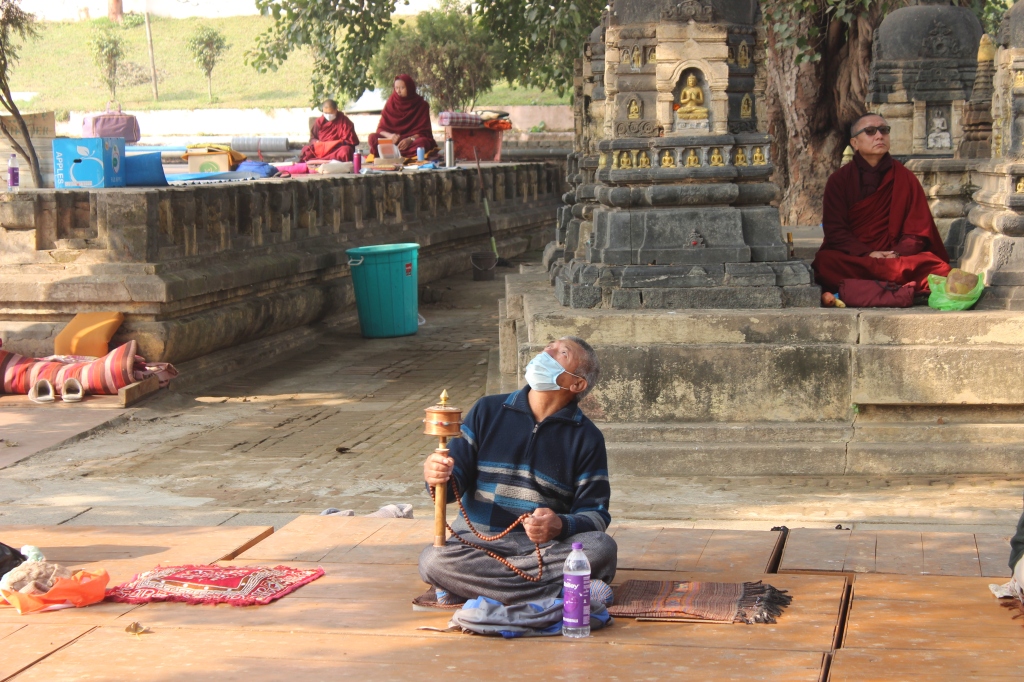
    Bodh Gaya, in the state of Bihar (from the Sanskrit vihara, or temple), in India, is top dead center for the history of Buddhism, famous as the place where the Buddha got ‘woke,’ or found enlightenment, whichever translation you prefer, same thing, really. And if Patna did little to show the glory of its previous existence as Pataliputra, then Bodh Gaya goes a long way to make up for that disappointment, not that there are none of the noise, air pollution, and grime that plague so many other Indian towns and cities—there are—but there’s none of that inside the Mahabodhi temple complex itself.

    No, there are just Buddhists from all over the world gathering to share some of the well-being that they have acquired through the practice of Buddhism, even if the several traditions may have diverged widely from the original inspiration which was the Buddha’s almost alone, after…

    View original post 991 more words

     
  • Unknown's avatar

    hardie karges 6:07 am on December 26, 2021 Permalink | Reply
    Tags: , , , , , , ,   

    Buddhism Unmoved: in Support of ‘Spiritual Bypassing’ 

    The one who can control himself, can control the world—his world…

    Anger is an object lesson, not just about hatred, which seems obvious, but lust, craving, passion, and all the rest. It feeds on itself until it destroys something, if not everything. This is one of the Three Poisons of Buddhism, along with greed and ignorance, and it would be hard to decide which is worse. Because they all destroy whatever is in their path, like fires burning endlessly and mindlessly, when the obvious solution would be to simply let them go, to burn themselves out. If any three words could sum up the message of Buddhism, it would likely be, ‘let it go.’

    But it’s not always so easy, of course, given the nature of the beast, its very nature being its difficulty to let go. So, in a sense, they are all one, that fire burning, which we Westerners like to immortalize as something romantic called ‘passion,’ while conveniently forgetting that word’s roots in suffering, as in the ‘passion of Christ,’ nothing romantic about that. But so we fantasize, that our greed is our glory and our lust is our love, when nothing could be further from the truth, from any metaphysical viewpoint—at least, not in Buddhism.

    Because Buddhism is a religion and philosophy of dispassion, in both the traditional meaning of ending suffering and the modern meaning of avoiding strong emotion. This drives many Western psychologists crazy, of course, because they sense any emptiness as a cause of alarm. The first thing they teach in photography class is to ‘go for peak emotion.’ And the psychologists want all potential conflicts to be met head-on. To not do so is something they call ‘spiritual bypassing,’ with obvious derision. Well, if avoiding anger is ‘bypassing,’ then I heartily recommend it. For nothing good can come from anger. One man’s religion is another man’s aversion, I suppose.

     
  • Unknown's avatar

    hardie karges 8:07 am on December 19, 2021 Permalink | Reply
    Tags: Buddha-nature, , , , Lin Chi,   

    First Precept of Buddhism: Thou Shalt not Kill… 

    If you meet the Buddha on the road, feed him. Now isn’t that better than the traditional Zen koan: “If you meet the Buddha on the road, kill him”? And I know, I know, there are approximately 1000 explanations and clarifications about what Lin Chi really meant, most of them veering toward the ever-popular non-dualistic trend, in the sense that the Buddha-nature (bodhicitta) is within us all, so that if you meet a Buddha that is separate from yourself, then it is likely an imposter—or not.

    After all, who really knows what Lin Chi meant, more than 1000 years ago, or all the other hundreds of koans that are supposed to lead to enlightenment, simply by twisting the mind, or thought, or language, so that there is no other option? Out of the confusion, enlightenment will come, when the limits of language are laid bare—or not. Because who really knows what any of the hundreds of Buddhist philosophers really meant? And who really understands ‘non-dualism’? And why is it important?

    Because what the Buddha himself taught was really quite simple, and I don’t remember non-dualism being part of it. That was Hinduism. What the Buddha taught was compassion, in response to great suffering, and the same commandments and precepts that they all teach. So, language is part of the deal, but so is silence, meditation. Language can’t always solve the problems that language creates, but silence often can, if you just give it a chance.

     
  • Unknown's avatar

    hardie karges 7:10 am on December 12, 2021 Permalink | Reply
    Tags: ,   

    Buddhism: Salvation Nirvana Love Magic… 

    Revenge is never sweet. Find a way to accept your enemy as your brother, and the world will be a better place. This is the social and societal side of Buddhism, which is seldom talked about, but which is fundamental to its value, with accent on the fun. Because, while much of Buddhism has to do with personal satisfaction and peace of mind, there is a tendency to overlook the underlying social function which makes it indispensable to cultures and countries the world over. This is its ‘First do no harm’ function of ahimsa, non-violence, that makes it so attractive across the broad board, beyond the mostly petty distinctions that divide Buddhism, and all religions, for that matter.

    So, when the Buddha on his death bed told his disciple to ‘be a light unto yourself,’ and Saint Paul said to be a light unto the world, the essential message is the same: do the right thing. But Buddha was playing a clever little word game in his message, since the Pali word dipa can mean both ‘light’ and ‘island,’ as in Dipavali, the festival of lights, and Lankadeepa, the island of Sri Lanka. And the light that the Buddha wants is one that is self-contained, like an island, while the light that Saint Paul wants to be shined upon the world is the word of God, received and transmitted.

    But this distinction, which is really and truly only a small distinction, also defines the difference between Theravada Buddhism and Mahayana Buddhism, with its Buddha-nature, Bodhisattvas, and shunyata, or Emptiness. This is the message to forego Nirvana until all of us are ready, and so project that Buddha-nature on to the world. Is that nature not a light to be shined? And that zero that defines emptiness also defines a center. Is that not the same distinction between us and the world, and so really a non-distinction? Of course it is, and it isn’t, so the only thing left to do is save yourself, and then save the world, simple if not easy.

     
  • Unknown's avatar

    hardie karges 6:59 am on December 5, 2021 Permalink | Reply
    Tags: , , , , , , , , , , , , , , ,   

    The Ways and (Skillful) Means of Buddhism… 

    ‘Skillful means’ is not about telling people what they want to hear. It’s telling them what they need to hear, in a way that’s acceptable to them. And if this sounds obvious, it can be more complicated than it seems. It can even contradict one of the main precepts in the Eightfold Path, in fact, if it fails to acknowledge the importance of Right Speech. One of the Buddha’s later commentators, in fact, even bragged about how the Buddha could preach about cosmic Self to the Brahmanists, while preaching non-self to the already-committed Buddhists. Fast-forward to the future and a prominent senior Buddhist monk today claims that Buddha, in fact, was never committed to a doctrine of non-self, but was undecided about it (so that we can now accept rebirth with no issue of what it is that gets reborn). But this is not ‘skillful means.’ And this is not Right Speech.

    As the New Testament of the Christian Bible is often paraphrased: “Let your yes be yes; and let your no be no.” Bingo. That Buddhism is an open doctrine is fine, and to be commended. That it sometimes gets twisted almost beyond recognition is not always so good. But that’s exactly what happened when Mahayana went in two almost opposite directions from its shunyata (emptiness) starting point, one leading to the Vajrayana of Tibet, the other leading to the Zen of Japan. And for a long time, that’s where Buddhism stood, and stalled, and those are the two extremes that made the biggest impact in the New World—until now. Because now there is a new dialectic to that interplay of magic and trance, and it should be no surprise that the only realistic synthesis would be a return to the primal roots of early Buddhism. So, Theravada now finds its best messaging in its simplest Forest Temples, and the debates in the background resume.

    Only this time it is not the background of Brahmanism and Jainism, but dozens of so-called ‘New Age’ ideas and the general air of conspiracy. But for me Secular Buddhism is the rightful heir to the debate with religiosity, something which original Buddhism had not the luxury, because Science as we know it did not exist. But Reason and rationality did, embedded in the nature of cause and effect, the words for which define ‘reason’ in more than one Asian language. And that’s how Buddhism won the original debate, for me, at least, because it was the rational option. And it still can be, if it can find its peace with Science, because that is the air we breathe in this day and age, logic and testing. We only need a belief system to make sense of it all. If not, then ‘belief’ becomes a bad word, synonymous with ‘faith,’ and we are left to our own devices to find succor and solace. I find no contradiction between my Buddhism and the best science we know. If forced to choose, then I will refuse, and let the chips fall where they may.

     
c
Compose new post
j
Next post/Next comment
k
Previous post/Previous comment
r
Reply
e
Edit
o
Show/Hide comments
t
Go to top
l
Go to login
h
Show/Hide help
shift + esc
Cancel