


DJ Trump and the Sarvāstivādin Theory of Momentariness…
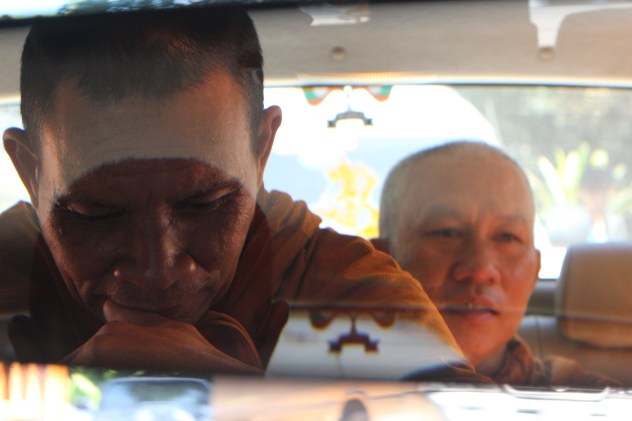
Reflections in the back seat
For those of you who are not in the process of pursuing a Ph.D. in Buddhist Studies, let me explain that the Sarvāstivādins were a large Abhidharma-era group that split off from the mainstream Theravādins after Asoka’s third Buddhist Council at Pataliputra c. 250 BCE, over their insistence that ‘everything exists’, i.e. ‘sarvam asti‘ (or something like that, my Sanskrit sucks), while the Theravādins preferred a bit more ‘discrimination’…
And part of that theory of everything was an atomistic conception of time: atoms, of both time and matter, and classifiable as either: (1) states of consciousness (citta); (2) mental ‘concomitants’ (cetasika); (3) corporeality (rūpa); plus (4) nirvāna. According to the Sarvāstivādin conception of time, these could exist equally well in the past, present or future. For their part the Theravādins only acknowledged the present, albeit in successive moments… (More …)
 hardie karges,


 Yes, I’m talking about that theoretical ghost in each of our machines. So the first time a human being saw his reflection in still water must have been incredible, our hero unbelieving, disbelieving, unsure if what’s he’s seeing is really him, himself, and so now aware of self, for maybe the first time, previously only aware of everything other…
 Intent is the elephant in the courtroom of modern justice, beyond forensics and beyond genetics, the need to know what someone was thinking and why they thought it, at such-and-such a time and such-and-such a place. But isn’t this a system doomed to failure? And is it really necessary?
 You’ve got something pretty special when you put friendship and compassion together, and something pretty simple. Even people who profess to believe in nothing, and categorically reject use of that word ‘belief’ can surely believe in friendship and compassion. And friendship, universal friendship, is a very important concept, easy to forget in our day and time that at some time in the not-so-distant past anyone who was not part of the family was suspect and an object of great fear and suspicion…
 streaming consciousness...
Reply