

Buddhist Shunyata: Emptiness and Chaos, Form and Content, Zeroes and Ones, ad Infinitum…
Every act of cruelty is a good chance to prove the power of kindness, in some sort of reverse logic, which largely defines our lives on this planet. Because nothing is what it seems, and everything is a cause of concern. But it needn’t be, because everything that can happen will happen, by certain laws of physics, but only if given enough time, of course. And that is our job, to control the time line in our dimension, which is largely defined by space. We travel in space, not time, not yet, anyway. Time is mostly an act of mind coordinating events which have already happened in apparent space, so three dimensions, while time is only one–the past. That is all we know about time, because that is the only aspect of time that we can measure. Everything else is pure mathematical probability, in the case of the future, or a fleeting moment of presence, and best held in abeyance, in the case of that legendary present moment. But that ‘present moment’ doesn’t exist, as such, anyway, because it is a contradiction in terms, as defines our lives in language. Because if we speak of a moment, as a point in time, then there are many, in rapid succession, one after the other, as they stack up for counting in that warehouse we call the past. But if it is truly the present, then if must be an ongoing continuum, uncountable in its immediacy, and so hardly recognizable as a moment, but more like an eternity, an infinity, one and not many, but really more like zero than one, form without content. Thus all the numbers of our counting system fit neatly and best between the conscious and mental paradigms of zero and one, neither of which can ever be truly present and physical, but both of which can be reasonably intuited. And this is much of the background noise and radiation of the Buddhist concept of ‘shunyata’, variously defined as void, emptiness, nothing, or ‘zero-ness’, bingo! Because that is what the word ‘shunya’ means, in multiple Asian languages, and its invention in pre-literate India was more or less simultaneous, conceptually and arithmetically. I don’t think that this was coincidental. So instead of positive numbers or negative numbers, maybe all we really have are fractions of a single number One as defined by its erstwhile twin Zero. These might also be seen as Chaos and Void, content and form, or even male and female, depending on circumstances. Thus everything is the opposite of what it seems, from certain angles, and at certain times of the day. My hunger defines my terms of fulfillment, and levels of dissatisfaction define my feeling of happiness–or not. So in some Maslovian hierarchy of needs, there is a sweet spot of contentment and a vast suburb of uncertainty. Every frown hides a smile, and every tear hides laughter–somewhere, somehow…
 hardie karges and

 The concept of the Golden Mean always crossed my mind when studying Buddhism, but I never heard anyone reference it re: the Middle Path, i.e. madhyamagga, until recently, and while I’m not sure the reference is entirely correct, I do think the possibilities are exciting.
 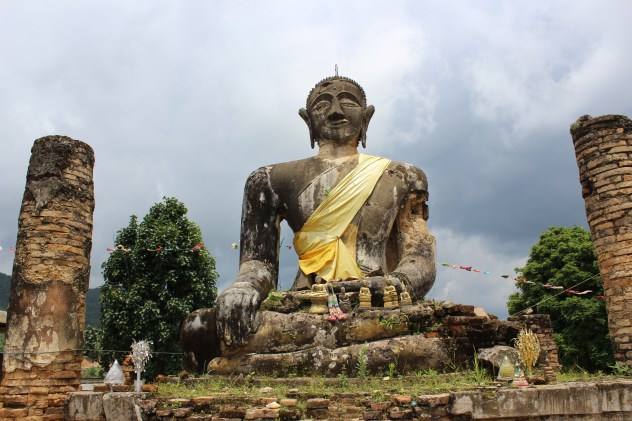 The Buddhist doctrine of shunyata is one of its most famous, and the one that put Mahayana Buddhism on the map, a full step beyond what was envisioned with the original teachings of the Buddha, yet well within that purview. It is usually translated as ’emptiness’ or ‘voidness’, though I prefer ‘zero-ness’, in recognition of the fact that the word ‘shunya’ or ‘sunya’ literally means just that, zero, and in the modern standard language of every Theravada Buddhist country today, still means just that, or a derivation thereof…


 streaming consciousness...
Dave Kingsbury 5:15 pm on January 7, 2020 Permalink |
Not sure how but this post reminded me of Blake’s phrase – without contraries, no progress. Emptiness, by that token, is a creative opportunity. And as you say, ‘every act of cruelty is a good chance to prove the power of kindness’ – have a good 2020, Hardie!
hardie karges 7:50 pm on January 7, 2020 Permalink |
Thanks, Dave, happy 2020 to you, too!