Tagged: philosophy Toggle Comment Threads | Keyboard Shortcuts

  • Unknown's avatar

    hardie karges 4:25 am on October 6, 2024 Permalink | Reply
    Tags: , , , , , philosophy, , , , theft   

    Buddhism in the Bardo Realms: You Are Never Alone 

    Buddhism in Bhutan

    The existential conundrum of our lives is that we are never alone, nor can we be, nor would we likely ever want to be, even if we could. Think of it this way: Suppose you want to enjoy yourself by yourself or just take a little swim. So, you walk down to the beach, find a nice little spot, and proceed to disrobe and jump right in. There’s only one problem: when you come back, you don’t know if your stuff will still be there or not—bummer. This is what many a happy tourist deals with every day.

    Oh, sure, there are ways to mitigate the circumstances. You can go with a friend, but that friend really can’t jump right in, now, either, can they? No, they can’t, because then any potential plunderer has just doubled his payoff. Even if you have a designated watcher for a larger group, that designee still doesn’t get to have his fun (and you still must trust him not to run). So, maybe hire a professional designee? Ditto. Or you could lock it in a box, if it’s a public space with such amenities, but that would probably preclude a dip in the buff, boo hoo. And even then, would you just wrap the key around your little finger?

    Or, you could just leave the key in your pocketed swim suit, but then, why not just leave your stuff in your room, and saunter to the beach semi-nude and flip-flop friendly, because, after all, nobody will steal a pair of flip-flops, or a towel, now, will they? Or would you even care if they did? And your room is safe, right? But what about the maid? Or you could just drive, and lock everything in the trunk, if you’re American, or the boot, if you’re a Brit, but by this time you’re making quite a big show of it, so maybe just call the whole thing off?

    This is the existential conundrum: that our fates are so intertwined, that it doesn’t leave a lot of time, or space, for accidents or circumstance. So, what is the solution? In a more peaceful time, in a more peaceful world, I have it on good authority that people left their houses unlocked with no ill repercussions, and that is the way that it should be. But that was in a world less crowded than today. And many people take it as their supreme inalienable right to reproduce without limit. So, now we live in a world of eight billion with no end in sight. And there’s no place to hide. So, we must learn to live in peace. And Buddhism is nothing, if not a religion of peace.

     
  • Unknown's avatar

    hardie karges 3:41 pm on June 30, 2024 Permalink | Reply
    Tags: , , , , , , , philosophy, , , , , , , ,   

    Buddhist Love is not like Falling in Love, Sorry…     

    No, Buddhist love is nothing like the weeping and wailing and gnashing of teeth that often accompanies Christian ceremonies, whether birth or death or the multicolor gray area in between, mostly sex. Buddhist love, metta, is just a whole lot like friendship, and there’s nothing wrong with that. So, Platonic love, then maybe? I think Plato would be cool with that, maybe too cool. And that’s what falls short for a lot of people, for whom devotion is the primary practice of their religion. 

    It just doesn’t have the feeling of total surrender required for the religious experience in many people’s minds. But that’s Buddhism: cool, baby, cool. The devotional aspects were the last major additions to the three major canons of Buddhism, and long after the original discipline orientation of Theravada and the transcendental orientation of Mahayana. So, it’s no coincidence that the Tibetans got their Vajrayana straight from the source of India, which is primarily devotional to this day, whether of Shiva or Vishnu, no matter the object. Devotion is the important thing for the devotee. 

    But whether the two additional ‘vehicles’ may or may not have added something important to Buddhism, the core practice of discipline and dana (giving) remain unchanged. Upgrade the meditative practice of anapanasati to vipassana, and BOOM! You’ve got a rebirth of the original Buddhism with or without the doctrine of Rebirth to the non-Self (?!). Ouch. Yep, that’s better now, just to avoid questions that have no good answers. Too many cooks ruin the broth. The kindness is more important than the love.  

     
  • Unknown's avatar

    hardie karges 2:50 am on June 16, 2024 Permalink | Reply
    Tags: , , , , , , , philosophy, , , , Tiraatana, , Triratna   

    Buddhist Basics for Beginners: Three Gems… 

    Buddha, Dharma (teaching), and Sangha (community) are the three foundations of Buddhism. The Buddha, of course, is the one enlightened being to whom the inspiration for this teaching originally came and to whom we owe the effort at consolidation and collection of the diverse teachings into one coherent body of work. This happened at a time when such a thing had hardly been done before, and a paradigm hardly existed, so Buddha had to wing it. I’d say he did well. 

    The dharma, of course, is the teaching itself, which could arguably be considered the most important part of the practice. It is often translated as ‘law’ and that seems understandable, if we understand that the intention to commit as well as submit is central to the practice. The practice itself is somewhat novel in that you really don’t have to DO much of anything at all. This is perhaps best exemplified by the practice of meditation, something of a higher practice of Buddhism, not required but highly admired. 

    It’s much more important that you don’t do certain things, e.g lie, cheat, steal, kill, commit adultery, etc., very similar to the second half of the Biblical Ten Commandments (but don’t drink). All you really have to DO is be kind and peaceful. Unlike Christianity, though, which expects you to go forth and multiply, Buddhism is quite happy if you commit your life to meditation and contemplation. The object is to reduce suffering, not find bliss (sorry, Joseph C).  

    There are other dharmas, also, notably the Hindu sanatana dharma and Jainism, which are all similar, yet also quite different in specific details. The idea is to make the Sangha as large as possible, of course, the same as any religious practice, all of which work best when they have the largest number of members, for obvious reasons. If the majority of the world’s population could ever agree on anything, then that would be a notable accomplishment. If they could all agree to keep the peace at any cost, then so much the better. Buddhism is a good starting place. 

     
    • jmoran66's avatar

      jmoran66 8:38 pm on June 16, 2024 Permalink | Reply

      You just put Buddhism In A Nutshell in to a nutshell. Nicely done.

  • Unknown's avatar

    hardie karges 4:03 am on May 26, 2024 Permalink | Reply
    Tags: , dissatisfaction, , Existentialism, , , , , , , , , , philosophy, , , , , , , ,   

    Buddhism 499: Sometimes Some Things Are Lost in Translation  

    Beware re-translations. The Buddha spoke a Sanskrit-related language. Sanskrit never went extinct. ‘Dukkha’ still means ‘suffering’, sorry. Many Western Buddhists try to manipulate the message, however slightly, to make it more appealing to Western tastes, but that says as much about Western tastes as it does about Buddhism. The issue in question, of course, is the First Noble Truth, which states something as innocuous—and obvious—as the fact that suffering exists, nothing more, nothing less, UNLESS: you want to make that jagged little pill a little easier for someone from Hoboken to swallow. 

    Because if the principle of suffering is important enough to list it first and foremost as the foundational principle of your new religion, then that’s easily hyperbolized into such platitudes as ‘Life is Suffering’, ‘All Life is Suffering’, and so on, which is understandable, but somewhat depressing for many Western tastes accustomed to fast food and Ferris Wheels (for those of us raised on Existentialism, it’s not such a problem). But the easiest way to mitigate that circumstance is to soften the edges of that term ‘suffering’ to make it sound more like ‘dissatisfaction’, ‘stress’ (ahem), ‘spot of bother’ (maybe ?), or my favorite: ‘bummer’, haha. 

    Okay, so I’m joking a little bit, but the modern notion of ‘stress’ was surely unknown in 5th C. BCE India, so that’s a bit of a joke, also. But the effort at mitigation is certainly allowable under the Buddha’s own notion of ‘skillful means’, so it’s just a question of what’s appropriate. Bottom line: dukkha means ‘suffering’ as surely today as it did 2500 years ago, as a quick trip to Google Translate will quickly prove (yes, they have Sanskrit). The problem is that many Westerners see life as something ‘fun fun fun’ and so actually want rebirth or reincarnation (if not eternal life), while many traditional Easterners downplay any attachment to this cosmic play of samsara, while seeking release in Nirvana. 

    What to do? Nothing, really, because Buddhism should not be concerned with gaining adherents or scoring points, but merely offering some solace and refuge for those who need such. The world is what it is, and you’re probably going to die, regardless of any and all medical advances (though Virtual Reality is a remote possibility). Therefore, even the best scientific advances can only be limited in scope, and satisfaction with those limits is much better than trashing ourselves and/or the planet in frustration. As always, the middle path offers a practical solution: enjoy life, but don’t get too attached to the wheel. Accept some limits without total submission to them. Persevere. The middle path is long and winding.

     
  • Unknown's avatar

    hardie karges 4:18 am on May 19, 2024 Permalink | Reply
    Tags: , , , harmony, , , , philosophy, , , ,   

    Buddhism 103: Sometimes the Symptoms are the Disease…   

    Sometimes the symptoms are the disease. Suffering is like that. Buddhism is the medicine. There is no cure. That implies negation. But there is cessation. And that implies a diminution, by degrees, with the possibility, and expectation, of a complete removal of the causes of all suffering and the subsequent re-establishment of complete health, harmony, and happiness. And, if that sounds somewhat simplistic, then so be it, because such is human health. Diseases are not always the result of deep causes and conditions.  

    Sometimes diseases are ephemeral, and the slightest change of equilibrium can sink or float the entire boat. That’s why the super-young and super-old are most vulnerable. We’ve either lost that protective shield of healthy disposition, or we haven’t even developed it yet. But the simple disease of unnamed random suffering is even trickier to avoid and evade. Because it is purely psychological, with few or none of the biological connections to disease which are typically the case.  

    And that is where Buddhism can help the most, those cases in which biology has little or nothing to do with the suffering. Because suffering can be caused by anything—finances, relationships, bad attitudes, or work. And the solution to those kinds of problems fall into one of two categories, external or internal. You can either change your circumstances or you can change your connection to those circumstances. For example, you can change your work, or you can learn to like it. And many things work that way, a simple attitude adjustment. Add some meditation for extra benefit. It’s that special sauce. It works. Try it.  

     
  • Unknown's avatar

    hardie karges 5:28 am on May 12, 2024 Permalink | Reply
    Tags: , , , , , , , , , , , philosophy, ,   

    Buddhism in the Back Room: Doing Laundry to do Laundry… 

    Beware a path too easy, because it may be a false one. Maybe that goes without saying, but probably not, because most people assume that if they ever find an acceptable path in life, then hopefully it should at least be easy. And I get it, me too, but good luck finding that in real life, because real life is nothing if not a challenge. And Buddhism is no different. In fact, ease and benefit may be inversely proportional, i.e. the easier it is, the less benefit you’ll derive from it. Which almost seems too obvious, that you get what you work for, but sometimes it’s necessary to spell things out. 

    This goes to karma, of course, actions, and comes back around as a sort of fate, prescribed actions based on prior performance, anything but predetermined, even when that is what some people want in their religion above all else. Many people can see no reason to believe in a religion when it offers them nothing but freedom of choice. People want magic. Except when they want certainty. Don’t worry. When they know, you’ll know, and life will be nothing if not exciting in the process. 

    And isn’t that what most people want more than anything—excitement? Unfortunately, that is the case all too often. People are more desirous of drama than dharma, and who cares if the kids must figure out what’s right and wrong in their own free time and at their own limited initiative. But Buddhism is better than that. The Buddhist Five precepts are almost identical to the Christian’s second set of Five Commandments, everything except the alcohol. The first set of five are fundamentally Islamic. Then Buddhism only gets better: Emptiness, Consciousness, Kindness, and Goodness, the Four Nesses’ even nobler truth, IMHO. You heard it here first.  

     
  • Unknown's avatar

    hardie karges 3:49 am on March 31, 2024 Permalink | Reply
    Tags: , , , , , , memories, , philosophy, , , thoughts,   

    Buddhism 499: Thought as Language and Memory…  

    The things we’re most attached to are our memories. If you can let go of them, then you can let go of anything. But the attachment here is insidious, because it is not strictly voluntary, but more customary, even essential. Because, like computers, we are in many ways defined by speed and memory, the two measurements which simultaneously both limit us and liberate us. What is more basic to our ability to think than language? Memory, of course, even if it’s always the past. Language is optional in the proto-consciousness of our lingo-less ancestors. Memory is not. 

    That’s the strict definition of thought, or awareness, but the sentimental attachments are more problematic. That’s when we become attached to our memories for purely sentimental reasons, or even worse: craving. Craving has long been identified as the chief cause of suffering in the Buddhist worldview, and that isn’t likely to change any time soon. The memories themselves aren’t usually the source of craving, of course, but the objects they represent are, insomuch as all memories are memories OF something. 

    So, here we are, featherless bipeds with a difference: we think like crazy, literally, mostly through the medium of language. In fact, in some people’s eyes, thought is indeed identified with language, as if no thought existed prior to language. I’m not sure how to prove it one way or the other, but I take it as an act of faith that that is not the case. Surely the animal kingdom conducts activities that can only be regarded as thought-driven, given the logic and forethought inferable.  

    Certainly, they have memories, and just as certainly, they have no language. But can we say that they are happier because of their lingo-less existence? Maybe. As always, the sweet spot lies somewhere in the middle. Dogs won’t cure cancer, but they may have less of it to begin with. Still, they’ll likely never live to the ripe old ages that we now consider normal. So, the best bet is to stop the thought stream periodically with meditation, and use memory as a substitute sometimes, but not as a practice of sentimental craving. Bingo. Sounds like an enlightened practice to me.  

     
  • Unknown's avatar

    hardie karges 6:19 am on March 10, 2024 Permalink | Reply
    Tags: , , , , , , , , , philosophy, , , , , ,   

    Buddhism at the X-roads: More Dharma, Less Drama 

    To live from sensation to sensation is to live like an animal. To follow dharma is to live like a human. Because, despite the attraction of the so-called ‘present moment,’ which may or may not be real, the Buddha prized reason and rationality above almost all else, easily verified by his insistence on recognition of the causes and conditions underlying all actions and motivations. He may or may not have said something supporting the ‘present moment,’ but I’m not sure what or when that would have been. 

    Bottom line: reason(s) and rationality are to be prized above almost all else in Buddhism, the one possible exception being the need for, and insistence upon, meditation. And, for me, this is where that ’present moment’ comes into play, it being almost the perfect metaphor for that suspension of belief and disbelief which is meditation, all thought suspended in favor of pure awareness, of breath, if nothing else, anapanasati, the original meditation of which all others have subsequently derived.  

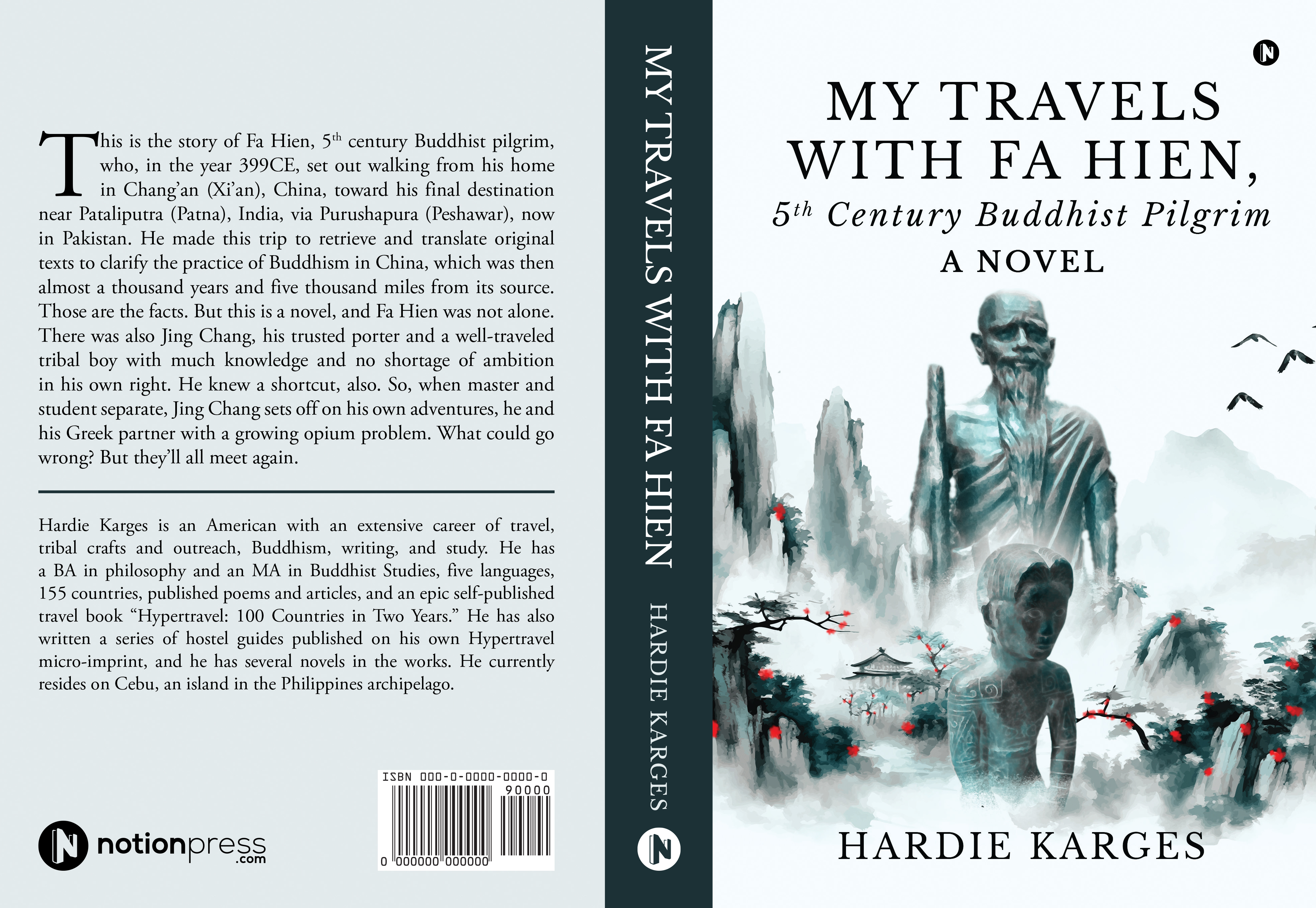
    Meditation is so fundamental to Theravada Buddhism that it has recently almost become re-branded as Vipassana, or ‘insight meditation,’ all the other disciplines involved in the practice of Buddhism notwithstanding. And this is likely what the Chinese Buddhist pilgrims Fa Xian (Hien) and Xuanzang found above all else, silent meditation, since almost nothing else was written, and was almost too heavy to carry once they had it transcribed from the original Pali or Sanskrit into Chinese.  

    But how do you transcribe meditation into any language for inclusion in a book which someone may or not read at some point in history? Meditation was largely independent of written vinaya (discipline), and that is what had sustained Buddhism for around 1000 years by that time. And that’s what sustains it today, all the opinions and debate on Facebook and elsewhere notwithstanding. Original Buddhism required only silence, and concentration, no apps or other accessories necessary. 

     
  • Unknown's avatar

    hardie karges 4:26 am on February 25, 2024 Permalink | Reply
    Tags: , , , , , , , , , , philosophy, , , ,   

    Kindness and Compassion are the Heart and Soul of Buddhism  

    Buddhism in Bhutan

    Compassion has no expiration date. It’s never too late to make new friends with old enemies. This is one of the secrets to a good life: no grudges, no scorched earth, no retribution, and, most importantly, no regrets. It should be simple, since you don’t really have to do anything, but in fact it’s one of the hardest things ever, so attached as we are to our egos and our ‘face’ that we spend so much time and effort saving, lest someone steal it right off of our heads, haha. 

    The Dalai Lama once said that his religion was simple, and that’s kindness, which is compassion, in a word, same thing, same time, and that’s Buddhism, too, in a word. All the elaborate lists and literary expositions that comprise the Buddhist Abhidharma are unnecessary to describe the heart of Buddhism, so why waste so much time and effort when you can put it all in a word, or two? Because yes, there is another word that needs to be included, and if karuna is the first word, then metta is the second, often translated as ‘lovingkindness’ or simple ‘friendliness.’ 

    Put the two words together, and you’ve captured the heart and soul of Buddhism. In fact, modern standard Thai language does indeed often combine the two words for extra effect, so mettakaruna is a word or phrase that you will hear often there. Suffering is famously the back-story to Buddhism, that and its cessation, and that’s pretty much all you need to know. The cosmology of self and rebirth are important but debatable, IMHO, and thus of secondary importance, ditto nirvana. The analogy to Christian forgiveness might be worth mentioning but it isn’t necessary. Be good; don’t be bad. It’s that simple. 

     
  • Unknown's avatar

    hardie karges 3:35 am on January 28, 2024 Permalink | Reply
    Tags: , , , , philosophy, , , , , , , , zero point   

    Buddhism and the Power of Silence  

    Words once spoken cannot be taken back. Actions once committed cannot be retracted. Silence is better than violence. This is one of the hidden little gems of Buddhism, the value of silence. And other than the emphasis on meditation, it’s something that doesn’t often get mentioned—until now. Because here and now, in the modern age and the Western world, the noise is almost deafening, and the calls to engage are never-ending, no matter that much of that engagement is cruel and disheartening.  

    As a ‘digital creator’ on Facebook, I get it all the time, as if non-engagement were synonymous to incompetence. But nothing could be further from the truth. Silence is not violence, and BLM (Black Lives Matter) should know this. MLK (Martin Luther King) certainly knew it well, as did Mohandas K. (Mahatrma) Gandhi. Silence is one of the most powerful weapons in the world, in fact, but it is also much more than that. As the operating method of meditation, it can save souls (people) and so, it can also save nations.  

    If silence is the zero point for meditation, then meditation is the zero point for life. In this analogy, silence is like the zero (shunya) for which emptiness (shunyata) is named and can be thought of like the mathematical zero as the point between positive and negative (existence or non-existence?) numbers or the absolute zero temperature beneath which there is no lower, or even the zero-point energy of quantum physics as that point closest to absolute stillness. That’s the goal of meditation, insight optional, and that’s the goal of life, if only for a moment, now and again, always and forever. 

     
c
Compose new post
j
Next post/Next comment
k
Previous post/Previous comment
r
Reply
e
Edit
o
Show/Hide comments
t
Go to top
l
Go to login
h
Show/Hide help
shift + esc
Cancel