Tagged: Middle Path Toggle Comment Threads | Keyboard Shortcuts

  • Unknown's avatar

    hardie karges 3:58 am on July 6, 2025 Permalink | Reply
    Tags: , , , , , , Middle Path   

    Buddhism and the Principle of Relativity 

    Buddhism is not about glorifying the Buddha. It is about humbling yourself. Because if you think that you are the master of this world, then you have more problems than anyone can help you with, Buddha included. But this is intrinsic to all the world’s religions, isn’t it? Surrender to that which is greater and better than you? Yes, of course. The problem is to separate that from the petty dictators who would derail that religious instinct for their own nefarious purposes in order to accumulate wealth and power.

    The Buddha is a symbol and the exemplar, and, in many ways, the ‘way shower’ that Jesus was. And even though he was certainly quite special, he was hardly unique. Many are the prophets who simply said what was obvious to them, yet hidden to many others, because their eyes were not open to something so sublime. Middle Path? Duh. I could’ve told you that, but it was all about the content in the context of a historical situation that typically finds itself stalled at a series of crossroads.

    And so it was in the time of the Buddha in the place of the Buddha, where ‘Hindu’ Brahmanists were dualling (!) with the resident Jains over many of the same questions that obsessed the Buddha, no wonder. So, the Brahmanists were awash in rituals, while the Jains were awash while nude in spring rains, so the Buddha steps in and says let’s split the difference: enough ritual to remember while we’re here, but let’s wear some clothes while we’re at it, so that our donors giving dana are not scared of us by sight. Done. A practice was established of partial renunciation and partial reconciliation, and the rest is history.

     
  • Unknown's avatar

    hardie karges 2:56 am on March 2, 2025 Permalink | Reply
    Tags: , , gratitude, , , , , , , Middle Path, , Pangea, ,   

    Buddhism and the Middle Path Dialectic… 

    Gratitude is the companion to kindness and compassion in a perfect circle of Right Action and virtuous intent. Gratitude may be more of a Western thing than an Eastern thing, but that changes nothing. Gratitude is good. Lovingkindness was more of a Western thing than Eastern, also, until the Buddhists adopted it as their own as a suitable translation for the Sanskrit/Pali word metta, and the rest is history. The circle is complete, West meets East, Buddhism meets Christianity, and we are all better off for it.

    Because there is no fundamental distinction between the positions of West and East, not really, simply flip sides of the same coin, two pillars of a dialectic, in which antithesis counters the thesis in order to reach a higher synthesis. Now that’s not strict formal Buddhism (it’s Hegel), but I think it’s a nice approach to the Middle Path, illustrating clearly the fact that the Middle Path is not a cold hard set of prohibitions or dogmas, but is open and fluid and capable of change if and when the time is right for it.

    Notwithstanding the fact that India and the West have a common origin (see my upcoming book) genetically and geographically, if you go even farther back, the entire civilized world has common origins in Africa as homo sapiens and even farther back in Pangea as the large family mammalia, that split then from their reptilian ancestors. That’s who we are, consciousness and all, putting nouns and verbs together in sentences growing more complex every day, looking for a path with heart, despite all the suffering. Look inside; that’s the trick.

     
  • Unknown's avatar

    hardie karges 4:48 am on December 22, 2024 Permalink | Reply
    Tags: , , , , , Middle Path   

    Buddhism and the Middle Path of Least Resistance… 

    The Middle Path can be tricky, it seems, to avoid being sucked into the seductions of the sideline. Streams flow smoothest at the center. But the edges are where the fun occurs, apparently, giving rise to the word ‘edgy’ and the pleasures therein, pushing envelopes and sealing deals, and leaving nothing to the imagination but fantasy. Why do we love hot coffee or iced coffee but detest the tepid middle temps? We love extremes, even at the risk of self-harm. So, in a very important way, the Middle Path is not something tricky and difficult and a test to one’s patience, at all, but is really the easiest and most convenient path.

    We often make life hard in our quest for abundance and diversions, stacking up stuff in piles all the while with no real plan to utilize them, much less to ever dispose of them. But this is often unnecessary. I know it’s almost cliché by now, but how much do you really need? We often assume ‘the more the better’, but that puts all other clichés to shame, and nothing indeed could be further from the truth. For this I speak from personal experience, while passing no judgment against the predominant capitalist economies of the West and their wannabes.

    But it can be a trap and largely defines the Buddhist concept of ‘craving’, which is generally to be avoided. But that’s not just stuff in the closet but stock in trade. The first thought I had when starting to do business, was my exit plan. And, not surprisingly, that’s the part that I did best, defining the timeline as a function of the overall business plan, and therefore leaving with few regrets, and even less stock in trade, while being largely successful, for what I wanted to accomplish. The Buddhist Middle Path is not so different, really. To say that it is the path of least resistance would not say nearly enough, but neither would it be totally wrong. To go with the flow can be good sometimes.

     
  • Unknown's avatar

    hardie karges 4:32 am on December 8, 2024 Permalink | Reply
    Tags: , , , , , , , Middle Path, , , , ,   

    Buddhism Basics: Metta and Karuna, Kindness and Compassion… 

    Kindness and compassion, metta and karuna, are not the path of weakness. They are the path of true strength, which may or may not coincide with the popular images of ‘big men’ and ‘strong men’ flexing muscles and making waves, but that is not the paradigm of the Buddhist monk in partial renunciation from the world. That is the paradigm of the world that the Buddhist must renounce, at least partially, the world of hatred, fear, and anger, often masquerading as bravado, strength, and victory.

    Ironically, many Buddhists may defer to such popular images of strength and victory while forgoing it themselves. Because they know that such phenomena are the manifestations of the world, samsara, over which they have little of no control. We can only control ourselves. But, if we can stay on the good side of those circumstantial strong men that the world spits out like so many celebrities for sale, then so much the better. That’s ‘skillful means.’ It doesn’t imply superior dharma or any kind of enlightenment on the part of the big man, just survival instincts on the part of the average bloke.

    But Buddhism is a path of kindness and compassion. That much is certain. The only question is how best to manifest that in our own private lives. As always, the Middle Path seems to offer the best clue. Don’t be too passive or too aggressive. There is a sweet spot right there in the middle somewhere, defined by an almost equal distance from the extremes that we must avoid. And if it seems like this is a path for losers and nondescript middlemen, then nothing could be farther from the truth. Living right is its own reward.

     
  • Unknown's avatar

    hardie karges 4:35 am on November 3, 2024 Permalink | Reply
    Tags: , , , , Middle Path   

    Buddhist Middle Path and the Problem of Free Will… 

    The path is not straight and narrow. It may be long and winding. It may go in circles. It may go up and down. But it’s best somewhere in the middle. Let’s call it that ‘sweet spot.’ Let’s call it ‘that special blend.’ Let’s call it ‘the Middle Path.’ It’s all alluding to the same thing: avoidance of extremes—and rigid definitions. Because those are two recipes for disaster. The current debate over free will is a perfect example (can you believe that there’s a debate over free will in the year 2024?).

    The determinist side says that there are all these preconditions that make absolute free will impossible. Duh. But who’s talking about absoluteness? The free will side says that man’s free will is unlimited. Huh? There’s only one problem; nothing is unlimited. Oh, dear, what to do? There seems to be clear evidence of free will and clear evidence of determinism at the same time. But how is that possible? What is the solution to such an obvious existential conundrum?

    Bingo. The Middle Path to the rescue, i.e. there must be some free will, but not absolute, and there must be some determinism, but not unlimited, and they just might be able to coexist at the same time, doing the do-see-do, doing the hootchie-koo, doing the I-love-you with the best of all opposites that feel inclined to mix and match and see what life can bring amidst all the hardship and suffering that we must endure in this Godforsaken world. It’s only a tribute to the brilliance of life and culture that this simple truth is the foundation to something much larger and lasting at the same time. And that is Buddhism, pure and hopefully simple, on a good day.

     
  • Unknown's avatar

    hardie karges 2:56 pm on September 22, 2024 Permalink | Reply
    Tags: , , , , , , , Middle Path, , , , ,   

    Buddhism 101: There are no Winners or Losers…  

    There are no winners or losers. There are only players and non-players. Either one is fine, but if you play, then play well. The concept of winning and losing is obviously a binary circumstance, as are players vs. non-players or even East vs. West. But sometimes binary terms are effective in conveying a message, even if they are often ineffective in organizing your life. Because, we Buddhists have long been of the opinion that the Middle Path is the best guide to living your life with or without any scientific proof. 

    But the concept of winning vs losing is especially offensive, as it suggests that some people are simply better than others, regardless of any merit displayed or accrued in the process of playing the game, which suggests racism, if not just arrogance or hubris. None of that has ever been proven, of course, and my gut hunch is exactly the opposite: the more mixed the race the more superior, but again that’s hard to prove or disprove. 

    The issue of players vs non-players is more well-defined, though, in that participation is an act of will and not an accident of birth. So, when comparing the aggressive Abrahamic traditions vs the renunciative dharma traditions, it is possible to draw some conclusions, even if they are still subject to interpretations and circumstances. Because, while India and China long ago embraced renunciative dharma and taoist traditions, their cultures are anything but. And while the abrahamic West is known for its aggressive colonialism, some of the world’s finest most peaceful cities and cultures are to be found there today. 

    So, it’s a mixed bag at best, and I myself qualify as a proponent of renunciation only in the sense that too much wrong action has already been done, and so its opposite is now often preferable. But I don’t think that humans should be passive and that’s not how I live my life. So, my conception of Buddhism is somewhat like Marx’s communism, something appropriate after the previous partial phases have occurred, i.e. its time has come. At an earlier time, something else was possibly more appropriate, but not now. So, when someone insults you or feeds bait your ego, do nothing–quickly.

     
  • Unknown's avatar

    hardie karges 8:16 am on September 7, 2024 Permalink | Reply
    Tags: , , , , , , , , , , Middle Path, , , , ,   

    Buddhism: It’s a Process… 

    I am not the same person as yesterday, and I will be a different person tomorrow. I am not DNA code. I am skandhas, anatta, annicca, that is: I am a ‘heap’ of causes and conditions, nothing permanent, always changing. So don’t get too attached to yourself or to anyone else, because tomorrow offers no guarantees. Oh, and one more thing: there’s no soul, at least nothing like what the Christians or Hindus have in mind, eternal and/or cosmic, though Buddhism usually allows for at least a limited sort of rebirth.

    After all, we don’t want to get too dreary now, do we? Certainly not. But the principles listed here are foundational to Buddhism. And so, life and the world are at least somewhat illusory, at least in their most obvious manifestations as part of the visual and sensory feast that constitute our world of perceptions. But there is another principle that is even more important to some of us as Buddhists, and that’s the concept of the Middle path, which can be applied to almost anything, including itself, that hypothetical middle path which defines Buddhism by its very lack of definition.

    And such is the history of Buddhism, as it evolves almost dialectically, from thesis to antithesis to synthesis, only to start the process all over again. It is in that view that Buddhism emerged in the first place, as the middle path between the excesses of Hinduism and the extreme renunciation of Jainism. And it is that process which continues today, as Mahayana offers an alternative to the original Theravada, and to which Vajrayana and Zen start the process all over again. Now the original Theravada Buddhism would like to remake itself as Vipassana: meditation, that is, first and foremost. I like that idea.

     
  • Unknown's avatar

    hardie karges 7:41 am on August 31, 2024 Permalink | Reply
    Tags: , , , innocence, , Middle Path, ,   

    Buddhism in the Balance: Right Thoughts, Right Action 

    The wisest person has the mind of a child: always open, always learning. Of course, there are also many types of wisdom that accrue with age, so the perfect balance is just that: a perfect balance. And that’s the hardest part, of course, walking that fine line between two opposite extremes, in order to find that sweet spot that ultimately transcends them both. But that’s what Buddhism is all about, first and foremost, in its highest mode of being, the Middle Path, central to its foundation.

    Meditation is the paradigm of that open child-like mind, to the point that even thoughts should be scared to show their silly faces there, begging for attention and generally making a nuisance of themselves. But I’m being generous on the subject of thoughts and thinking. Many Buddhists, but especially ‘non-dualists’, reject all thought as being of little use and no more than a distraction. But the Buddha promoted ‘right thought’, i.e. good thoughts, and I totally agree with that.

    It’s disturbing that many ‘spiritual’ people are so ready to ‘throw out the baby with the bathwater,’ so to speak, assuming that if our evil thoughts cause so many problems, then all thoughts must be evil. Nothing could be further from the truth, of course. Thoughts have revolutionized the course of human history and propelled us into an era largely peaceful and progressive, at least compared to what came before. You don’t have to study much history before you realize that no matter how bad things are now, they’ve been much worse before. Walk that fine line between innocence and experience for the highest wisdom.   

     
  • Unknown's avatar

    hardie karges 3:46 am on June 9, 2024 Permalink | Reply
    Tags: , , dialogues, , , , Middle Path, , , ,   

    Buddhism and the Middle Path with Feeling  

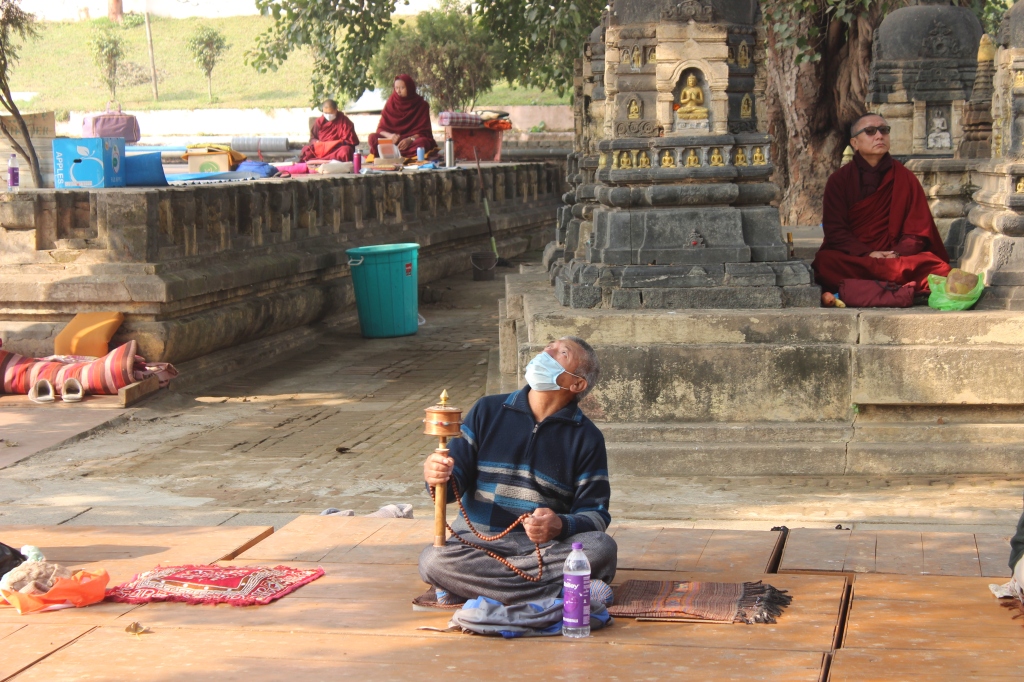
    Buddhism in Bhutan

    The fact that there is always a middle position between two extremes is not Buddhist. That’s business: buy low, sell high or just split the difference and celebrate the art of the deal, haha. The fact that there is a path is Buddhist. The middle position between extremes is also fundamental to the Socratic dialogues and resulting Platonic dialectic. And this is very compatible with Buddhism, in which a thesis and corresponding antithesis result in a higher synthesis.  

    The path comes into play over the passage of time, as multiple compromises and corresponding dialectics form a pathway over time. This assumes that the accumulated decisions and compromises are of a similar nature, such that the path has meaning in and of itself and they are not a series of isolated incidents. Why is this significant? Because this is your life, by analogy, at least, a path through the wilderness.  

    And we are all searching for something, aren’t we, mostly happiness and fulfillment, in this life, the rewards for which are not always monetary nor measurable in any way? The human dimension is one of feeling, above and beyond all thought and language, all physics and metaphysics, all rhyme and reason. Because if something just doesn’t feel good and feel right, then it’s mostly worthless, at the end of the day. For all our pretenses and pretensions, we are still animals, after all, pursuing pleasure and avoiding pain. 

     
  • Unknown's avatar

    hardie karges 4:03 am on May 26, 2024 Permalink | Reply
    Tags: , dissatisfaction, , Existentialism, , , , , , , Middle Path, , , , , , , , , , ,   

    Buddhism 499: Sometimes Some Things Are Lost in Translation  

    Beware re-translations. The Buddha spoke a Sanskrit-related language. Sanskrit never went extinct. ‘Dukkha’ still means ‘suffering’, sorry. Many Western Buddhists try to manipulate the message, however slightly, to make it more appealing to Western tastes, but that says as much about Western tastes as it does about Buddhism. The issue in question, of course, is the First Noble Truth, which states something as innocuous—and obvious—as the fact that suffering exists, nothing more, nothing less, UNLESS: you want to make that jagged little pill a little easier for someone from Hoboken to swallow. 

    Because if the principle of suffering is important enough to list it first and foremost as the foundational principle of your new religion, then that’s easily hyperbolized into such platitudes as ‘Life is Suffering’, ‘All Life is Suffering’, and so on, which is understandable, but somewhat depressing for many Western tastes accustomed to fast food and Ferris Wheels (for those of us raised on Existentialism, it’s not such a problem). But the easiest way to mitigate that circumstance is to soften the edges of that term ‘suffering’ to make it sound more like ‘dissatisfaction’, ‘stress’ (ahem), ‘spot of bother’ (maybe ?), or my favorite: ‘bummer’, haha. 

    Okay, so I’m joking a little bit, but the modern notion of ‘stress’ was surely unknown in 5th C. BCE India, so that’s a bit of a joke, also. But the effort at mitigation is certainly allowable under the Buddha’s own notion of ‘skillful means’, so it’s just a question of what’s appropriate. Bottom line: dukkha means ‘suffering’ as surely today as it did 2500 years ago, as a quick trip to Google Translate will quickly prove (yes, they have Sanskrit). The problem is that many Westerners see life as something ‘fun fun fun’ and so actually want rebirth or reincarnation (if not eternal life), while many traditional Easterners downplay any attachment to this cosmic play of samsara, while seeking release in Nirvana. 

    What to do? Nothing, really, because Buddhism should not be concerned with gaining adherents or scoring points, but merely offering some solace and refuge for those who need such. The world is what it is, and you’re probably going to die, regardless of any and all medical advances (though Virtual Reality is a remote possibility). Therefore, even the best scientific advances can only be limited in scope, and satisfaction with those limits is much better than trashing ourselves and/or the planet in frustration. As always, the middle path offers a practical solution: enjoy life, but don’t get too attached to the wheel. Accept some limits without total submission to them. Persevere. The middle path is long and winding.

     
c
Compose new post
j
Next post/Next comment
k
Previous post/Previous comment
r
Reply
e
Edit
o
Show/Hide comments
t
Go to top
l
Go to login
h
Show/Hide help
shift + esc
Cancel