Tagged: Chan Toggle Comment Threads | Keyboard Shortcuts

  • Unknown's avatar

    hardie karges 8:14 am on April 30, 2023 Permalink | Reply
    Tags: , Chan, , , Huineng, , , ,   

    Buddhist Imperfection and the Crazy Wisdom of Zen  

    The Buddha never said we’re all perfect, quite the opposite. He said that we are nothing but ‘heaps’ of causes and conditions that he called skandhas. He never even said that he’s perfect. And those imperfections can be the basis for positive change. He DID list change as one of the causes of our suffering, but significantly less than that of the First Noble Truth—craving. Maybe that’s not surprising, from someone who was born into the lap of luxury, since change for someone of destitute poverty might only be for the better.  

    But that’s arguable, also, so let’s just split the difference and apply the Buddha’s own Middle Path to conclude that change can go either way, good or bad, which is convenient, since it’s inevitable. The point is that, in its origins, imperfection is at the heart of the Buddha’s vision, though the Zen sect of the Mahayana school would, like some Christian sects (such as Christian Science), reverse that position and argue that manifesting our innate perfection is only right and proper. 

    They also said that if you meet the Buddha on the road, then you should kill him. Hmmm. Obviously, there’s a logical explanation to that apparent exhortation to violence, but I won’t go into it. I’ll only say that I prefer a simpler approach to enlightenment. The Zen thing is to show the limits and traps of language, and I agree whole-heartedly with that, but I don’t necessarily agree to a Dadaist approach to it. One of the Christian sideline precepts is to say what you mean and mean what you say, (“Let your yes be yes and your no be no”), and they just might have that right. 

    No, I don’t think that anyone has all the answers, and it is to Buddhism’s credit that so much dialogue is allowed, and even encouraged, which promotes a larger dialectic. In fact, this is how the Zen master Hui-Neng upstaged the heir apparent to replace the current master, to whom he was only a rank (in)subordinate. Thus began the line of thought that we are not here to train our minds but to acknowledge the illusion of reality, so something like an alternative Mayanist (haha) school, which thrives to this day as subplot to many more orthodox traditions. We are not perfect, but this is why we practice… 

     
  • Unknown's avatar

    hardie karges 9:23 am on April 2, 2023 Permalink | Reply
    Tags: Chan, , , , , , , ,   

    Buddhism 101: Meditation with no Mediation, except the Middle Path… 

    If you’re sipping tea while doing meditation, then it’s not really meditation, unless you’re meditating on the tea itself. And that’s a very nice thing to do, I hear, and it would seem, though I’ve never directly participated in it myself, it being a thing very Zen-like, and my own practice being something very different from that, a more-or-less traditional form of Buddhism. But the result should be the same: a calm and peaceful form of abiding, insight optional. 

    The point is to be very aware of all things that are occurring, and with as few distractions as possible. So, in a tea meditation ceremony, the point is to be aware of all things involved in the ceremony, from the preparation to the smell to the little buzz of brain neurons firing. In traditional meditation the point is to concentrate on the breath or something else innocuous yet transcendent, to liberate the mind from its usual task of struggling for survival in a dog-eat-dog world.  

    In either case, traditional silent meditation or a more elaborate ceremony, the point is to be attentive to the point of hyper-attention and to not be distracted. Because, to be distracted is to disrupt the whole point of the meditation, which is sati, or awareness, and samadhi, a term variously translated as something in the range of feelings from absorption to transcendence, so akin to dhyana, the term from which the Chinese chan and Japanese zen derive. I still prefer traditional meditation, seated, serious, and silent, with some misgivings about guided meditations, but very open to more active but silent forms such as the tea ceremony and walking meditation.

    The problems arise with the lack of definition and subsequent degeneration of the form, but not to the point of dismissal. Walking meditators just might need to decide whether to walk fast or slow. A brisk walk can be very satisfying, but I’m not sure that it’s meditation. It’s probably best to master the art of silent sitting before any experimentation. The point is to reboot consciousness, starting at zero, with a fresh outlook on life, language optional, because language is the classic conundrum. We can’t live with it and we can’t live without it. Be safe out there.

     
  • Unknown's avatar

    hardie karges 1:34 pm on December 23, 2022 Permalink | Reply
    Tags: , Chan, , , , , , , samathi,   

    Buddhism and the Bearable Lightness of Being 

    Be more like the water, more like the air, and less like the humans, obsessed with their opinions. And by this, I don’t mean to imply that we should all be ‘air-heads’ or anything else that might seem less than human or beneath our dignity. I only mean to imply that flexibility is good, and that lightness is good, i.e. the lightness of being, being without baggage, the baggage of language, which, if used properly and creatively, is one of the most beautiful things in the world.

    BUT… When used for maleficent purposes, language can be truly evil, SO… sometimes it’s better just to do without, don’t you think? Which moves us back to the subject of meditation: what it is, what it does, and how to benefit from it. Everything in Buddhism eventually comes back to meditation, if it’s done right, because that was always its chief selling point, despite all the sharper points of karma and dogma.

    People wonder why Buddhism was so well and easily accepted in China in the first millennium of the Common Era, when Taoism was already there, and when Taoism is so similar. Well, it’s often assumed that Taoism influenced Buddhism, so as to create a Buddhism “with Chinese characteristics,” haha, but it’s just as likely—or more so—that Buddhism influenced a nascent Taoism to make it what it is today.

    Either way, the critical difference would be the meditation technique which defined Buddhism long before the Brahmins started promoting karma as the definition of Buddhism, in order to enhance their own superior position. Remember that the Japanese word ‘Zen’ comes from the Chinese word ‘Chan’ which comes from the Sanskrit word ‘dhyana’ which means something like ‘meditative absorption’ or ‘deep meditation’ in Sanskrit, to distinguish it from the ordinary ‘concentration’ which is also a definition of the Sanskrit/Pali word ‘samathi.’ That’s my take on the subject, anyway. Merry Christmas.

     
    • Tiramit's avatar

      Tiramit 10:14 pm on December 23, 2022 Permalink | Reply

      Thus, it is what it is. I like your take on the subject anyway and Merry Christmas to you too!

  • Unknown's avatar

    hardie karges 11:08 am on September 27, 2020 Permalink | Reply
    Tags: , , Bhavana, Chan, , jhana, , , , ,   

    Meditation and Mediation, Buddhism on the Half-Shell… 

    The best meditation requires no app. Only silence can solve the problems caused by language. Not that I don’t find ‘guided meditations’ interesting, I just don’t think that they are the best form of meditation.

    Not that there need be many forms of meditation in the first place, but that comes with the turf, the modern commercial turf, that just one more thing under the tree will get us through the next year with flying colors, the colors of Christmas and New Year in joy and celebration of what I am not sure, but it seems that abundance is the common theme, my cup running over and all that jazz, eternal life and all that rap.

    But is the ‘special insight’ of ‘vipassana’ really some sort of qualitative improvement over the ‘awareness of breathing’ in anapanasati? Is there really any difference between the ‘calm abiding’ of ‘samatha’ and the ‘concentration’ of ‘samadhi’?

    Self-described experts go on and on about the ‘four different kinds’ of meditation like bloggers slicing and dicing adverbs and artichokes for the special garnish to Sunday brunch, to be ladled over with the special sauce of ‘mindfulness.’

    Then there is the ‘mental development’ of bhavana holding lengthy sessions, while the ‘trance-like states’ of ‘dhyana’ and ‘jhana’ morph into entire schools of Chinese Chan and Japanese Zen, so that entire cultures can be exported overseas a millennium later, and Alan Watts can make a living without ever having to plant rice, much less harvest it.

    So I suppose that there is a difference between a ‘one-focus’ meditation and a ‘field-focus’ meditation, but I’m really not sure, if the underlying concentration is upon the breath, or if you’ve got a really quiet place, then worth noticing the heartbeat, which our ears normally block out as background noise.

    But there seems to be a more significant distinction between meditation ‘upon’ something and meditation for meditation’s own sake. And this is where guided meditation comes in, because it is certainly a meditation upon something, if it is meditation at all.

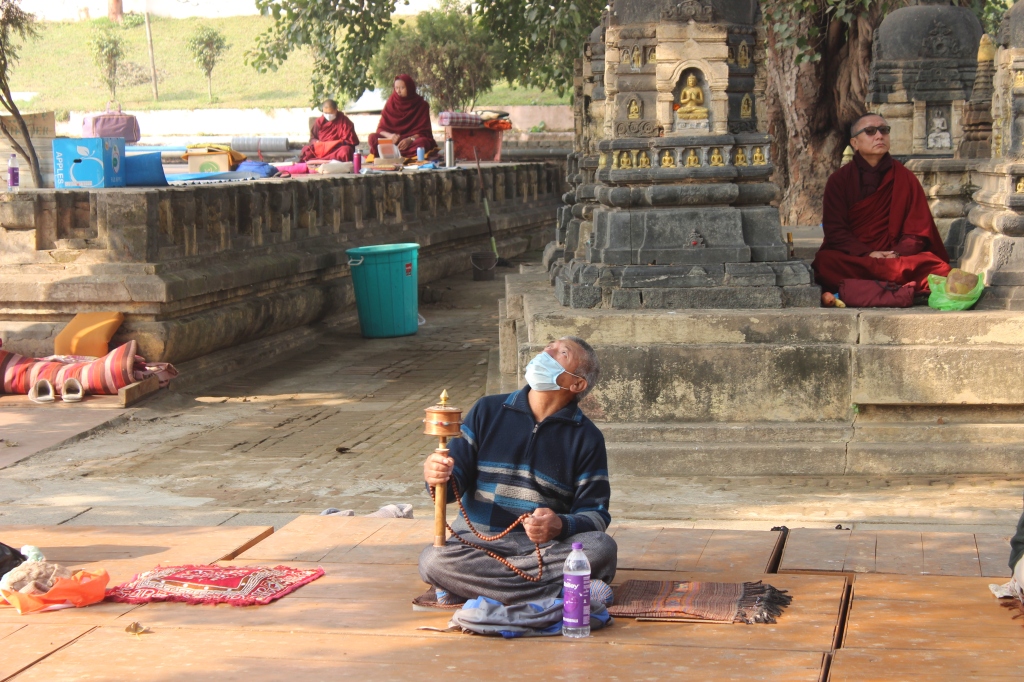
    And I’m not sure who started this, because I have practiced the art in formal and semi-formal settings in three SE Asian countries, all of the Theravada school of Buddhism, and I can assure you that there was no bloke holding forth at the time. But I do see this online with monks of the Tibetan school, and saw it myself with a Western ex-monk of the same school in Nepal. So which is better, guided or silent?

    That I can’t say, but when I discussed all this with research neurologists interested in measuring the effects of meditation on the brain, all they wanted to know was, “Were you able to stop the internal dialogue?” To which I giddily responded something like, “Yes.” To which they responded with a dubious, “Do you understand this concept?” “Of course. That’s all I remember of Don Juan’s ‘Tales of Yaqui Power.”

    Guided meditation won’t do that, so you still need silent meditation IMHO. But to be a good Buddhist, more important than the sutras, the precepts, and all the meditations are the simple acts of kindness and compassion, ‘metta karuna’…

     
    • openmind123omega's avatar

      David Cole 4:46 pm on September 27, 2020 Permalink | Reply

      Sādhu… Thanks!

      • hardie karges's avatar

        hardie karges 5:14 pm on September 27, 2020 Permalink | Reply

        Welcome!

c
Compose new post
j
Next post/Next comment
k
Previous post/Previous comment
r
Reply
e
Edit
o
Show/Hide comments
t
Go to top
l
Go to login
h
Show/Hide help
shift + esc
Cancel