Tagged: center Toggle Comment Threads | Keyboard Shortcuts

  • Unknown's avatar

    hardie karges 5:22 am on August 25, 2023 Permalink | Reply
    Tags: , , center, , , , , ,   

    Shunyata: Emptiness at the Center of Buddhism  
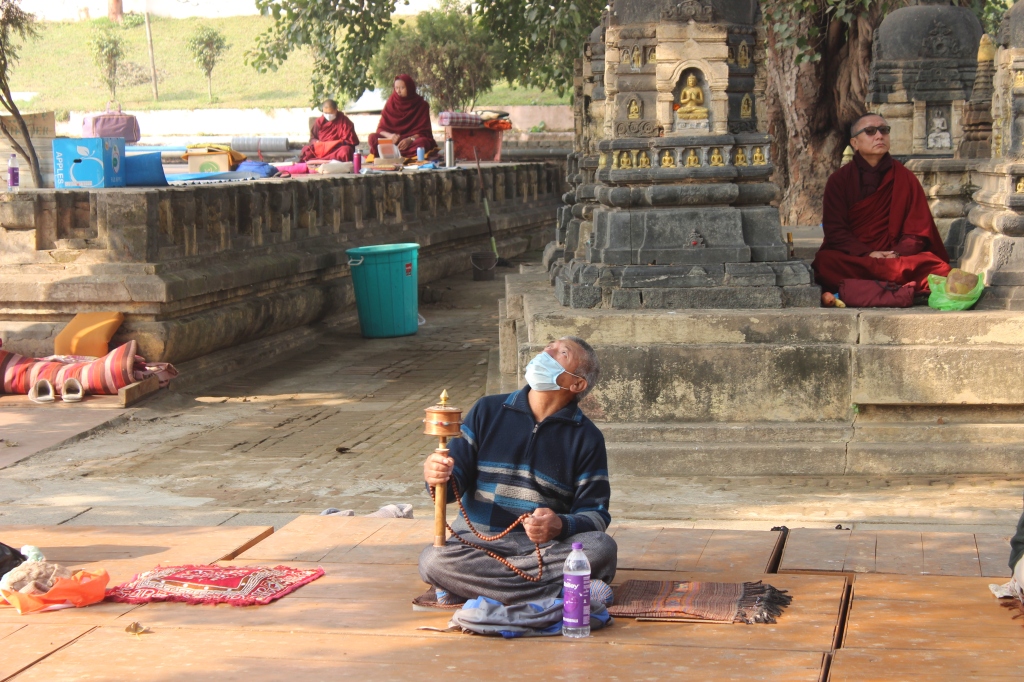
    Shunyata is famous as the Emptiness factor of Buddhism. But that zero, shunya, also defines a center. And so that same word, or some variation of it, forms the word or concept of centrality in many Southeast Asian languages, where it first arose. Thus, it refines the concept of the Middle Path in the same way that it refines the concept of anatta or ‘non-self.’ Now we can see that not only is there no permanent enduring self to worship or obey throughout eternity, but there is no permanent enduring anything to worship or obey throughout eternity.  

    In the same way we can see that not only is there a Middle Path that defines our passage through life, but there is also a center that we can keep coming back to, if we want, or revolve around, if we must, lest we lose our bearings in the passages of time and space. Because that Middle Path can be meandering, as we’ve already seen, but a center is more fixed, by definition, even if it is following a path in 3-D space. It is still fixed in relation to its surroundings. And so is a center.  

    So, I think that it’s possible to postulate and adhere to a Central Point of Buddhism in the same way that we follow a Middle Path. Nothing has changed except the precision of the definition, as with anatta. Thus, we should always ‘stay centered’ in the same way that we should avoid extremes in following a Middle Path. If this seems trite, trivial, and even somewhat torturous to accept, then I suggest otherwise. Because if that concept of samsara was originally a ‘wandering’ which soon became synonymous with ‘the world,’ then at some point we must settle down and find our center. 

     
  • Unknown's avatar

    hardie karges 6:04 am on July 15, 2018 Permalink | Reply
    Tags: , center, , , , , , , sunya, ,   

    Buddhism, shunyata and the cult of zero… 

    IMG_1559The Buddhist doctrine of shunyata is one of its most famous, and the one that put Mahayana Buddhism on the map, a full step beyond what was envisioned with the original teachings of the Buddha, yet well within that purview. It is usually translated as ’emptiness’ or ‘voidness’, though I prefer ‘zero-ness’, in recognition of the fact that the word ‘shunya’ or ‘sunya’ literally means just that, zero, and in the modern standard language of every Theravada Buddhist country today, still means just that, or a derivation thereof…

    And if that sounds a bit spacey and abstract, it’s probably best thought of as an extended version of the Buddha’s doctrine of anatta or ‘no-self’, or no soul or no ego, i.e. no intrinsic reality to the human personality, which, according to this theory, is merely a collection of (s)kandhas, literally ‘heaps’ of transient characteristics with no permanence… (More …)

     
    • quantumpreceptor's avatar

      quantumpreceptor 6:29 am on July 16, 2018 Permalink | Reply

      Hey great post and expansion of the zero idea. Even for the fact that zero has been named means that it is something.
      Have you heard of sunyata as being explained as empty of? Empty of its own or independent existence?

      QP

      • hardie karges's avatar

        hardie karges 7:15 am on July 16, 2018 Permalink | Reply

        Thanks. Yes, I think that your definition is the most commonly accepted one, and if I didn’t say that, then I meant to. Mostly I just wanted to give some context to the development of the doctrine. It seems that ‘shunya’ was discussed even in the Buddha’s time, becoming ‘shunyata’ later on. The invention of the zero was a really big deal, and it just may have much more to do with the development of Buddhism than is commonly acknowledged, a thesis I intend to investigate further. Thanks for your comment…

        • quantumpreceptor's avatar

          quantumpreceptor 12:23 pm on July 17, 2018 Permalink

          Yes, Hardie, that’s a really interesting idea to develop that further, I can’t wait.

          As for being a discussed​​, I would even say that it was a hot topic. In Tibetan, we have three words rangtong, shentong, and detong. The tong comes from tongpanyi which is Tibetan for shunyata. Rangtong is empty of self-nature​. Many see only rangtong as nihilistic nits nature. Shentong is described as emptiness with something on top. The idea here was that because it could be experienced that the experience was part of reality. This was debated as being materialistic.

          Detong is also very interesting. De comes from Dewa and means great bliss. So detong is seen as the great joy that arises from emptiness. This happens when mind recognizes its own radiant space.

          You may look at these three terms as competing ideas and to some extent be correct. However, you may also see them as a natural progression as one leading to the next as if they were steps along the way. I cannot wait to find out more about your zero theory.

          QP

    • Dave Kingsbury's avatar

      Dave Kingsbury 4:52 pm on July 16, 2018 Permalink | Reply

      Some great practical suggestions that could give town planners something to think about. If they aren’t an endangered species! Seriously, they worry about what to do with empty shops … community hubs? You bring this abstract subject to life by relating it to modern discoveries and issues eg. “It should be noted that this is not much different from the logical conclusions to be drawn from a thorough consideration of the implications of the reality depicted by quantum mechanics: things are not real, not really”

      • hardie karges's avatar

        hardie karges 6:13 pm on July 16, 2018 Permalink | Reply

        I’ve always loved Mexican cities, with the central park and lots of community space. I always assumed it was a Spanish thing, but it may actually be pre-Columbian. And what with ‘high streets’ now under the assault of online shopping, it’s probably time to reassess the role of cities…

        • Dave Kingsbury's avatar

          Dave Kingsbury 11:50 am on July 17, 2018 Permalink

          I’d love to think we had matured enough to take considered stock of the past and come up with a better future, though I fear we might be too locked in our mad consumer present …

c
Compose new post
j
Next post/Next comment
k
Previous post/Previous comment
r
Reply
e
Edit
o
Show/Hide comments
t
Go to top
l
Go to login
h
Show/Hide help
shift + esc
Cancel