

Tagged: religion Toggle Comment Threads | Keyboard Shortcuts
-
hardie karges
-
hardie karges
Buddhism 499: Taming the Mind…

Treat perfect strangers with the same kindness you give your pets and the world will be a better place. And pets deserve that special treatment, of course, but don’t we all? Because all too often, kindness is transactional, tit for tat, is it not? Yes, it is, whether we even realize it or not, we’re so accustomed to that sort of reciprocity, as long as the dog is loveable, of course, and silently obedient. And many Buddhists do that, also, which is not a bad thing in itself, unless it rewards evil at the same time.
Because justice and fairness is a real thing, too, of course, and that is the flipside to the equation. Pets are a special circumstance in the hierarchy of the world, and I love them greatly, no vestigial nostalgia for the savage wilderness here, no thank you. I wish that every animal in the world could be tamed and therefore survive, rather than live a precarious existence in a world where it is commonly thought that returning an animal to the wilderness is somehow standard logical procedure.
As always, the truth lies somewhere in the middle. Conscientious taming seems perfectly acceptable to me, in lieu of wilderness, but dancing bears would seem to be going too far. But the point is that the kindness so often typically displayed toward our pets de rigueur is often totally lacking in our relationships to our human equals, even when they’ve done much to deserve it. No matter that there are Buddhist websites called Wildmind and so forth, the founding principle of Buddhism is to tame the mind, and that is a very good thing…
-
hardie karges
-
hardie karges
Buddha Talk: The Karma of Intent…
If Buddhism is an open doctrine, it needs to be updated frequently. If it’s a closed doctrine, then it loses relevance over time. All of which is to say that the Buddha was a real person, with real thoughts and feelings, not just some otherworldly manifestation emanating from above in some transcendental livestream, as some of the Mahayanists might prefer it, they with bills to pay and demons to slay and Taoists just nipping at their heels waiting for the price of real estate to stabilize.
But dharma practice doesn’t have to be hard and cold. It can be soft and warm and still non-clinging. People think of something often referred to as ‘the law’ as something written in stone and cruel in its intentions. But that is not the case with Buddhism. Buddhism is a philosophy, and one that is measured by its results, not just its intentions. And those results are palpable, from the ‘calm abiding’ produced by meditation to the long-term mindfulness produced by ongoing practice.
If you’re in it for the bliss, then good luck with that, because it’s a bit uncertain and a bit difficult to measure subjectively or objectively. Personally, I prefer the increased certainty of lesser expectations that accompany devotion to the Middle Path that defines Buddhism. Because that is not a cheap shortcut designed to increase the coffers while padding the rolls. No, that is intrinsic to that which is Buddhism and which is honest to a fault. To avoid extremes is to avoid mistakes. The only certainty is negation, but that is not always a viable approach to a situation that needs action, karma, honest effort.
-
hardie karges
Buddha Talk: Buddhism and Language, With and Without…
Language is a tool, not a weapon. It is a gift, not a curse. It all depends on the circumstances, time and place and details of the chase. To be honest, it is almost impossible to imagine life without language, since not only do we habitually think in a language, but for many people the two are inseparable. And that is why meditation is practiced, is it not? Yes, I think it is, because we can think without it, using what I often call ‘mental maps’.
Now, meditators and fellow travelers can gleam and bliss out about ‘insight’ and ‘calm abiding’, but the modus operandi is to cut off the language, or at least slow it down, if not exactly swatting thoughts away like flies on our windshields. The fruit of this activity is not something we can control, but only comment upon, for better or worse. Meditation may or may not provide ‘calm abiding’, much less insight, though those are worthy goals, I feel, but it can reduce the dependency on language, and that helps. It’s interesting that in some languages, to think and to feel are interchangeable concepts, but not so much in English.
The important point to remember is that not only are thought and language not synonymous, but the one is not even necessary for the other. Because, not only do animals think without language, but so do computers, i.e. they use machine language. Machine language is binary, 0’s and 1’s, and its (Boolean) logic corresponds to that, more than, less than, equal to, etc., i.e. ‘and’, ‘or’, ‘not’. This can just as (or more) easily correspond to all the phenomena of existence as the more familiar Aristotelian logic that we are familiar with, variations on if/then syllogisms. Your dog and cat have little need for that, and you could probably do with less. All you really need is mindfulness.
-
hardie karges
Buddhism, the Four Poisons, and a Self with no Face…

Jealousy is maybe more insidious even than greed, hate and delusion, because it has no face, just a false self reflected in thousands of tiny mirrors. And that self is the original conundrum, of course, between Buddhism, Jainism, and Hindu Brahmanism, the source of much contention and spirited debate. Because, when Buddhism crowned itself as the Middle Path between excesses of luxury and lack, it also defined itself as the Middle path between (Hindu) Brahmanism and Jainism, the one full of noise and ceremony, and the other full of silence and fasting—slowly.
Buddhism famously split the difference, of course, advocating the mediation between extremes in some sort of dialectical approach that might easily resemble the thesis, antithesis, and synthesis that Hegel would elaborate more than two thousand years later. The beautiful part of this approach is that it not only avoids those pesky extremes, but it also provides a way forward in any ever-changing world in which the only certainty is negation. But that jealousy will fade when it has nothing to fall back on, no false identity or permanent traits which too often define a being in this life in this world.
Because, in many opinions, that is all we have to buy or sell on the free market for souls in a world where matter in motion is the only alternative. This world is but a simulation of the real world, though, in which light is the only medium and love is the only exchange. You can grab it fast or you can make it last, and the balance between the two is even better. So, let’s make a shopping list for our Eightfold Path. Right thoughts, right words, and right action are more than the lyrics to a song by Franz Ferdinand. It’s a way of life.
-
hardie karges
Buddhism and the True Cost of Freedom

None of us is truly free. We are all truly connected. But we sometimes value this ideal of freedom more than life itself, as if having a child were more of a burden than a blessing, as if having a car were more important than having a home. But if any one of us were to truly experience this blessed freedom, then we probably wouldn’t really want it. We worship the idea of freedom, not the thing itself. But this is a hard lesson for a red-blooded American, we of the ‘warrior ethos’ and the mid-morning coffee break.
So, when we want a healthy dose of that much-vaunted freedom, we ‘go driving’ with the top down, preferably, and foot to the floor, definitely, heads out the window, like dogs with dark glasses and tongue lapping lips. Meanwhile, the Europeans look skeptical and all for good reason. Because it’s not sustainable, that’s why. It’s the same old myth of abundance, wherein not only do we want our own healthy dose of infinity, but we want it filled to overflowing with our own stuff, whether it be physical things or memorable experiences.
And memories are one of the most cruel tricks of possession, because then and there we categorize our experiences for safe keeping according to size and shape, use and abuse. But those are just dead forms and figures, with little application to today’s needs. We put them on walls and pedestals, adjusted for height and shape. But nothing really works, and any salutary effect is very short-lived. The freest person on this earth is that orange-robed monk walking nowhere fast and dedicated to making it last.
-
jmoran66
As an ex-American. I can relate to this mindset. Thankfully, I got out of there and am in a place where, through practice, I have been able to move beyond that way of thinking. I am in Thailand.
-
hardie karges
Good choice. I was there for a long time myself, mostly up north, around Chiang Rai. Where are you?
-
jmoran66
I’m in Bangkok. Been here for years, now. Over time, I’ve come to see it as fertile ground for practice, in it’s own way. It took a while to grasp that, however.
-
-
hardie karges
Yes I didn’t like Bangkok much at first but gradually warmed up to it. I might visit again, hoping to do a video series on monks and temples in SE Asia. Stay tuned. Thank you for your comments.
-
-
hardie karges
Buddhism and Non-Duality…

If Buddhism acknowledges no soul, then there should be fewer ‘dark nights of the soul’, and more sunshine and happiness. But it doesn’t always work that way, of course. Because dark nights of the soul are a good metaphor for something that probably has its basis elsewhere, and very possibly in our languages themselves, though it might be hard to know what is cause and what is effect, since all Indo-European languages are constructed similarly, no surprise, and so all have a certain amount of duality built in.
Now, I’ve never called myself a ‘non-dualist’ before, but not because I thought there was nothing there to discuss, but just because I thought that there was maybe not as much as most ‘non-dualists’ were implying. Because if non-duality specifically states that there is no separation between Atman (soul) and Brahman (ultimate reality), as Hinduism clearly states, then Buddhism dealt with that issue long ago by simply denying the existence of any soul, much less the cosmic one that classic Hinduism favors.
But the dualism of language persists, in which subjects do all kinds of things to objects which modern linguists and literary editors have no apologies for. Nothing happens by accident or without an actor acting upon a subject, passive voice be damned. A book written in English language passive voice will not be published in the USA, no matter how accurate or convincing. But Hindi is much more open to that phenomenon of language, so is Spanish, and presumably others.
So, we English speakers are the victims of our own critical thinking, which causes us so many problems of guilt by association with events over which we have no control. But if we insist that nothing happens by accident, then there we hang in the chasm of uncertainty, which is largely of our own creation, in that we create and mold our language to certain styles and norms. There lies much of the dark night of the soul. That’s why meditation is so helpful in reducing the inequities of language.
-
hardie karges
Buddhists Walk, not Run, for Peace, not President…
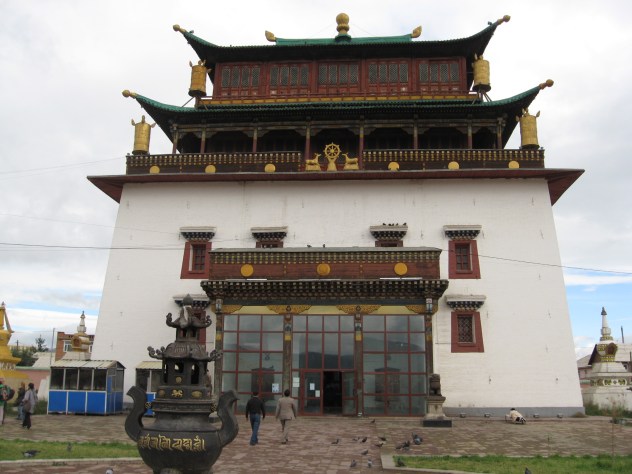
Good things come to those who wait. Instant gratification is cheap, but unfulfilling. Time is the special sauce that adds flavor. And while it’s not something that the Buddha necessarily talked about, I think it goes well with the general thrust of Buddhism, which is essentially a non-thrust. Western action is heavily reactive, leaving no action unanswered, as I hear Mark Z exhort every day: “Engage, engage, engage,” as if social media were like going blindly into an empty void and people have to be reminded to say something to that best friend that they haven’t seen in years.
Apparently, Mark Z has yet to get the word that people leave Facebook just to get away from the toxic level of aggressive behavior that often passes for engagement. Back to the point of the post: maybe if people weren’t so quick to engage, then maybe everybody would be happier for a few more minutes of each day. Those minutes add up and, if nurtured carefully, can make the difference between a bad life and a good one.
If the monks that Walk for Peace accomplish nothing else, then they get the message out for mindfulness and meditation, that action is more important than reaction, especially when that action is a good one. I doubt that the Buddha ever talked about awareness of breath, but that’s what the monks talk about. That’s not Buddhism; that’s Vipassana meditation, so close enough, I guess. The important thing is that it’s non-reactive. Karma is about actions, not reactions. If you have nothing good to give, then SFTU. Again, the Buddha never said that, but someone did.
-
hardie karges
Buddhism and Language, With and Without…

Language is a tool, not a weapon. It is a gift, not a curse. It all depends on the circumstances, time and place and details of the chase. To be honest, it is almost impossible to imagine life without language, since not only do we habitually think in a language, but for many people the two are inseparable. And that is why meditation is practiced, is it not? Yes, I think it is, because we can think without it, using what I often call ‘mental maps’.
Now, meditators and fellow travelers can gleam and bliss out about ‘insight’ and ‘calm abiding’, but the modus operandi is to cut off the language, or at least slow it down, if not exactly swatting thoughts away like flies on our windshields. The fruit of this activity is not something we can control, but only comment upon, for better or worse. Meditation may or may not provide ‘calm abiding’, much less insight, though those are worthy goals, I feel, but it can reduce the dependency on language, and that helps. It’s interesting that in some languages, to think and to feel are interchangeable concepts, but not so much in English.
The important point to remember is that not only are thought and language not synonymous, but the one is not even necessary for the other. Because, not only do animals think without language, but so do computers, i.e. they use machine language. Machine language is binary, 0’s and 1’s, and its (Boolean) logic corresponds to that, more than, less than, equal to, etc., i.e. ‘and’, ‘or’, ‘not’. This can just as (or more) easily correspond to all the phenomena of existence as the more familiar Aristotelian logic that we are familiar with, variations on if/then syllogisms. Your dog and cat have little need for that, and you could probably do with less. All you really need is mindfulness.


 hardie karges and


 streaming consciousness...
Reply