Tagged: First Noble Truth Toggle Comment Threads | Keyboard Shortcuts

  • Unknown's avatar

    hardie karges 2:38 am on August 31, 2025 Permalink | Reply
    Tags: First Noble Truth, , , , ,   

    The Buddhist Middle Path in an Imperfect World 
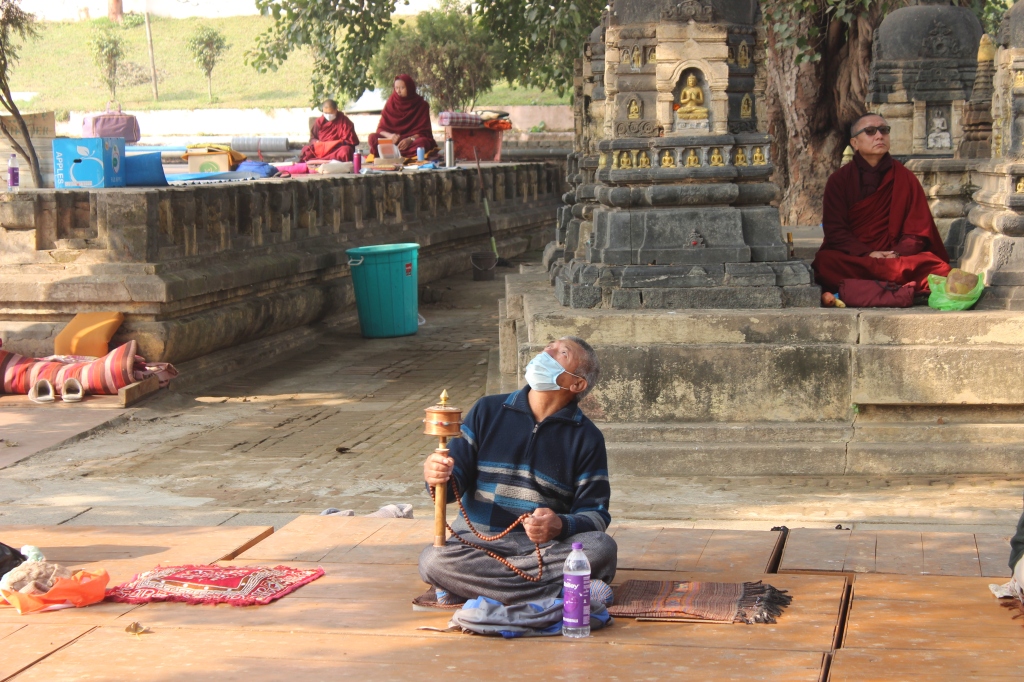
    If there is a Middle Path, then there is a choice. And if there is a choice, then there is free will. That’s important, because if there is no free will, then there is no morality. And if there is no morality, then there is no right or wrong. The world is a jungle and anything goes, and if anything goes, then you can be assured that much of that will be bad. Because we may be a diverse group of unique individuals, or not, but I’m fairly sure tha the number of angels here is limited.

    The Buddha made it clear, and I agree, that this is not a perfect world, i.e. there is suffering, the First Noble Truth. How was he, and we, so sure of that? No one gets out of here alive. That’s how we know. When that changes, then maybe it will be time for a new philosophy and a new religion, but until then, we do the best we can in an imperfect situation. We can mitigate that suffering by lowering our expectations and being open to change, but many needs will still be unresolved, and many changes will be difficult.

    So, the Middle Path is not so hard, but it’s not so easy, either. That’s why it’s called the Middle Path. Because taking sides is easy, clear, and distinct, but often wrong. Following a narrow winding path is much more difficult, looking for signs to hopefully find the way through rugged terrain in troubling times. The important thing is to keep pushing forward and create a path if it’s not so obvious. Because the most obvious paths are like water, flowing downhill until they reach something bigger and better. Once you find flowing water, then you have found a path of little resistance, and there will be a way forward.

     
  • Unknown's avatar

    hardie karges 3:40 am on October 13, 2024 Permalink | Reply
    Tags: , , , First Noble Truth, , , , , ,   

    Buddhism 101: Pain is Our Birthright… 

    Pain is our connection to the realm of sentient being. We are all equal in this regard. But we have a path, thankfully. This refers to the First Noble Truth, of course, something like ‘There is suffering.’ Period. Full stop. That’s the foundational thesis of Buddhism, which all further dissertations struggle to assimilate, what with its apparent pessimism, which only gets worse (before it gets better). ‘Birth is suffering, aging is suffering, sickness is suffering, dissociation from the loved is suffering, not to get what one wants is suffering.’ Yeow. Yes, life’s a real sh*t-show at times. What to do?

    Oh, sure, the PhD’s try to explain it all away by saying that ‘suffering’ can mean ‘dissatisfaction’, ‘stress’, or maybe even ‘bummer’, but the result is the same: it’s not a good look, not when everybody else is bragging about their seven flavors of bliss and their multiple stairways to heaven. But that’s what the Buddha said, and that’s what he meant. But I think that he also meant that’s our connection to the world and each other. Otherwise, how would we even really know that we’re really alive? Pleasure is fleeting.

    But pain is real. And a large part of it is caused by the simple fact of our oh-so-human cravings. Bingo. There’s a path for that, and it will keep us humble in its universality. Because isn’t the underlying cause of all craving, desire, lust, and greed, our selfish assertion that we are something special and deserving of whatever we can get? Haha. Gotcha. Because we are but a bundle of causes and conditions that predictably lead to the defilements which define us: hatred, greed, anger, and those oh-so-pesky cravings. The path outta there is as simple as the decade-old Franz Ferdinand song which seconded that emotion: “Right Thoughts, Right Words, Right Action.” Simple, no? It works. Try it.

     
    • jmoran66's avatar

      jmoran66 4:25 am on October 13, 2024 Permalink | Reply

      I think you, as they say, nailed it here. There’s nothing to add.

    • hardie karges's avatar

      hardie karges 4:59 pm on October 13, 2024 Permalink | Reply

      Thank you for your comments.

  • Unknown's avatar

    hardie karges 4:03 am on May 26, 2024 Permalink | Reply
    Tags: , dissatisfaction, , Existentialism, First Noble Truth, , , , , , , , , , , , , , , , ,   

    Buddhism 499: Sometimes Some Things Are Lost in Translation  

    Beware re-translations. The Buddha spoke a Sanskrit-related language. Sanskrit never went extinct. ‘Dukkha’ still means ‘suffering’, sorry. Many Western Buddhists try to manipulate the message, however slightly, to make it more appealing to Western tastes, but that says as much about Western tastes as it does about Buddhism. The issue in question, of course, is the First Noble Truth, which states something as innocuous—and obvious—as the fact that suffering exists, nothing more, nothing less, UNLESS: you want to make that jagged little pill a little easier for someone from Hoboken to swallow. 

    Because if the principle of suffering is important enough to list it first and foremost as the foundational principle of your new religion, then that’s easily hyperbolized into such platitudes as ‘Life is Suffering’, ‘All Life is Suffering’, and so on, which is understandable, but somewhat depressing for many Western tastes accustomed to fast food and Ferris Wheels (for those of us raised on Existentialism, it’s not such a problem). But the easiest way to mitigate that circumstance is to soften the edges of that term ‘suffering’ to make it sound more like ‘dissatisfaction’, ‘stress’ (ahem), ‘spot of bother’ (maybe ?), or my favorite: ‘bummer’, haha. 

    Okay, so I’m joking a little bit, but the modern notion of ‘stress’ was surely unknown in 5th C. BCE India, so that’s a bit of a joke, also. But the effort at mitigation is certainly allowable under the Buddha’s own notion of ‘skillful means’, so it’s just a question of what’s appropriate. Bottom line: dukkha means ‘suffering’ as surely today as it did 2500 years ago, as a quick trip to Google Translate will quickly prove (yes, they have Sanskrit). The problem is that many Westerners see life as something ‘fun fun fun’ and so actually want rebirth or reincarnation (if not eternal life), while many traditional Easterners downplay any attachment to this cosmic play of samsara, while seeking release in Nirvana. 

    What to do? Nothing, really, because Buddhism should not be concerned with gaining adherents or scoring points, but merely offering some solace and refuge for those who need such. The world is what it is, and you’re probably going to die, regardless of any and all medical advances (though Virtual Reality is a remote possibility). Therefore, even the best scientific advances can only be limited in scope, and satisfaction with those limits is much better than trashing ourselves and/or the planet in frustration. As always, the middle path offers a practical solution: enjoy life, but don’t get too attached to the wheel. Accept some limits without total submission to them. Persevere. The middle path is long and winding.

     
  • Unknown's avatar

    hardie karges 8:14 am on April 30, 2023 Permalink | Reply
    Tags: , , , First Noble Truth, Huineng, , , ,   

    Buddhist Imperfection and the Crazy Wisdom of Zen  

    The Buddha never said we’re all perfect, quite the opposite. He said that we are nothing but ‘heaps’ of causes and conditions that he called skandhas. He never even said that he’s perfect. And those imperfections can be the basis for positive change. He DID list change as one of the causes of our suffering, but significantly less than that of the First Noble Truth—craving. Maybe that’s not surprising, from someone who was born into the lap of luxury, since change for someone of destitute poverty might only be for the better.  

    But that’s arguable, also, so let’s just split the difference and apply the Buddha’s own Middle Path to conclude that change can go either way, good or bad, which is convenient, since it’s inevitable. The point is that, in its origins, imperfection is at the heart of the Buddha’s vision, though the Zen sect of the Mahayana school would, like some Christian sects (such as Christian Science), reverse that position and argue that manifesting our innate perfection is only right and proper. 

    They also said that if you meet the Buddha on the road, then you should kill him. Hmmm. Obviously, there’s a logical explanation to that apparent exhortation to violence, but I won’t go into it. I’ll only say that I prefer a simpler approach to enlightenment. The Zen thing is to show the limits and traps of language, and I agree whole-heartedly with that, but I don’t necessarily agree to a Dadaist approach to it. One of the Christian sideline precepts is to say what you mean and mean what you say, (“Let your yes be yes and your no be no”), and they just might have that right. 

    No, I don’t think that anyone has all the answers, and it is to Buddhism’s credit that so much dialogue is allowed, and even encouraged, which promotes a larger dialectic. In fact, this is how the Zen master Hui-Neng upstaged the heir apparent to replace the current master, to whom he was only a rank (in)subordinate. Thus began the line of thought that we are not here to train our minds but to acknowledge the illusion of reality, so something like an alternative Mayanist (haha) school, which thrives to this day as subplot to many more orthodox traditions. We are not perfect, but this is why we practice… 

     
  • Unknown's avatar

    hardie karges 9:31 am on April 19, 2020 Permalink | Reply
    Tags: , , , First Noble Truth,   

    Buddhism During a Crisis, Coronavirus Redux… 

    Nothing better illustrates the Buddhist First Truth of suffering than the Coronavirus, proclaimed as novel, but I’m not so sure. Because nothing is truly novel in the realm of suffering, especially when delivered by the sneaky intercessions of a virus. Somebody once said that pain is inevitable, but suffering is optional, though it wasn’t Buddha who said that, however congruent with his teachings it may or may not be. No, the Buddha was pretty clear about the inevitability of suffering, and the Eight-Step program to its mitigation, and hopefully cure. Now if there’s a difference in meaning between pain and suffering, then it’s the difference between looking and seeing, listening and hearing, touching and feeling, in that one verb is transitive, affecting objects, while the other is intransitive, something felt, so more than simple observation of another.

    But my point is that Buddhism can help, in times like these, by simply acknowledging the normalcy of suffering, if nothing else. I suspect that many Westerners accustomed to amusement parks and weekend larks will have a much harder time of it than some Orientals accustomed to struggle. After all, you don’t see Asians serenading each other in captivity, now, do you? And if the Western commitment to ‘never change our way of life’ is charming, in a way, then in another way, it’s rather discouraging. This IS a good time for paradigm shifts, I’d say. Because mostly this is a psychological shock, more than medical, economic, or even ecological. Most Westerners are accustomed, even taught, to control Nature, reign her in, to do our bidding, and the idea that She is there as something to be awed and revered, is rather secondary. I mean sure, we go visit national parks and snap our pics, but as often as not we’re snapping pics of each other, and God knows, our selfies.

    Most of all, though, we’ve just never been taught to look inward, and those introverts among us tend to be categorized as ‘losers’ by the type-A bullies who think that aggression comes first, then questions come later, if ever. So I don’t see the Coronavirus as a death sentence, but just the opposite, in fact, an opportunity to make some necessary changes socially and ecologically, perhaps first and most important, but also personally, mostly within the theme of ‘less is more’, simple pleasures, and a shift away from consumption toward contemplation. For now, though, the bottom line is all about control, self-control, preferably. Because I don’t think it’s any accident that the countries hardest hit are those that are the most freedom-obsessive, and the countries doing best are those most controlled. But I prefer the self-control of the Buddhist countries over the government control of the ex-Communist countries of East Europe and elsewhere. So for us it’s a bittersweet victory, but for Nature it’s jubilant. Global Warming lost a battle this year…

     
c
Compose new post
j
Next post/Next comment
k
Previous post/Previous comment
r
Reply
e
Edit
o
Show/Hide comments
t
Go to top
l
Go to login
h
Show/Hide help
shift + esc
Cancel