Tagged: DNA Toggle Comment Threads | Keyboard Shortcuts

  • Unknown's avatar

    hardie karges 2:34 am on November 23, 2025 Permalink | Reply
    Tags: , DNA, , , random mutation, , Stockholm Syndrome   

    Buddhism and the Stockholm Syndrome 

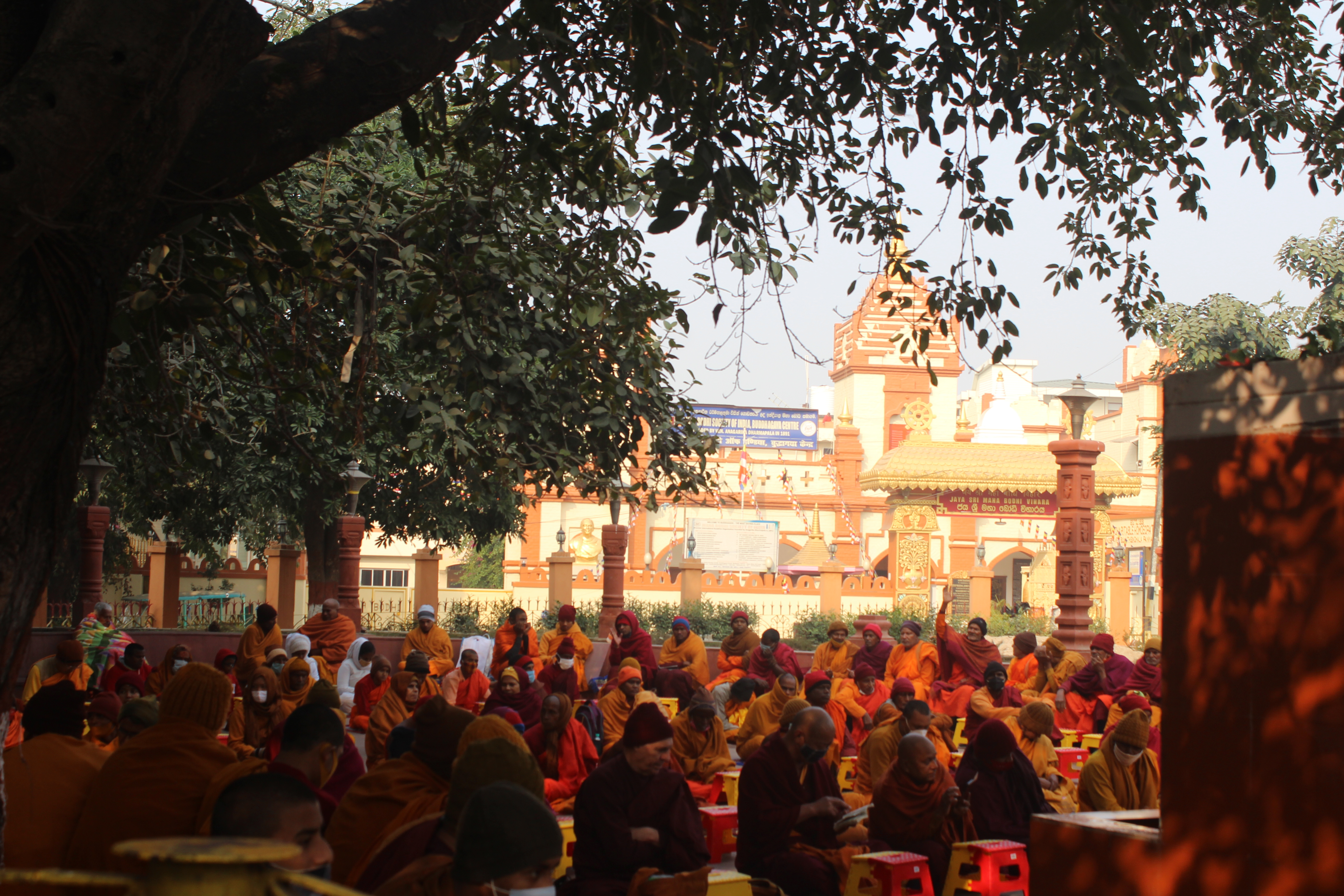
    Buddhism in Bhutan

    When the world outside is cruel and chaotic, you find your peace inside. But there is a fine line between the Buddhist principles of renunciation and inner peace, despite external circumstances, on the one hand, and surrender to the forces of evil on the other. And it is a very fine line, complete with extenuating circumstances and unintended victims. But I see it every day, Buddhist monks, many of them of senior status, celebrating the politics of oppression, especially if it limits the rights of women.

    Because, even though women are some of the finest practitioners of Buddhism in the world, their plight is not easy, especially in some of the more traditional Asian countries. But the situation is not limited to women, but also applies to the knee-jerk reaction of many senior monks to serve power unswervingly, rather than speak truth or even quietly protest, as though they expect more trickle-down benefits the more they kneel subserviently. Now, this might be just an extension of the Asian Boss syndrome, to serve leaders unquestioningly, or it could be something worse.

    It could be ‘Stockholm Syndrome’, in which prisoners or victims actually bond with their captors and accept willingly their captive status. This is the worst case scenario for captive women, of course, but not one bit better for mankind as a whole. Life is a process of re-imagining, and I firmly believe in the regenerative power of the species, any species. DNA may progress by random mutation, but the evolution of consciouness evolves consciously.

     
  • Unknown's avatar

    hardie karges 2:20 am on November 16, 2025 Permalink | Reply
    Tags: , , , DNA, , genocide, , , ,   

    Buddhism and the Saving Grace of Suffering… 

    Suffering is the raw material for a further and higher evolution of consciousness. The world is neither happy nor sad. It just is. Adjectives come later. I’ve often wondered how such horrendous situations could have existed in the past, in which wholesale slaughters not only occurred, but were commonplace. How could people have possibly been so heartless as to commit such horrible acts of genocide, and gendercide, in which the defeated men were executed point blank while the women and children were enslaved and entrained for further engagement, all so that one group of men could claim superiority over another?

    Because hunger has no heart, and so they had no heart(s), not as we know the concept. The evidence would suggest that such feelings of empathy and sympathy did not even exist at that point in the development of mammalian psychology. Mammalian psychology? WTF?! But think about it, and see if you don’t agree. Because, for millennia, not only humans, but all animals, merely and simply grew, expanded, and multiplied, with probably limited contact except in situations of the hunt, for food.

    Now we can easily see gorillas and chimpanzees performing acts that can only be described as ‘almost human’. Consider the DNA. But extend the concept to include the dogs, the cats, and even the elephants (!) that we consider to be our pets, and the likeness not only continues but expands exponentially. DNA can’t explain all that, certainly not beyond the mammalian similarity and symmetry. So, what could explain all that?

    One possible explanation is that the exponential population expansions which had occurred for millennia (with at least one, probably more, prehistoric bottlenecks), suddenly came to an end as we approached Year 0, and populations struggled to maintain those levels for at least a millennium. So, is evolution self-correcting? Does that evolutionary need for constant population increase mean that people might start to be nice to each other if it means higher populations? Christianity might favor that explanation. Or Jesus might take full credit entirely, from his teaching.

    But I have another idea. We really know very little about what we really want and even less about how to attain it. But we do know what we don’t want, since the only true certainty is negation: not this, not that, not the other. How much death and destruction must be endured before someone gets the idea to try a little tenderness, i.e. kindness and compassion? Ah, that feels good, as long as we’re all one family. Let’s do that. Be kind.

    This life and this world require nothing but kindness and compassion…

     
    • Zohar Leo Palffy de Erdod's avatar

      Zohar Leo Palffy 5:10 am on November 16, 2025 Permalink | Reply

      This is true, but only in potential, not in the structure of the world.
      Suffering itself teaches nothing.
      Only awareness of suffering can teach.
      Some people go through pain and become embittered.
      Others open up.
      The evolution of consciousness is not an automatic result, but a choice that is not available to everyone.
      Therefore, I would clarify:
      Suffering is an opportunity for evolution, not a guarantee of it.

      • hardie karges's avatar

        hardie karges 7:22 pm on December 7, 2025 Permalink | Reply

        Thanks for your comments.

  • Unknown's avatar

    hardie karges 2:31 am on September 28, 2025 Permalink | Reply
    Tags: , , , DNA, , , , , , , ,   

    Buddhism 102: Cooling the fires of Kilesha… 

    When everything is burning, cool the fires inside with the water of empathy and the chemistry of compassion. There are always at least two different ways to kill a wildfire, of course, as every firefighter knows. You can kill it with water, or you can kill it with fire itself. But which method causes more damage? That’s why water is always preferable, when possible. Because to kill a fire with a rival fire is to destroy everything in the path, ‘scorched earth’, so to speak. It ain’t pretty.

    But drenched earth can be quite pretty, especially after a nasty fire. And if those fires are inside, such as with hatred, greed, and anger, then the improved results are notable. Two foes can fight to the death, of course, but neither one could truly be considered a winner in that case. So, peaceful solutions are always preferable. Both parties will live to play another day, and with all faculties intact, both might even succeed.

    But that is the hardest thing to accomplish, of course, what with alpha males hogging the harem and acting like DNA whose only goal is to climb the ladder of succession to another day and another successful matchup in the breeding room and the board room, where the winner takes all and the losers take nothing. That’s the world of Nature, sometimes cruel and forbidding. But we can do better than that. Because we have the world of consciousness and mind, hopefully even some measure of mindfulness. Be kind.

     
  • Unknown's avatar

    hardie karges 8:16 am on September 7, 2024 Permalink | Reply
    Tags: , , , , , DNA, , , , , , , , , ,   

    Buddhism: It’s a Process… 

    I am not the same person as yesterday, and I will be a different person tomorrow. I am not DNA code. I am skandhas, anatta, annicca, that is: I am a ‘heap’ of causes and conditions, nothing permanent, always changing. So don’t get too attached to yourself or to anyone else, because tomorrow offers no guarantees. Oh, and one more thing: there’s no soul, at least nothing like what the Christians or Hindus have in mind, eternal and/or cosmic, though Buddhism usually allows for at least a limited sort of rebirth.

    After all, we don’t want to get too dreary now, do we? Certainly not. But the principles listed here are foundational to Buddhism. And so, life and the world are at least somewhat illusory, at least in their most obvious manifestations as part of the visual and sensory feast that constitute our world of perceptions. But there is another principle that is even more important to some of us as Buddhists, and that’s the concept of the Middle path, which can be applied to almost anything, including itself, that hypothetical middle path which defines Buddhism by its very lack of definition.

    And such is the history of Buddhism, as it evolves almost dialectically, from thesis to antithesis to synthesis, only to start the process all over again. It is in that view that Buddhism emerged in the first place, as the middle path between the excesses of Hinduism and the extreme renunciation of Jainism. And it is that process which continues today, as Mahayana offers an alternative to the original Theravada, and to which Vajrayana and Zen start the process all over again. Now the original Theravada Buddhism would like to remake itself as Vipassana: meditation, that is, first and foremost. I like that idea.

     
  • Unknown's avatar

    hardie karges 5:27 am on February 11, 2024 Permalink | Reply
    Tags: bonobos, , , , DNA, , ,   

    Buddhism 499: Conciliation is always better than confrontation…  

    There is always an alternative to war and conflict. Conciliation starts at home. Such is the way of the world. If we can’t maintain the peace within our families, then how can we ever hope to keep the peace among such large, scattered and diverse groups as exist in the world these days, with eight billion souls and counting? Score one for samsara, the world in all its gory details: hate, greed, fear, and anger, watch your step and be on a constant lookout for danger.  

    But it doesn’t have to be that way. Except for chimpanzees—but not bonobos—no other species besides glorious homo sapiens feels the need to kill for any other reason than to acquire food. We do it because we’re wired that way, I guess, DNA and all that rap, A, C, G, T nucleotides, with sometimes Y and W (just kidding), as if all our thoughts and emotions were pre-programmed at the factory, just like the determinists claim, and all our actions doomed to repetition and suffering.  

    Enter religion, and now we have reason and inspiration to up our game. For now, we have expanded our family to include all like-minded souls, regardless of race, gender, or geography, the only problem being, of course, that that is still not enough. For one thing, different religions don’t always agree with their own governments, much less with each other. Still there is hope, and the rule of thumb to ‘leave well enough alone’ is not a bad guide for the guileless. Sometimes you don’t have to do anything. You have to do nothing—quickly. And like so, determination can defeat determinism, and peace can prevail.

     
  • Unknown's avatar

    hardie karges 12:06 pm on November 13, 2022 Permalink | Reply
    Tags: , , , DNA, , , , , ,   

    Buddhism and Survival of the Species 

    Buddhism is more than just a religion or philosophy. It is a method for planetary survival, and that’s why we’re here right now. Because I care about planetary survival, and I hope that you do, too. And by ‘planet,’ I specifically mean the human race, since I have no doubt that the rock itself can continue to provide for itself, regardless of whether humans had ever shown up to sully the mix. But we are like DNA, and DNA is like language, and so we must cross our T’s and dot our I’s and make sense of random mutations.

    As soon as our survival was assured, we humans set about killing each other. And the coincidence of this with the invention of language may have not been so coincidental at all. Thus, once adopted, language has somehow become intrinsic to our existence, and so it is necessary to make our peace with it. Buddhism is famous for meditation, of course, and so that is one way of dealing with language, by losing it—powerful. Because for all the rap about insight, mindfulness, and ‘calm abiding,’ the one thing common to all meditation is silence. Guided meditation is something else.

    Christianity was fine when the human race was still young, and the need to breed was still arguably extant. But with eight billion people (and counting), the passion of Christ has long since been replaced by the passion of mice, breeding like rabbits and eating like wolves. This is not what the world needs right now. We’re a successful species, unless we continue to kill ourselves. I don’t think a species has ever gone extinct by mass suicide. But we could become the first, regardless of stated intents. Buddhism is one way to resolve this issue favorably, by choosing inner peace over mass consumption…

     
  • Unknown's avatar

    hardie karges 6:07 am on October 2, 2022 Permalink | Reply
    Tags: brain, , , DNA, , jit, jitjai, ,   

    Buddha in the Mirror: Form is Emptiness, and Mind is Heart… 

    The mind should be like a mirror, reflecting everything and possessing nothing. Because no one really knows what the mind is. We only know it by its fruits, the fruits of a consciousness that is certainly important, however indefinable and possible unknowable. But that’s okay, because to define it is to limit it, and you know where that leads, roadblocks and dead ends and reasons to give up the search for meaning when that is at the heart of what mind truly is.

    That much we know, and not much else, because the mind is as mysterious as the ways in which it expresses itself. But it’s always been associated with the heart, even before we really knew much, if anything, about the workings of that anatomical organ. So, that’s probably the best clue to what we know about it, that it was long considered to be the center of not only love, but consciousness, those two aspects of human existence considered to be inseparable, even when it was presumed to be located in that chest cavity which contained so many other important organs which were essential to life, specifically the lungs.

    The importance of gray matter would only be known much later, much like DNA, so we must have been thinking: why would THAT be important? Everything important was seen to reside in that chest cavity, no matter that our primary sense organs were all located in the head. Buddhist citta makes no mention of any sense organ, to my knowledge, but Thai language quickly compounded that consciousness jit with the jai heart to make a compound jitjai which persists to this day, long after the scientific biological functions are well known.

    So it is in popular culture, also, that love is somehow located in the chest cavity, regardless of all evidence to the contrary (the kids can stay. I won’t talk about genitalia, haha). But this is important, because love IS an expression of mind, not body, even before language came along to muddy the mix. So, now we associate mind (not necessarily THE mind) with cognition and cogitation and logic and symbolism, but that is all secondary. Mind is heart, and the mind’s quest is for meaning, not truth.

     
  • Unknown's avatar

    hardie karges 10:31 am on June 5, 2022 Permalink | Reply
    Tags: , , DNA, , , , , MS_DOS, , , Visual Basic   

    Meditation and Mediation, the Twin Foundations of Buddhism 

    Buddhism in Bhutan

    If you need a reason to meditate, then maybe that’s not really meditation. Meditation neither gives nor responds to demands. It simply IS. To be honest I probably think of it as a system re-boot more than anything else, that row of zeroes at the end of a really big number, that means that a dot will soon come, and then things will begin all over again on the other side of some line. Meditation is the dot between the two zeroes. The zeroes represent emptiness, of course, aka shunyata…

    There are all different flavors of meditation, supposedly, according to all the books and the writers, but they all tend to get back to basics, concentration on something, or everything, or nothing. But for me they all represent that same re-boot, a return to primordial pre-linguistic thought, if only for a few moments. Because once we think in a language, we never really go back. It’s simply not possible. But a new language could substitute for the old, just like Visual Basic took over where MS-DOS left off.

    Could humans ever function with a non-linguistic operating system? Of course, because we once did. And then the invention of language (or the manifestation of that instinct, for you Chomskyites) was probably the biggest revolution in the history of mankind. Just ask the Neanderthals, if you’re lucky enough to have some of their DNA. They disappeared as a species shortly after the appearance of language in Homo sapiens, hint hint.

    Ironically, they had all the same hardware and software for language themselves. Apparently, they “just didn’t have much to say.” (Spencer Wells). But that’s not our problem. Our problem is that we have too much to say, and not enough time to say it. So, we race to the finish line, shooting our mouths off and writing the Great American novel ad infinitum, whether anyone wants to read it or not. Meditation can help with that. The only app you need is silence. Mediation? That’s the Middle Path between extremes…

     
  • Unknown's avatar

    hardie karges 9:09 am on September 12, 2021 Permalink | Reply
    Tags: , Carlos Castaneda, , DNA, , Gardenm of Eden, , , ,   

    Buddhism: The Limits of Language and the Benefits of Meditation 

    The wisest person has the mind of a child, always open, always learning, with no preconceptions, and higher advanced concepts optional. It almost seems like we spend the first half of our lives cluttering up our minds with useless nonsense, and then spend the second half of our lives trying to undo all that. Ha! But language is like that, isn’t it? Once we invented it, then we made it part of our central conscious operating system, as if nothing could be more natural. Could it have been any other way? Was the invention of language merely an accident? It’s debatable. Could we have made a decision to keep it as a plaything but reject its centrality in our conscious interface with reality?

    The experience of our modern computerized world would indicate that once we have a new language, then not only will we certainly use it, but it will spread like a virus within us, restless and hungry, assuming a centralized position with our process of consciousness and expanding as rapidly as it can. It almost sounds like a business, ha! But mostly it sounds like DNA. And that is why anthropolinguistics was once so crucial to the study of prehistory prior to the advent of DNA genomics. Because language also mutates and so leaves ‘markers’ along its historic path, all of which can be coordinated chronologically, just like non-recombinant y-DNA and mt-DNA do…

    But what’s good for business and cultural evolution are not necessarily what’s good for healthy human psychology. And so, we meditate, to reverse that very process that is so profitable for our wallets and dangerous for our enemies. For it is no accident that the remaining hominid species besides our own disappeared soon after our acquisition of language. And so the prime purpose of meditation is to stop the internal dialogue, if only for a second, or a few minutes, or an hour, or a lifetime. When I discussed meditation with some neurological researchers, that’s the first question they asked: “Can you stop the internal dialogue?” That’s the main point that I can remember of Carlos Castañeda’s Don Juan character, also, in his ‘Tales of Yaqui Power,’ etc…

    Is language the forbidden fruit of the tree of the knowledge of good and evil in the Garden of Eden? Maybe. The analogy would seem to hold, not that good and evil are really on offer, but the fallacious and pretentious knowledge of such is always a temptation, and forever destined to fail. With language we are suddenly faced with a duality of mind and body, one doing all the talking and the other a captive audience. We externalize the dialogue to turn all that brilliance and perspicacity loose on the world, but with mixed results. It seems that language creates more problems than it can solve and resolve. And so we meditate. The mind is a minefield, enmeshed in views. Sometimes it’s simply better to forego thought, or at least language…

     
  • Unknown's avatar

    hardie karges 9:33 am on September 6, 2021 Permalink | Reply
    Tags: , , , DNA, , , , , Snaskrit   

    Buddhism: Self, Consciousness, DNA and Thought… 

    I am not the same person as yesterday, and I will be a different person tomorrow. I am not DNA code. I am skandhas, anatta, anicca. For those of you unfamiliar with Buddhist terminology in Sanskrit or Pali, then anicca is impermanence, anatta is non-self, and skandhas are the ‘heaps’ of conditions that comprise us. If this all sounds a bit like the Greek philosopher Heraclitus, then please see my previous blog. So, in essence, we are phenomena, undefined and of an uncertain nature. Even the best scientists have not yet figured it all out, and that won’t change the Buddhist perspective, anyway, because it would likely only be later disproven.

    Because the Buddhist perspective is to deny any special preeminent position to the self or the soul, or any other permanent fixed immortal and eternal personality, which is the specialty of some religions, notably Christianity, and in a different way, Hinduism. Thus, this is an ontological position, in the hierarchy of Being and beings, but it also serves to deflate the over-puffed egos of Alpha males and others with more stuffing than substance to their personalities. All that is vanity, hubris, and a threat to the natural order, the human race, and psychological health, which the Buddha intuited long ago, without the benefit of science.

    The fact that Buddhism traditionally reserves a place for a poorly defined ‘rebirth’ seems to show that it is still conflicted with its role in the larger Indian tradition, since it’s difficult to say exactly what it is that gets reborn. The fact that it is unconcerned with that inconsistency would seem to indicate that it’s playing the long game and is willing to let that issue work itself out eventually. The Buddha himself said something similar to that effect, that it’s better to live as if rebirth were a proven fact, even though that proof is not yet there. I’m okay with that. Thus, it also indicates that Buddhism is something of an open doctrine. I’m okay with that, too. Sounds like the Middle Path to me.

    Now I love DNA, but that’s not the subject here. The subject here is me—or the lack thereof. DNA can tell the provenance and much of the story that its humble sponsor—me—and my forebears have taken over the last umpteen millennia—and counting, but it still can’t say much about me. And that thread of DNA winds back into time immemorial, not always recombining, and so may be almost eternal, and thus immortal, but that’s not me. What is ‘me’ is a jumble of memories and perceptions, sensations and reflections, that all often go under the general term ‘thought.’ But consciousness and thought are not synonymous. Thought depends on language. Consciousness does not. That is the difference, and in many ways it is superior. Cogito ergo no sum. Scio ergo sum.

     
c
Compose new post
j
Next post/Next comment
k
Previous post/Previous comment
r
Reply
e
Edit
o
Show/Hide comments
t
Go to top
l
Go to login
h
Show/Hide help
shift + esc
Cancel