Updates from hardie karges Toggle Comment Threads | Keyboard Shortcuts

  • Unknown's avatar

    hardie karges 4:35 am on November 3, 2024 Permalink | Reply
    Tags: , , , ,   

    Buddhist Middle Path and the Problem of Free Will… 

    The path is not straight and narrow. It may be long and winding. It may go in circles. It may go up and down. But it’s best somewhere in the middle. Let’s call it that ‘sweet spot.’ Let’s call it ‘that special blend.’ Let’s call it ‘the Middle Path.’ It’s all alluding to the same thing: avoidance of extremes—and rigid definitions. Because those are two recipes for disaster. The current debate over free will is a perfect example (can you believe that there’s a debate over free will in the year 2024?).

    The determinist side says that there are all these preconditions that make absolute free will impossible. Duh. But who’s talking about absoluteness? The free will side says that man’s free will is unlimited. Huh? There’s only one problem; nothing is unlimited. Oh, dear, what to do? There seems to be clear evidence of free will and clear evidence of determinism at the same time. But how is that possible? What is the solution to such an obvious existential conundrum?

    Bingo. The Middle Path to the rescue, i.e. there must be some free will, but not absolute, and there must be some determinism, but not unlimited, and they just might be able to coexist at the same time, doing the do-see-do, doing the hootchie-koo, doing the I-love-you with the best of all opposites that feel inclined to mix and match and see what life can bring amidst all the hardship and suffering that we must endure in this Godforsaken world. It’s only a tribute to the brilliance of life and culture that this simple truth is the foundation to something much larger and lasting at the same time. And that is Buddhism, pure and hopefully simple, on a good day.

     
  • Unknown's avatar

    hardie karges 4:36 am on October 27, 2024 Permalink | Reply
    Tags: , asceticism, , , , , , , , , , , , , Padmasambhava, , , , Upanishads, ,   

    Buddhism is the Middle Path between Jainism and Brahmanism… 

    Brahmanism is what we now call ‘Hinduism’, but that term didn’t really exist way back when, only recently applied by the Brits to the plethora of sects and devotions which now constitute Hinduism. But it was in the midst of the Upanishad era at the time of the Buddha, which would redefine the previously Indra-based fire rituals which had reigned during the Vedic times. And with the advent of the new Upanishadic orientation, the resulting resemblance to Buddhism was profound—but still distinct.

    And so was Jainism distinct from both of them, at the same time that it shares much with them. But remember, that the ‘Hinduism’ that the Jain reacted to in the 6th century BCE is not the same as modern Hinduism, either, and that is partly because of this same three-way dialogue. Jainism was largely a reaction against the Brahmanists’ fire sacrifices, they being extreme nonviolent vegetarians. But many modern Hindus are also vegetarians, with Buddhists characteristically somewhere ‘in between.’

    That’s the Middle Path, specifically between the extreme asceticism of the Jains and the lavish rituals of the ‘Hindus’, but also between the many gods of Hinduism and the total lack of them in Jainism. Technically Buddhists don’t really have them, either, but, you know… Later versions of Buddhism were not so strict about that, such as the Tibetan version of Vajrayana, which came direct from India sometime after the 5th century and attested by Padmasambhava in the 8th century.

    But both Jains and Hindus were crazy about souls, Jains finding them everywhere and Hindus finding them cosmic, Atman, preferably in union with the cosmic dharma principle Brahman. But Buddhism found little of value in any of that, and so chose non-self anatta. So, they all evolved into different sects with different orientations, and we generally all get along nicely. The main difference is that Hinduism tilted toward a nationalism which international Buddhism could never assimilate. And Jains, ‘winners’ in Sanskrit, were ultimately the losers.

     
  • Unknown's avatar

    hardie karges 11:07 pm on October 23, 2024 Permalink | Reply
    Tags: , book, , , publication, Silk Road   

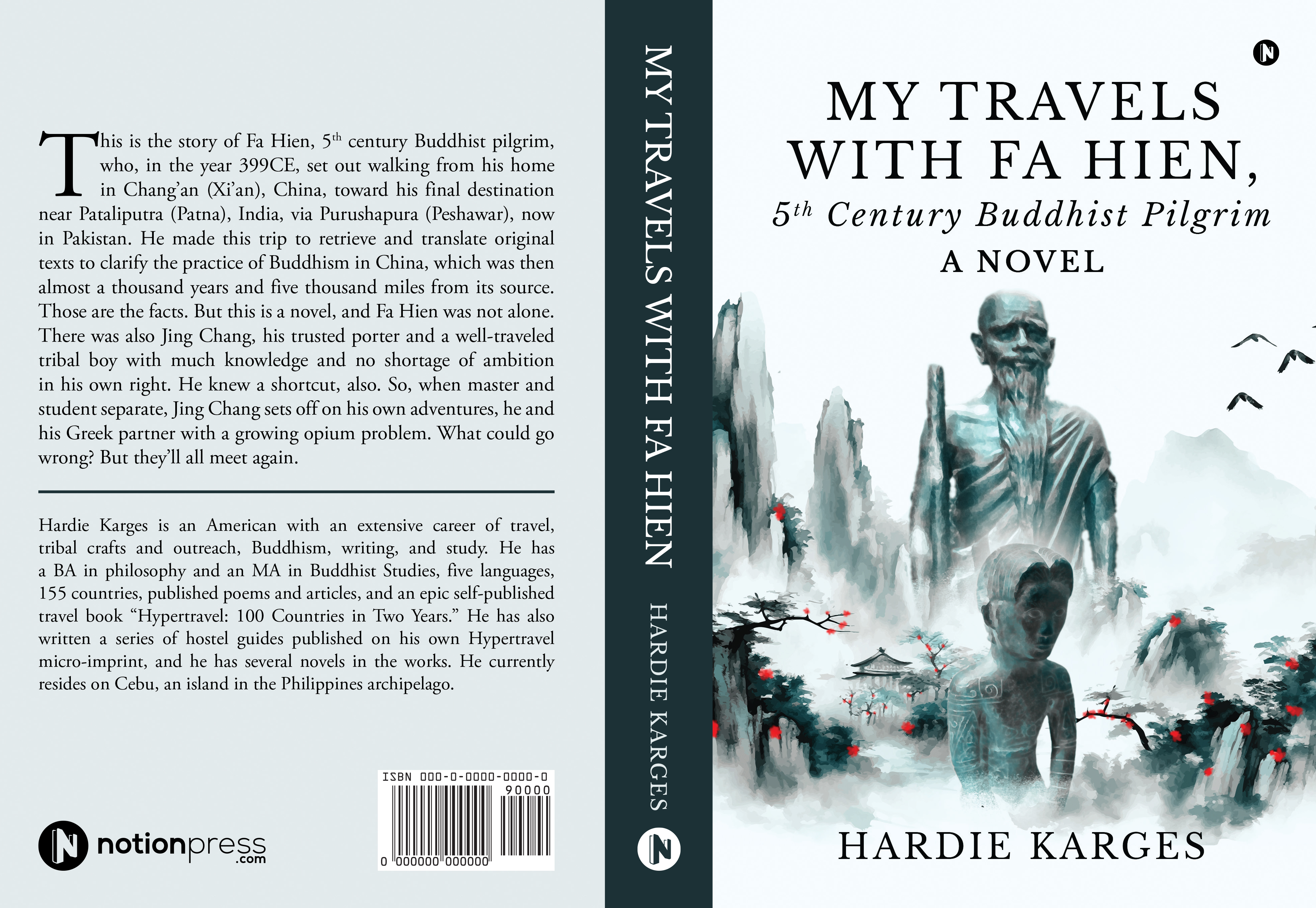
    My Travels with Fa Hien, 5th Century Buddhist Pilgrim 

    Coming soon to an Amazon near you! My Travels with Fa Hien! (or How I Spent My Covid Vacation, i.e. writing, re-writing, editing, and re-writing again the story of one of my heroes, Fa Hien, aka Fa Xian). He was a Silk Road traveler almost 1000 years before Marco Polo, but he traveled for Buddhism, not profit. So, in my wildest imagination, I decided to join him. This is the story, my tribute to Buddhism and Asia, where I’ve lived much of my life. It will be available worldwide and e-book soon. A portion of all sales will go to needy kids in India. Thank you. Stay tuned. (And, if you’ll join the group I created for this project, I’ll try to keep it clean and updated, haha… https://www.facebook.com/groups/535608355867565)

     
  • Unknown's avatar

    hardie karges 10:42 pm on October 23, 2024 Permalink | Reply  

    https://notionpress.com/read/my-travels-with-fa-hien-5th-century-buddhist-pilgrim?book=published&utm_source=share_publish_email&utm_medium=email

     
  • Unknown's avatar

    hardie karges 5:00 am on October 20, 2024 Permalink | Reply
    Tags: , , , , evangelical, , , , , , , , , ,   

    Buddhism at the Checkout Lane: the Best Rebirth is Spiritual 

    Spiritual rebirth begins within. It should never end. Samsara is something different. Samsara literally means ‘the world,’ always did, though perhaps etymologically from a distant past word connoting ‘wandering,’ but who knows? Etymology is always a best guess. As far as we know, at the time of the Buddha the word meant ‘the world,’ as it does to this day in modern Nepali, the modern language closest to its Sanskrit roots. Hindi probably got tired of the debate, so adopted the Arabic word dunia for most ordinary usage.

    But Buddhists turned the world cyclical, and so that circularity came to represent samsara more than the other aspects of the world itself. And that circularity specifically refers to the concept of rebirth, heavily borrowed from the Hindu concept of reincarnation, but without the literal transfer of the physical body from one generation to the subsequent one. In fact, Buddhism goes to great lengths to explain away the conundrum of <“What is reborn?”> at the same time that they go to equally great lengths to explain exactly what is the nature of this self that we’re denying. It’s a mess.

    Bottom line: the Christians—the evangelical Christians, of all sects—may have beat us to the punch on this issue. Because their insistence on being born again in the spirit is not only in the Bible, in multiple quotations, you may hear it loud and long at any tent revival in the lower US south from participants both black and white, in their exaltation at surviving a ‘Long Dark Night of the Soul’ as originally described by the 16th century Spaniard St. John of the Cross (not Eckhart Tolle).

    There is scarce reference to rebirth in any Buddhist text, though the Brahmanist Hindus and especially Jains would likely have many if only they had bothered to write it down. But that’s another story. The important thing is that spiritual rebirth is a very beautiful thing and idea, whereas physical reincarnation or even sorta kinda almost maybe rebirth of consciousness in a random body is a leap of logic, not to mention dubious science. And to those who say you can’t just pick and choose this and that, from assorted religions, I respectfully respond, “Why not?” They all did. Embrace it.

     
  • Unknown's avatar

    hardie karges 3:40 am on October 13, 2024 Permalink | Reply
    Tags: , , , , , , , , ,   

    Buddhism 101: Pain is Our Birthright… 

    Pain is our connection to the realm of sentient being. We are all equal in this regard. But we have a path, thankfully. This refers to the First Noble Truth, of course, something like ‘There is suffering.’ Period. Full stop. That’s the foundational thesis of Buddhism, which all further dissertations struggle to assimilate, what with its apparent pessimism, which only gets worse (before it gets better). ‘Birth is suffering, aging is suffering, sickness is suffering, dissociation from the loved is suffering, not to get what one wants is suffering.’ Yeow. Yes, life’s a real sh*t-show at times. What to do?

    Oh, sure, the PhD’s try to explain it all away by saying that ‘suffering’ can mean ‘dissatisfaction’, ‘stress’, or maybe even ‘bummer’, but the result is the same: it’s not a good look, not when everybody else is bragging about their seven flavors of bliss and their multiple stairways to heaven. But that’s what the Buddha said, and that’s what he meant. But I think that he also meant that’s our connection to the world and each other. Otherwise, how would we even really know that we’re really alive? Pleasure is fleeting.

    But pain is real. And a large part of it is caused by the simple fact of our oh-so-human cravings. Bingo. There’s a path for that, and it will keep us humble in its universality. Because isn’t the underlying cause of all craving, desire, lust, and greed, our selfish assertion that we are something special and deserving of whatever we can get? Haha. Gotcha. Because we are but a bundle of causes and conditions that predictably lead to the defilements which define us: hatred, greed, anger, and those oh-so-pesky cravings. The path outta there is as simple as the decade-old Franz Ferdinand song which seconded that emotion: “Right Thoughts, Right Words, Right Action.” Simple, no? It works. Try it.

     
    • jmoran66's avatar

      jmoran66 4:25 am on October 13, 2024 Permalink | Reply

      I think you, as they say, nailed it here. There’s nothing to add.

    • hardie karges's avatar

      hardie karges 4:59 pm on October 13, 2024 Permalink | Reply

      Thank you for your comments.

  • Unknown's avatar

    hardie karges 4:25 am on October 6, 2024 Permalink | Reply
    Tags: , , , , , , , , , theft   

    Buddhism in the Bardo Realms: You Are Never Alone 

    Buddhism in Bhutan

    The existential conundrum of our lives is that we are never alone, nor can we be, nor would we likely ever want to be, even if we could. Think of it this way: Suppose you want to enjoy yourself by yourself or just take a little swim. So, you walk down to the beach, find a nice little spot, and proceed to disrobe and jump right in. There’s only one problem: when you come back, you don’t know if your stuff will still be there or not—bummer. This is what many a happy tourist deals with every day.

    Oh, sure, there are ways to mitigate the circumstances. You can go with a friend, but that friend really can’t jump right in, now, either, can they? No, they can’t, because then any potential plunderer has just doubled his payoff. Even if you have a designated watcher for a larger group, that designee still doesn’t get to have his fun (and you still must trust him not to run). So, maybe hire a professional designee? Ditto. Or you could lock it in a box, if it’s a public space with such amenities, but that would probably preclude a dip in the buff, boo hoo. And even then, would you just wrap the key around your little finger?

    Or, you could just leave the key in your pocketed swim suit, but then, why not just leave your stuff in your room, and saunter to the beach semi-nude and flip-flop friendly, because, after all, nobody will steal a pair of flip-flops, or a towel, now, will they? Or would you even care if they did? And your room is safe, right? But what about the maid? Or you could just drive, and lock everything in the trunk, if you’re American, or the boot, if you’re a Brit, but by this time you’re making quite a big show of it, so maybe just call the whole thing off?

    This is the existential conundrum: that our fates are so intertwined, that it doesn’t leave a lot of time, or space, for accidents or circumstance. So, what is the solution? In a more peaceful time, in a more peaceful world, I have it on good authority that people left their houses unlocked with no ill repercussions, and that is the way that it should be. But that was in a world less crowded than today. And many people take it as their supreme inalienable right to reproduce without limit. So, now we live in a world of eight billion with no end in sight. And there’s no place to hide. So, we must learn to live in peace. And Buddhism is nothing, if not a religion of peace.

     
  • Unknown's avatar

    hardie karges 5:00 am on September 29, 2024 Permalink | Reply
    Tags: , , , , , , , , , worldling   

    Buddhism 101: Freedom from Fear and Hatred 

    The best religions give herd immunity against fear and hatred. The best philosophies explain the reason why. Buddhism can do this, also, whether or not you call it religion, whether or not you’re liberal or conservative. Because whether or not you’re liberal or conservative politically, Buddhism is the opposite of that, in its acceptance, or even encouragement, to renunciation, i.e. to give up all politics, and all other concerns of ‘house holders,’ as if shelters were the special curse of ‘worldlings.’

    And while I haven’t reached that point of detachment from the world, and may very well never, I do understand it, and to a large extent even applaud it, as long as those renunciants don’t assume that they’re by necessity any better than those same householders and other worldlings, on whom they also depend for sustenance and maintenance and news from the world. Because we’re all in this together, no matter our provenance, we all have the same sustenance, rice and bread and the ideas that feed our heads.

    The important thing is to eradicate fear, anger, greed, and hatred, once and for all, forever and completely. And if that takes some constant reinforcement, then so be it, enjoy the process and the esprit de corps. Because it’s important to be part of that community that provides solace and succor, and assurance that everything will be alright, if only we all stick together, maybe not like glue, but maybe more like sticky rice, with mango and coconut milk, yum yum, peace on earth and goodwill to all men.

     
  • Unknown's avatar

    hardie karges 2:56 pm on September 22, 2024 Permalink | Reply
    Tags: , , , , , , , , , , , ,   

    Buddhism 101: There are no Winners or Losers…  

    There are no winners or losers. There are only players and non-players. Either one is fine, but if you play, then play well. The concept of winning and losing is obviously a binary circumstance, as are players vs. non-players or even East vs. West. But sometimes binary terms are effective in conveying a message, even if they are often ineffective in organizing your life. Because, we Buddhists have long been of the opinion that the Middle Path is the best guide to living your life with or without any scientific proof. 

    But the concept of winning vs losing is especially offensive, as it suggests that some people are simply better than others, regardless of any merit displayed or accrued in the process of playing the game, which suggests racism, if not just arrogance or hubris. None of that has ever been proven, of course, and my gut hunch is exactly the opposite: the more mixed the race the more superior, but again that’s hard to prove or disprove. 

    The issue of players vs non-players is more well-defined, though, in that participation is an act of will and not an accident of birth. So, when comparing the aggressive Abrahamic traditions vs the renunciative dharma traditions, it is possible to draw some conclusions, even if they are still subject to interpretations and circumstances. Because, while India and China long ago embraced renunciative dharma and taoist traditions, their cultures are anything but. And while the abrahamic West is known for its aggressive colonialism, some of the world’s finest most peaceful cities and cultures are to be found there today. 

    So, it’s a mixed bag at best, and I myself qualify as a proponent of renunciation only in the sense that too much wrong action has already been done, and so its opposite is now often preferable. But I don’t think that humans should be passive and that’s not how I live my life. So, my conception of Buddhism is somewhat like Marx’s communism, something appropriate after the previous partial phases have occurred, i.e. its time has come. At an earlier time, something else was possibly more appropriate, but not now. So, when someone insults you or feeds bait your ego, do nothing–quickly.

     
  • Unknown's avatar

    hardie karges 4:56 am on September 15, 2024 Permalink | Reply
    Tags: , , , , ,   

    Buddhism in the Bardo Realms: Equanimity is Key…  

    Revenge is not sweet. Justice should be blind. Equanimity should prevail. This is a common mental trap, that somehow, we must ‘get even’, even when such is difficult or impossible to accomplish. Still, it’s a psychological juggernaut, somehow engrained in consciousness, that there is a balance beam of tit-for-tat justice, that somehow must be fulfilled or even expanded upon, as if something could be made ‘more right’ by applying penalties to deter future misbehavior, ‘punitive damages’ the operative concept.  

    And this is the basis of civil justice systems, of course, and that’s all well and good, but need not apply to your personal life. Because what’s good for Caesar is not necessarily best for you. The problem is that it’s a never-ending cycle which will never be at peace, just like old-time feuds between the Hatfields and McCoys. When the world was sparsely populated, it was easy just to leave and go elsewhere, but it’s crowded everywhere now. The Muslims made a positive step in limiting ‘punitive damages,’ so that ‘eye for an eye’ means just an eye for an eye, and no more. 

    But I think we Buddhists can go a step farther, so that not only is punishment not necessary, but neither is ‘getting even,’ even on a personal level. The only ‘evenness’ that we should be concerned with is evenness of mind, all the time, and that’s equanimity. There’s never any reason to get all excited, much less vengeful. If punishment is necessary to deter future crime in society, then maybe simple forbearance is the key to bring peace to the self and family. To just ‘let it go’ often works wonders.

     
c
Compose new post
j
Next post/Next comment
k
Previous post/Previous comment
r
Reply
e
Edit
o
Show/Hide comments
t
Go to top
l
Go to login
h
Show/Hide help
shift + esc
Cancel