

Buddhism in Mirrors Reflected…
The past demands no explanation. The future requires no warning. Tame your heart, tame your mind, tame yourself, and tame the world…
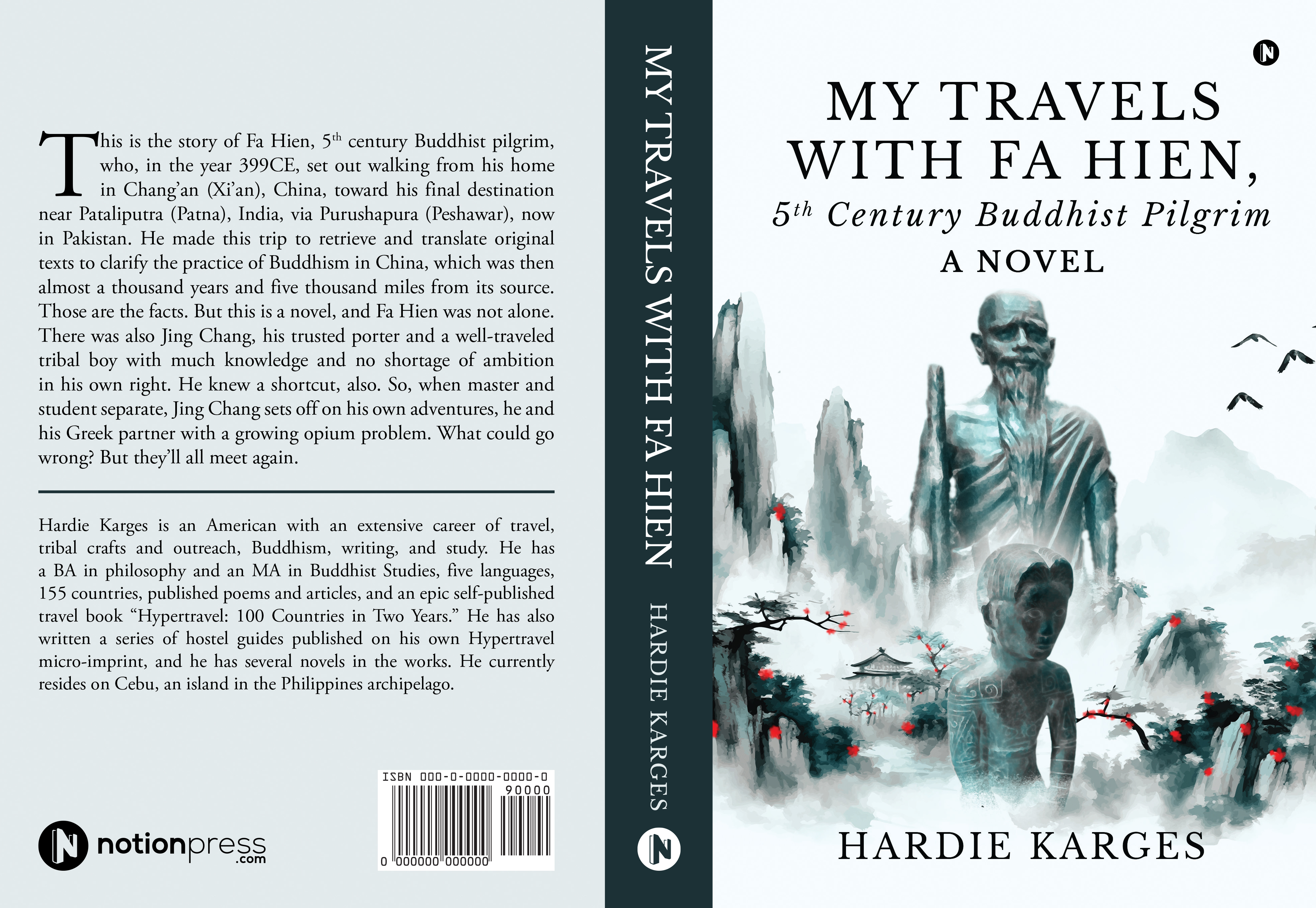
Coming soon to an Amazon near you!

The past demands no explanation. The future requires no warning. Tame your heart, tame your mind, tame yourself, and tame the world…

Live simply to simply live. Everything else is excess. But this is the hardest thing for most people to do, because we tend to see our lives as games of addition and subtraction, zero sum, such that our gains come at the expense of others, and there must be someone keeping score somewhere for there to be any playing field to begin with.
This is a logical fallacy, of course, and the actions of multiplication and division are no better, they the flip sides of each other, just like addition and subtraction, in which to multiply 3 x 4, for instance, is to automatically divide the lot into twelve equal parts, regardless of what the original quantity consisted of, and regardless of any intent, real or supposed.
But our lives on this planet, in this universe, for all practical purposes must be presumed to be zero sum operations, regardless of the amendments to the law of conservation of mass and energy which are at the heart of classical mechanics and physics. We simply have no other basis on which to proceed. The fallacy lies in the postulation of an all-powerful creator at the center of his creation, manipulating his puppets with heartstrings, no matter that such details are not in evidence.
But the zero sum holds, unless and until we find something more or better. So we have to assume that all actions are followed by equal and opposite reactions, more classical physics. Thus we are wise not to rush to judgments and short-sighted utilizations of scarce matter and energy, regardless of the fact that, if the system is indeed a closed one, that matter and/or energy is still there, albeit perhaps changed now into a form that makes it much hard to retrieve and re-purpose for other uses.
For instance: do we really want to burn a piece of wood, resting assured that the molecules still exist somehow somewhere, when the act of burning deprives us of a house and home in the process? Probably not. Thus the forms that matter and energy take are of supreme importance to our old-fashioned lives on this old-fashioned planet, regardless of the quantum effects which may or may not accrue, given the time and resources necessary to process that new information.
For now we are limited to the systems which define us, five or six senses, a language or our choice, and a system of rational thought that results from these origins. Whatever we use, and effectively change forever, may not be retrievable for future use. Thus it is better to use resources sparingly, lest they be lost to us effectively forever.
The Christian-Capitalist-Democratic myths of eternal life, resources, and freedoms are simply not backed by empirical observation. Yes, the game is zero-sum, as far as we currently know, in terms of matter and energy, but not ideas. Ideas are empty, and so without limit. Still there are no winners, and there are no losers. This is not a game. We are playing for keeps here.
Fight the war within your heart, and so leave the world at peace. That largely summarizes the Buddhist philosophy in a nutshell, with regard to the world at large, at least. And that was always a source of some consternation for me, at first, I coming from a Western country with a strong sense of action, freedom, and individualism. So to simply turn the eyes downward, or turn one’s head aside, hardly seems to be the correct way to deal with problems.
But it works, at least to a certain extent, by forgoing the bluff and bluster, and most of all the violence, and simply walking away calmly. In fact, that’s the first thing I learned in my Kung Fu class, for all the fancy moves and sleights of hand: just walk away; and 90% of the time it will work. The problem arises when there is no place to walk to, whether for lack of space or circumstances.
But this is a problem that the ‘minority’ groups of the world have encountered since Day One. As long as they have some place to escape to, then problems do not have to ‘come to a head,’ so to speak, and everybody is happy, more or less, and the world’s largest ‘races’ occupy the choicest valleys and prime sea coasts, and the most valuable trade routes between them.
And this is largely tolerable until the world’s population starts to surpass a billion or two, and then quadruples in population over the next hundred years. Welcome to 2020, and lots of hindsight. Now there is no place left to hide, and that didn’t always work so well, anyway. As hard as it is for us moderns to believe, there was a time not so long ago when young men were anxious to go to war, for reasons that I’m not so sure about.
Now I suppose it may be an unhealthy craving to be too attached to one’s own life, but not for the purpose of violence, I wouldn’t think. But this is the age of patriarchy, and such are the ways and means of its workings. Only one man is needed to fertilize the wombs of a hundred women, as any self-aggrandizing Alpha male knows, and the rest are free to rumble. Ouch.
Oh, how I long for the pre-Aryan Old Europe of Marija Gimbutas, the Old Asia, Old America, and the Old Africa of matriarchy, when women’s value was paramount, in direct proportion to the need to multiply the species, long before unemployed men began the long division of slicing and dicing body parts for mass internment, ashes to ashes and all that rap. But there is another clause in the dharma of Buddhism that pertains to this discussion and that is the need to remove the causes and conditions of suffering.
And assuming that these causes and conditions are originally internal, then they must be applied to all persons equally, across the board. If women refused to submit to the Alpha males for purposes of reproduction, would the problem simply go away? It might be worth a try. Everything is perfect in its imperfection. It is just what it is, Trump notwithstanding, nor left standing. Opinions fall flat in the face of reality…
I’m looking for something in everyone’s eyes: honesty, kindness, consideration, and compassion, smile optional, must be willing to re-locate. Laughter is the best medicine, no prescription required. Love comes with a warning…
Multi-tasking is a myth, aka ‘monkey mind’. Mindfulness is not a myth. Think one thought at the time. ‘Mindfulness’ is a difficult word to translate, and may or may not be the best translation of the Pali/Sanskrit word ‘sati,’ but that is the historical path of Buddhism, so that is the word with which we are left, and that is the task before us.
I think that the Christians have even borrowed the term now, and so it has taken on a life of its own. But what does it really mean? The term ‘sati’ originally meant something like simple ‘awareness’ or ‘consciousness,’ small ‘c’, almost certainly, (as it still means in modern standard Thai).
But even more certain would be to simply posit it as the inverse of its negation, and so ‘mindfulness’ is simply the opposite of ‘mindlessness’ and put the onus of exposition upon its protagonists, since the word ‘sati’ worked just fine for millennia, and its simple translations are more than sufficient.
But the quest for religion is the quest for transcendence, if not magic, and if that means creating holy words with extraordinary definitions, then ‘mindfulness’ is one of those, in the modern post-New-Age reinvention of our spiritual necessities.
And if that seems tired and trite, then rest assured that the most traditional Buddhists are in on the game, too, they also anxious to liberate terminology from the ordinary humdrum of daily existence, add some hype, aka ‘wu-wu.’
And one of the easiest ways to do that is simply to redefine terms and double them up. So Sanskrit ‘mudita’ becomes not just ‘joy’ but ‘sympathetic joy.’ And ‘metta’ becomes not just ‘kindness’ but ‘loving-kindness.’ And the Asians do this, too, Thais long combining ‘metta’ and ‘karuna’ (compassion) into one comprehensive ‘mettakaruna.’ Likewise ‘sati’ and ‘panya’ (knowledge) can become ‘satipanya’ for extra emphasis and expansion.
So beyond all the back-stories and linguistic back-formations, what does the word ‘mindfulness’ now really mean in the Buddhist epistemological sense? As stated originally, probably the best interpretation is focused thinking, i.e. one thought at the time, since there truly is not the ability to hold two thoughts equally and simultaneously, but simply to switch between them constantly, so a trick in itself, but perhaps not conducive to a peaceful mind.
But I think that a better notion is to think in terms of non-linguistic thought altogether, what I call ‘proto-consciousness’ or ‘paleo-consciousness,’ in the sense that this was once normal, no doubt, before the advent of language some 50,000 years ago, almost simultaneous with the demise of our competitors homo Denisova and Floresiensus, and finally Neanderthalensis.
That is no coincidence, and no cause to celebrate. But that was then, and this is now. God knows that we are nothing if not a young species, and all should be forgiven. Bottom line: Cooperation is better than competition, community better than individualism. And mindfulness is more than a simple agreement of terms.
When in doubt, do nothing—quickly. Meditate or contemplate, the choice is yours. There is no call to action. You don’t have to take the bait. And you certainly don’t have to fight to the death, literally or verbally. For all that, there just isn’t the time. The last word is for the biggest ego and the smallest mind…

Nearly took the advice and didn’t reply … 😉
… then my ego kicked in! :O

No problem! Happy Thanksgiving…
And to you, Hardie! 🙂
Your worst enemy can be your best friend, maybe save your life in the end, if you avoid harsh words, and show him some kindness. And this is especially true in a time of political disruption, when all norms of decency have been cast to the winds of fate, in favor of the expediency of racial familiarity.
For this is the great advantage of religion, if not the sole purpose, i.e. to provide the comfort of familiarity beyond mere racial and tribal identities. After all, most religions have similar, if not identical, goals. The problem, of course, is spreading that umbrella of familiarity wide enough to include everyone, so as to avoid merely extending tribal associations into the realm of religion.
For religion has no intrinsic connection to any nation or race, but that which the paths of culture provide. Culture can change, though, and sometimes immediately. There is nothing that necessitates that a European be Christian or an Asian be Buddhist, except that that is the path that the various cultures adopted in adaptation to the stimuli that occurred, whether natural or intentional.
In fact, the genetic dispositions of the founders of Eastern and Western philosophy are quite similar, probably more similar than the right and left sides of any individual brain. But many, if not most, circumstances are largely random, as best described by the ‘Butterfly Effect’ of Chaos Theory, in which the mere fact that a butterfly might flutter by changes the course of history.
So we are left to make sense of what seem to be random occurrences as best we can. But they are not all random, and that is the point of science, to find the order in the universe. That is NOT the point of religion, though, which is to find our place in that universe. At one time, in the not-so-distant past, the two endeavors were one and the same thing, not surprising in a human culture that has barely outgrown its diapers.
That does not imply any false duality, though, merely a hierarchy of necessity in a world grown more complex with the passage of time and the increasing specialization of the species homo sapiens. And if I once thought that we as a species might not survive, given our many sins, of commission and omission, then today I am gratified to find that Nature will likely have an important role in that final determination.
After all, natural selection is always right. But it is rarely predictive. Hindsight is 2020. Until then, we are best served by a gentleness in our approach to all matters of politics and religion. Buddhism is a good paradigm for that, arguably the best. Purify your heart. Fortify your mind. Lead the world by example…
Sorry, grasshopper. Your dreams can’t all come true. So I guess a few will have to do. Life can sometimes be frustrating for humans and other sentient beings. So said the Buddha. Almost eight billion people on this planet, and our best friends are cats and dogs, go figure…
“In springtime grow flowers. In summer grow fruit. In autumn count blessings. In winter take root,” I once said in a playful moment. In Christianity, of course, that sentiment is made famous in the quote, “To everything there is a season,” as originally expounded in the Biblical selection Ecclesiastes 3: 1-13, and brilliantly revised early in my lifetime in the work of Pete Seeger’s “Turn! Turn! Turn!,” and made famous by The Byrds, back when they were skinny.
The meaning and essence of the thought expressed, of course, is the rhythm and circularity of the seasons. But I think it works equally well in Buddhism, or any other belief system, for that matter, in that by extrapolation, it perhaps can apply to the entire universe.
We know little of the universe, though, so it is usually visualized in its macrocosmic view as planets in motion, even if the reality is equally a microcosm, if not more so, i.e. particles. But in its macro view, we see the revolution of moons around planets around stars around a poorly defined black hole center, and that is usually enough to convince us that there is at least some order to the universe, with or without an omnipotent creator, with or without an omniscient plan, aka ‘intelligent design.’
This is again one of the pet projects of fundamentalist Christians, notwithstanding the likelihood that a God of true engineering capabilities could have come up with many mind-blowing designs, rather than the same one over and over with design adaptations that can easily be explained by natural selection if not epigenetics.
But most Buddhists find their circularity in various iterations of the theme of rebirth and past lives, something which was never really the Buddha’s Big Idea, but which he’d have likely been foolish to reject, but not the latter-day obsession with it, in an almost inverse proportion to its scientific viability.
But that is the difference between religion and philosophy, that religion craves certainty, even where no certainty exists, and not casual musings, or even a healthy dialectic. Scientists have no such illusions. And the best philosophers are scientists, and vice versa, with or without the background in math or Plato.
So physicists today get an undefined Dark Matter occupying most of the universe, philosophers get Wittgenstein’s defenestration of language, and Buddhists after 2500 years get a soft pad on a cold floor with some bloke blabbing in the background, when I’d really rather meditate ‘like the Buddha did’—silently.
In almost every ancient Buddhist text, if you translate ‘samsara’ as ‘the world’ instead of ‘cyclic existence,’ it stills makes as much, if not more, perfect sense. Coincidentally the language which today preserves more Sanskrit than any other language, Nepalese aka Gurkha, uses the word ‘sansara’ to mean ‘the world,’ no accident. In Hindi they use ‘dunia,’ from the Arabic. They probably got tired of cyclic existence. But let’s not argue. The only thing to argue for is the end of all argument. That is the only cyclic existence that I know…
Too much anti-social media, too much hate, is not healthy for humans and other living beings. I’m sad that a word like ‘schadenfreude’ even exists. It’s sick. Cure it with kindness…

 hardie karges are discussing.
  streaming consciousness...
Reply