


BOOK REVIEW: “Buddha’s Brain”: by Rick Hanson and Richard Mendius
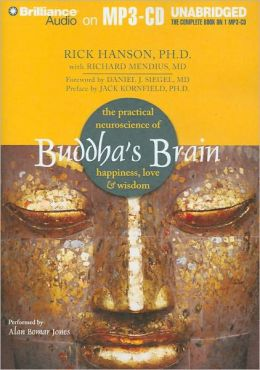
This book has been out there a while, about twenty years, but not only did I just now discover it, but I suspect that many people who’d like to ingest this kind of knowledge and information are more interested than inspired, because it’s not easy knowledge to ingest, without resorting to woo-woo and juju, which ultimately does not hold up to peer-reviewed scrutiny. Because this is the point where spirituality meets science, and the path is not for the weak hearted. The basic idea is that your mind, and by extension your brain, or vice-versa, in effect control the keys to your happiness, and that is the path of your salvation. To accomplish this Hanson the neuroscientist PhD and Mendius the MD mix and match metaphors and math to navigate this path for you. But where to begin?
They begin with what could be considered the mantra for this entire book, a quote so powerful that I used it as a standalone quote on my Facebook page: “Neurons that fire together, wire together,” meaning in short, that you can create a neural network that facilitates your happiness with the same ease and simplicity that you can go to a doctor, or a university, or a friend’s house for after-dinner drinks that might lead to the love of your life, and that sort of happiness. But wouldn’t any of those go better and easier with the kind of mental attitude and predisposition that almost guarantees success? You can create that. And, if that goes against the belief in ‘Thoughts without Thinkers,” well, so be it. That was never meant to be a call to inaction, but more like a generality, or a palliative, or a reminder to ‘not think too much.’
But, there must be a place in our lives for ‘right thoughts’ and ‘right actions’ and this is a good place to begin, i.e. mind training. Unfortunately, our brains and therefore minds have a negativity bias for survival, so this must be at least partially overcome, since it quickly leads to the suffering of separateness and a world of simulation which is very different from the present moment that largely defines sati, mindfulness. Because the second dart is often worse than the first dart, as explained here, i.e. our reactions are worse than the actions which have caused the negative effects that we are trying to mitigate. It’s a vicious circle, the dog chasing its tail when the tail is not the problem; the chasing is the problem. It is here that meditation can come to the rescue to reboot the action-reaction sequence with a solid dose of silence as salve and salvation.
If happiness is the goal, then we need to ‘accent the positive,’ or ‘Ac-Cent-Tchu-Ate the Positive’, if you prefer, all thanks to Bing and the Andrews Sisters and Johnny Mercer, while avoiding any and all clichés and giving a break to Mr. In Between, haha. Because as Buddhists we can seriously identify with that, all extremities duly avoided by Buddhist writ long unwritten. But meditation can only create a level playing field, per its role as the zero shunya of shunyata which is so important to the advanced transcendental Buddhism of Mahayana. Once the fires are calmed, then the neuroaxis can begin to do its thing, with the brain stem, limbic system, and pre-frontal cortex, etc. Sounds complicated, but guess what? It doesn’t have to be. It can be as simple as not responding to that first dart, adding your second dart to the karmic mix which, once established, becomes increasingly hard to shake.
And, if non-response sounds like ‘spiritual bypassing’, then, once again, so be it. That’s the whine of psychiatrists who fear a loss of revenue. Buddhism is a religion of at least partial renunciation. Because there are (at least) two wolves in every heart: Love and hate. Love and hate create us and them. The only cure is empathy, easier said than done, true, but not too hard. Just add kindness, and compassion. The compassion is to cure suffering, and the kindness is to bring happiness. Kindness is pre-frontal. Enlarge your circle. Meditate. Make it frontal. Control your attention; basal ganglia seek attention. It’s the power of meditation; sati leads to wisdom. Rapture and joy bring dopamine. Fast gamma waves bring singleness of mind. Relax the Self: don’t take things personally. Self is a convergence of many neural networks. It’s a process, always changing. Any questions? Don’t think too much. Chill. It’s worth the read. I give it a four.
 streaming consciousness...
Reply